Risk factors for corneal infiltrative events during continuous wear of silicone hydrogel contact lenses
- PMID: 20538985
- PMCID: PMC3061493
- DOI: 10.1167/iovs.10-5456
Risk factors for corneal infiltrative events during continuous wear of silicone hydrogel contact lenses
Abstract
Purpose: This study determined which microbiologic, clinical, demographic, and behavioral factors are associated with corneal infiltrative events (CIEs) during continuous wear of silicone hydrogel (SH) contact lenses.
Methods: Subjects (n = 205) were fitted with lotrafilcon A lenses for continuous wear and observed for 1 year. The main exposures of interest were corneal staining and bacterial lens contamination. Kaplan-Meier (KM) plots were used to estimate the cumulative unadjusted probability of remaining CIE free, and Cox proportional hazards regression was used to model the hazard of having a CIE, as a function of key predictor variables.
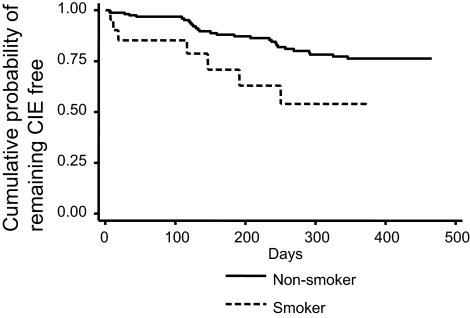
Results: The KM-unadjusted cumulative probability of remaining CIE free was 73.3%. Approximately 53% of subjects had repeated episodes of corneal staining (mild or greater), and 11.3% had repeated episodes of moderate or greater corneal staining. Corneal staining was not associated with the development of a CIE. The frequency of substantial bacterial bioburden on worn lenses at the time of a CIE was 64.7%, compared with only 12.2% during uncomplicated wear. The presence of substantial lens bacterial bioburden was associated with the development of a CIE (adjusted hazards ratio [HR], 8.66; 95% confidence interval [CI], 2.88-26.01). Smoking was also associated with a CIE (adjusted HR, 4.13; 95% CI, 1.27-13.45).
Conclusions: Corneal staining is common during continuous wear of SH lenses, but it is not associated with the development of a CIE. Smoking and substantial lens bacterial bioburden pose prominent risks of a CIE. In this study, more than 70% of the total risk of CIE in those with substantial lens bioburden is attributable to this exposure. (ClinicalTrials.gov number, NCT00727402).
Figures


References
-
- Keay L, Sweeney DF, Jalbert I, Skotnitsky C, Holden BA. Microcyst response to high Dk/t silicone hydrogel contact lenses. Optom Vis Sci. 2000;77:582–585 - PubMed
-
- Ladage PM, Yamamoto K, Ren DH, et al. Effects of rigid and soft contact lens daily wear on corneal epithelium, tear lactate dehydrogenase, and bacterial binding to exfoliated epithelial cells. Ophthalmology. 2001;108:1279–1288 - PubMed
-
- Papas EB, Vajdic CM, Austen R, Holden BA. High-oxygen-transmissibility soft contact lenses do not induce limbal hyperaemia. Curr Eye Res. 1997;16:942–948 - PubMed
-
- Steffen RB, Schnider CM. The impact of silicone hydrogel materials on overnight corneal swelling. Eye Contact Lens. 2007;33:115–120 - PubMed
-
- Dart JK, Radford CF, Minassian D, Verma S, Stapleton F. Risk factors for microbial keratitis with contemporary contact lenses: a case–control study. Ophthalmology. 2008;115:1647–1654, e1–3 - PubMed
Publication types
MeSH terms
Substances
Associated data
Grants and funding
LinkOut - more resources
Full Text Sources
Medical