. 2010 Nov;51(11):5675-84.
doi: 10.1167/iovs.10-5411. Epub 2010 Jun 10.

Changes in the biomechanical response of the optic nerve head in early experimental glaucoma

Affiliations

Changes in the biomechanical response of the optic nerve head in early experimental glaucoma

Michael D Roberts et al. Invest Ophthalmol Vis Sci. 2010 Nov.

Abstract

Purpose: To investigate the biomechanical response of the optic nerve head (ONH) connective tissues to IOP elevation in three pairs of monkey eyes in which one eye had early experimental glaucoma (EG).

Methods: A serial imaging technique was used to reconstruct the ONH and peripapillary sclera of three pairs of unilateral EG eyes fixed at 10 mm Hg. Eye-specific finite element models of the posterior pole were constructed with inhomogeneous material properties defined for the lamina cribrosa (LC) based on local connective tissue volume fraction (CTVF) and predominant LC beam orientation. These models were used to simulate an IOP increase from 10 to 45 mm Hg. A laminar material constant was varied to produce a range of LC displacements and scleral canal expansions, and the associated LC stress and strain were characterized.

Results: The models suggest that the LC of normal and EG eyes can deform posteriorly or anteriorly when the LC material stiffness is low or high, respectively. Scleral canal expansion was generally, but not always, reduced in EG eyes. Strains in the EG eye were similar to or lower than those in the contralateral eye for the same average LC displacement and increased when the LC was more plaint. Laminar stresses were consistently lower in the EG eye, regardless of LC stiffness.

Conclusions: Connective tissue remodeling in EG alters the biomechanical response of the LC to IOP elevation in an eye-specific manner. The models indicated that the LC tissues in EG eyes were more plaint than those in the contralateral normal eyes in two of three monkeys.


Figures

Figure 1.
Figure 1.
IOP-induced LC displacement is calculated relative to the anterior laminar insertion, to remove the global displacement of the scleral shell. (A) The full finite element model displacement field for a 35-mm Hg IOP increase shows that the LC elements displace substantially and tilt relative to the scleral shell equator. Note that the titling occurs because the inferior LC displaces more than the superior LC due to nonuniform scleral displacements (as the scleral shell deforms it pulls the LC with it). (B) This superior–interior tilting is more apparent when the LC elements are plotted with a narrower range to focus on laminar displacement only. (C) LC displacement relative to the anterior laminar insertion displays the laminar deformation with the component of displacement removed. In this example, the central LC displaces posteriorly. Examples of anterior displacement of the central LC can be seen in Figure 2.
Figure 2.
Figure 2.
LC displacement of paired normal and EG eyes of each monkey as a function of laminar stiffness. Note that in all eyes, when the laminar material constant, A, was low (i.e., a plaint LC) the central portion of the LC bulged posteriorly, and the average laminar displacement was large. When the laminar material constant was large (i.e., a stiff LC), the superior–inferior axis of the LC exhibited small anterior displacements. The highlighted region denotes the laminar material constant range over which average LC displacement is −5 to +5 μm.
Figure 3.
Figure 3.
Anterior and posterior scleral canal expansion in paired normal and EG eyes of each monkey as a function of laminar stiffness. These plots show that anterior and posterior scleral canal expansion was not as strongly affected by the laminar stiffness as LC displacement and was on the order of 3% to 4% of the scleral canal radius at IOP 10 mm Hg. These data also suggest that posterior scleral canal expansion within a given eye was generally larger than anterior scleral canal expansion, with the EG eye of monkeys 2 and 3 being an exception at high values of the laminar material constant. Note that both anterior and posterior canal expansion were lower in the EG eye than in the normal eye in monkeys 1 and 3, which is likely a reflection of the higher scleral modulus of elasticity assigned to the EG eye models. This clear separation between normal and EG canal expansion was not present in monkey 2, which had a significantly thinner peripapillary sclera.
Figure 4.
Figure 4.
Maximum principal strains in the LC associated with different amounts of average LC displacement. Top: anterior surface view of the tensile strain for normal and EG eyes of each monkey for −20, −5, and +5 μm average LC displacement. Bottom: median-based box plots of elemental tensile strain in the lamina for target LC displacements ranging from −40 to +10 μm for both eyes of each monkey. These plots show that strains are higher in plaint versus stiff LCs. The similarity in strain distributions in paired normal and EG eyes at equivalent average LC displacement values is apparent. The box plot of strains in the normal eye with 0 average LC displacement is highlighted in blue to facilitate comparison to other box plots.
Figure 5.
Figure 5.
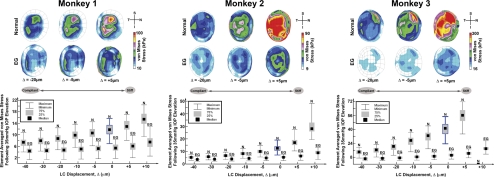
von Mises stress in the LC associated with different amounts of average LC displacement. Top: anterior surface view of the von Mises stress in the normal and EG eyes of each monkey for −20, −5, and +5 μm average LC displacement. Bottom: median-based box plots of elemental stress in the lamina for target LC displacements ranging from −40 to +10 μm for both eyes of each monkey. These plots show that as the LC was made stiffer and transitioned from a posterior to anterior displacement, the stresses in the normal eye were higher than in the contralateral EG eye and increased more quickly as a function of LC displacement. The box plot of stresses in the normal eye with 0 average LC displacement is highlighted in blue to facilitate comparison to other box plots.

References

    1. Quigley HA, Addicks EM, Green WR, Maumenee AE. Optic nerve damage in human glaucoma. II. The site of injury and susceptibility to damage. Arch Ophthalmol. 1981;99:635–649 - PubMed
    1. Hernandez MR, Igoe F, Neufeld AH. Cell culture of the human lamina cribrosa. Invest Ophthalmol Vis Sci. 1988;29:78–89 - PubMed
    1. Clark AF, Browder SL, Steely HT, Wilson K, Cantu-Crouch D, McCartney MD. Cell biology of the human lamina cribrosa. In: Drance SM, Anderson DR. ed. Optic Nerve in Glaucoma. Amsterdam/New York: Kugler Publications; 1995:79–105
    1. Hernandez MR. The optic nerve head in glaucoma: role of astrocytes in tissue remodeling. Prog Retin Eye Res. 2000;19:297–321 - PubMed
    1. Burgoyne CF, Downs JC, Bellezza AJ, Suh JK, Hart RT. The optic nerve head as a biomechanical structure: a new paradigm for understanding the role of IOP-related stress and strain in the pathophysiology of glaucomatous optic nerve head damage. Prog Retin Eye Res. 2005;24:39–73 - PubMed

Publication types