


Carbocyclic 6-benzylthioinosine analogues as subversive substrates of Toxoplasma gondii adenosine kinase: biological activities and selective toxicities
- PMID: 20541538
- PMCID: PMC2923275
- DOI: 10.1016/j.bcp.2010.06.001
Carbocyclic 6-benzylthioinosine analogues as subversive substrates of Toxoplasma gondii adenosine kinase: biological activities and selective toxicities
Abstract
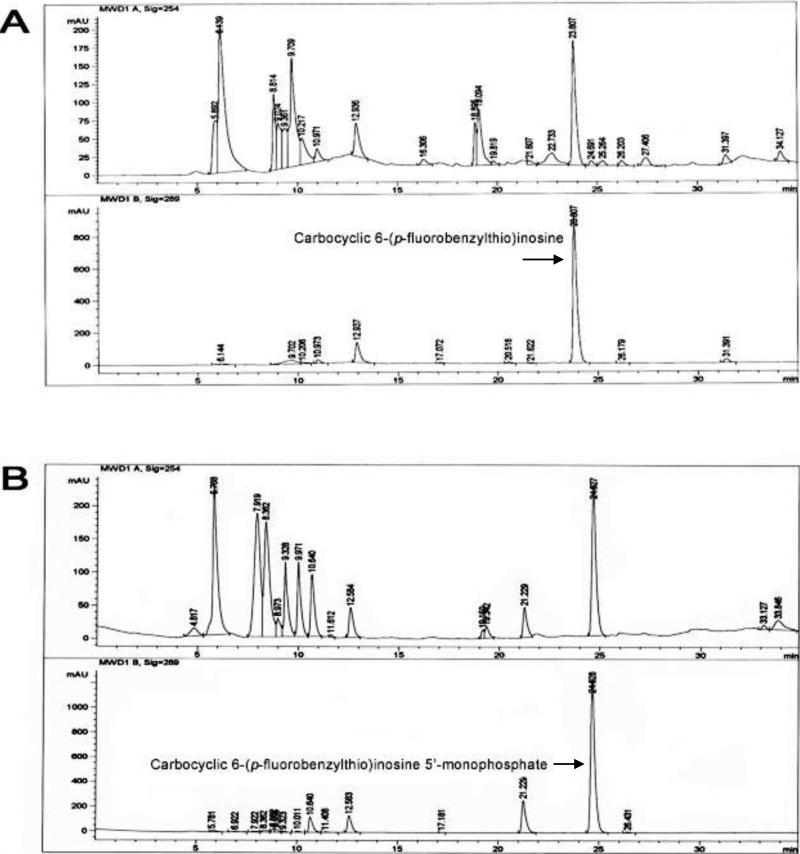
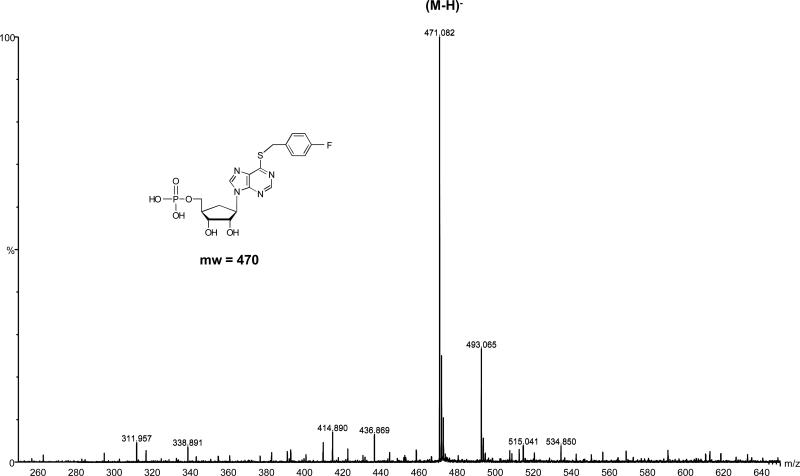
Toxoplasma gondii adenosine kinase (EC 2.7.1.20) is the major route of adenosine metabolism in this parasite. The enzyme is significantly more active than any other enzyme of the purine salvage in T. gondii and has been established as a potential chemotherapeutic target for the treatment of toxoplasmosis. Several 6-benzylthioinosines have already been identified as subversive substrates of the T. gondii but not human adenosine kinase. Therefore, these compounds are preferentially metabolized to their respective nucleotides and become selectively toxic against the parasites but not its host. In the present study, we report the testing of the metabolism of several carbocyclic 6-benzylthioinosines, as well as their efficacy as anti-toxoplasmic agents in cell culture. All the carbocyclic 6-benzylthioinosine analogues were metabolized to their 5'-monophosphate derivatives, albeit to different degrees. These results indicate that these compounds are not only ligands but also substrates of T. gondii adenosine kinase. All the carbocyclic 6-benzylthioinosine analogues showed a selective anti-toxoplasmic effect against wild type parasites, but not mutants lacking adenosine kinase. These results indicate that the oxygen atom of the sugar is not critical for substrate binding. The efficacy of these compounds varied with the position and nature of the substitution on their phenyl ring. Moreover, none of these analogues exhibited host toxicity. The best compounds were carbocyclic 6-(p-methylbenzylthio)inosine (IC(50)=11.9 microM), carbocyclic 6-(p-methoxybenzylthio)inosine (IC(50)=12.1 microM), and carbocyclic 6-(p-methoxycarbonylbenzylthio)inosine (IC(50)=12.8 microM). These compounds have about a 1.5-fold better efficacy relative to their corresponding 6-benzylthioinosine analogues (Rais et al., Biochem Pharmacol 2005;69:1409-19 [29]). The results further confirm that T. gondii adenosine kinase is an excellent target for chemotherapy and that carbocyclic 6-benzylthioinosines are potential anti-toxoplasmic agents.
Copyright (c) 2010 Elsevier Inc. All rights reserved.
Figures
References
-
- Dubey JP, Beattie CP. Toxoplasmosis of Animals and Man. CRC Press; Boca Raton, FL: 1988.
-
- Jones JL, Kruszon-Moran D, Sanders-Lewis K, Wilson M. Toxoplasma gondii infection in the United States, 1999-2004, Decline from the prior decade. Am. J. Trop. Med. Hyg. 2007;77:405–410. - PubMed
-
- Peterson E. Epidemiology, diagnostics, and chemotherapy. In: Ajioka JW, Soldati D, editors. Toxoplasma: Molecular and Cellular Biology. Horizon Bioscience; Norfolk, UK: 2007. pp. 37–58.
-
- Luft BJ. Toxoplasma gondii. In: Walzer PD, Genta RM, editors. Parasitic Infections in the Compromised Host. Marcel Dekker; New York: 1989. pp. 179–279.
Publication types
MeSH terms
Substances
Grants and funding
LinkOut - more resources
Full Text Sources
