. 2010 Jul;38(Web Server issue):W576-81.
doi: 10.1093/nar/gkq535. Epub 2010 Jun 11.

CPHmodels-3.0--remote homology modeling using structure-guided sequence profiles

Affiliations

CPHmodels-3.0--remote homology modeling using structure-guided sequence profiles

Morten Nielsen et al. Nucleic Acids Res. 2010 Jul.

Abstract

CPHmodels-3.0 is a web server predicting protein 3D structure by use of single template homology modeling. The server employs a hybrid of the scoring functions of CPHmodels-2.0 and a novel remote homology-modeling algorithm. A query sequence is first attempted modeled using the fast CPHmodels-2.0 profile-profile scoring function suitable for close homology modeling. The new computational costly remote homology-modeling algorithm is only engaged provided that no suitable PDB template is identified in the initial search. CPHmodels-3.0 was benchmarked in the CASP8 competition and produced models for 94% of the targets (117 out of 128), 74% were predicted as high reliability models (87 out of 117). These achieved an average RMSD of 4.6 A when superimposed to the 3D structure. The remaining 26% low reliably models (30 out of 117) could superimpose to the true 3D structure with an average RMSD of 9.3 A. These performance values place the CPHmodels-3.0 method in the group of high performing 3D prediction tools. Beside its accuracy, one of the important features of the method is its speed. For most queries, the response time of the server is <20 min. The web server is available at http://www.cbs.dtu.dk/services/CPHmodels/.


Figures
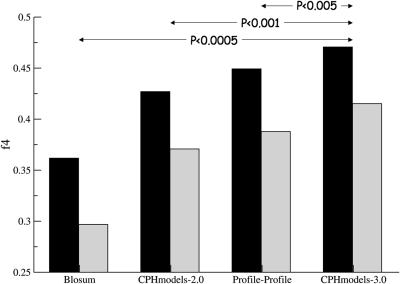
Figure 1.
Figure 1.
Fraction of correctly aligned residue pairs. The f4 measure is shown for the protein pairs in the benchmark training and test sets in black and gray, respectively. The four methods shown are; Blosum: Blosum62 with conventional gap penalties, CPHmodels-2.0: The original CPHmodels-2.0 server. Profile–profile: Sequence profile-based scoring function. CPHmodels-3.0: The profile and local structure based-scoring function proposed here. P-values are calculated using binomial test.
Figure 2.
Figure 2.
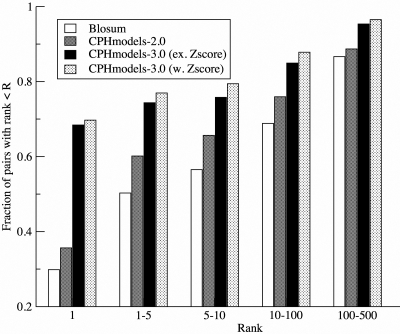
Fold recognition benchmark for the test set. The fraction of proteins where the correct template is identified within a given rank is given as the function of the rank. The template pool was filtered to exclude all structural superimposable (CE structural alignment Z-score >3.8) hits except the query/target in question. CPHmodels-3.0 (w. Z-score) is the CPHmodels-3.0 method including double-sided Z-score ranking, CPHmodels-3.0 (e.g. Z-score) is the CPHmodels-3.0 method excluding double-sided Z-score, and the other methods are as in Figure 1.
Figure 3.
Figure 3.
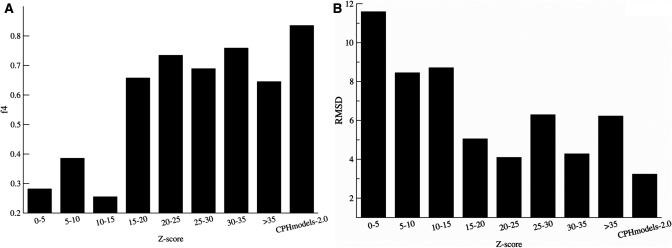
(A) Histogram of fraction correctly modeled residues (f4) as a function of the double-sided Z-score. (B) Histogram of RMSD as a function of the double-sided Z-score. The CPHmodels-2.0 bar refers to hits with Blast e-values <10−5 and sequence identity >30% modeled using the CPHmodels-2.0 method.
Figure 4.
Figure 4.
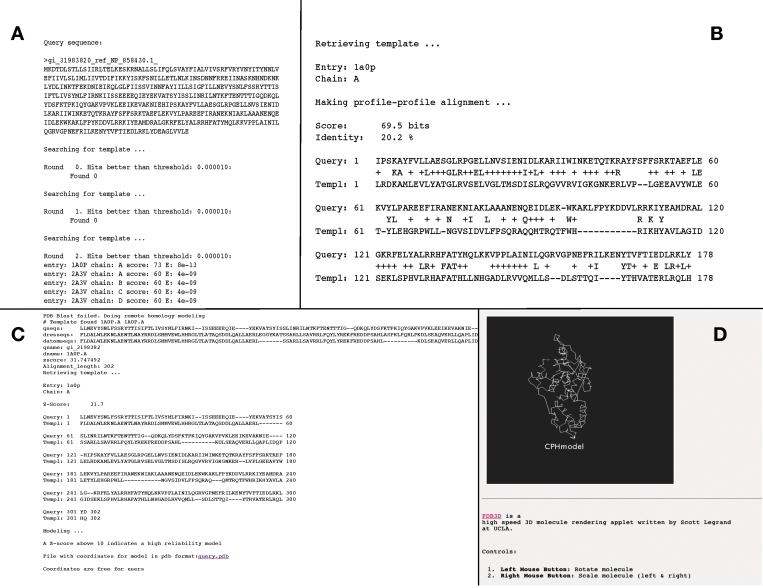
The output is appearing as one long page. The parts are ordered as appearing from the top. (A) The input query sequence in FASTA format, followed by pdb-hits from searches using a PSIblast PSSM generated against a UniProt database. (B) The resulting sequence alignment of the profile–profile alignment using the PDB-Blast hit. (C) The results from the remote homology modeling (if any). qseqs: The raw query sequence aligned in a unwrapped format. dresseqs: The raw sequence of the model template aligned in an unwrapped format. datomseqs: The part of the model template sequence for which atom coordinates exist in the PDB entry aligned in an unwrapped format. qname: Query name from input. dname: 1A0P.A PDB entry name and chain of model template. zscore: Z-score of alignment. Alignment_length: length of the alignment. Including final alignment and link to file with modeled coordinates in pdb format. (D) Fast-rendering outline of the model.

References

    1. Rost B, Sander C. Improved prediction of protein secondary structure by use of sequence profiles and neural networks. Proc. Natl Acad. Sci. USA. 1993;90:7558–7562. - PMC - PubMed
    1. Soding J, Biegert A, Lupas AN. The HHpred interactive server for protein homology detection and structure prediction. Nucleic Acids Res. 2005;33(Web Server issue):W244–W248. - PMC - PubMed
    1. Bennett-Lovsey RM, Herbert AD, Sternberg MJE, Kelley LA. Exploring the extremes of sequence/structure space with ensemble fold recognition in the program Phyre. Proteins. 2008;70:611–625. - PubMed
    1. Jaroszewski L, Rychlewski L, Godzik A. Improving the quality of twilight-zone alignments. Protein Sci. 2000;9:1487–1496. - PMC - PubMed
    1. Petersen TN, Lundegaard C, Nielsen M, Bohr H, Bohr J, Brunak S, Gippert GP, Lund O. Prediction of protein secondary structure at 80% accuracy. Proteins. 2000;41:17–20. - PubMed