. 2010 Sep;299(3):L334-44.
doi: 10.1152/ajplung.00017.2010. Epub 2010 Jun 11.

Neurotrophic and neuroimmune responses to early-life Pseudomonas aeruginosa infection in rat lungs

Affiliations

Neurotrophic and neuroimmune responses to early-life Pseudomonas aeruginosa infection in rat lungs

Silvia Cardenas et al. Am J Physiol Lung Cell Mol Physiol. 2010 Sep.

Abstract

Early-life respiratory infection with Pseudomonas aeruginosa is common in children with cystic fibrosis or immune deficits. Although many of its clinical manifestations involve neural reflexes, little information is available on the peripheral nervous system of infected airways. This study sought to determine whether early-life infection triggers a neurogenic-mediated immunoinflammatory response, the mechanisms of this response, and its relationship with other immunoinflammatory pathways. Weanling and adult rats were inoculated with suspensions containing P. aeruginosa (PAO1) coated on alginate microspheres suspended in Tris-CaCl(2) buffer. Five days after infection, rats were injected with capsaicin to stimulate nociceptive nerves in the airway mucosa, and microvascular permeability was measured using Evans blue as a tracer. PAO1 increased neurogenic inflammation in the extra- and intrapulmonary compartments of weanlings but not in adults. The mechanism involves selective overexpression of NGF, which is critical for the local increase in microvascular permeability and for the infiltration of polymorphonuclear leukocytes into infected lung parenchyma. These effects are mediated in part by induction of downstream inflammatory cytokines and chemokines, especially IL-1beta, IL-18, and leptin. Our data suggest that neurogenic-mediated immunoinflammatory mechanisms play important roles in airway inflammation and hyperreactivity associated with P. aeruginosa when infection occurs early in life.


Figures
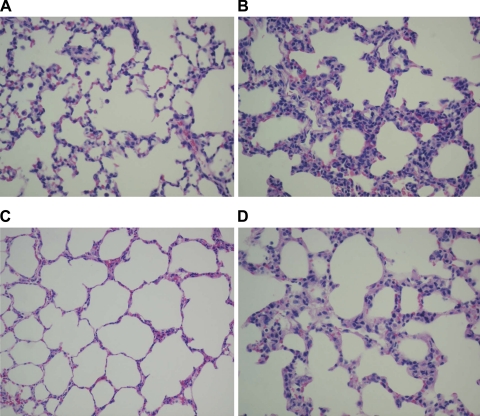
Fig. 1.
Fig. 1.
Histopathology of acute Pseudomonas aeruginosa strain PAO1 infection. The lungs of noninfected weanling (A) and adult (C) strain Fischer 344 (F344) rats were essentially normal with thin alveolar septa and no infiltrates. Interstitial pneumonitis with diffuse widening of alveolar septa due to lymphomononuclear infiltrates was noted in weanlings after 5 days of PAO1 infection (B). The lungs of infected adult rats (D) were almost normal at 5 days, although there was a mild widening of the alveolar septa due to sparse lymphocytic infiltrate. n = 3 rats per group.
Fig. 2.
Fig. 2.
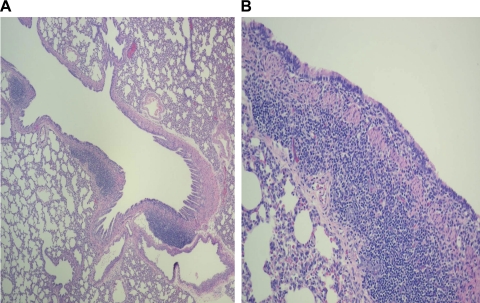
Bronchial-associated lymphoid tissue (BALT) hyperplasia in weanlings. Compared with noninfected controls (A), PAO1-infected weanling rats also showed marked hyperplasia of the BALT accompanied by lymphocytic infiltrate of the bronchial wall (B), which was not noted in adults. n = 3 rats per group.
Fig. 3.
Fig. 3.
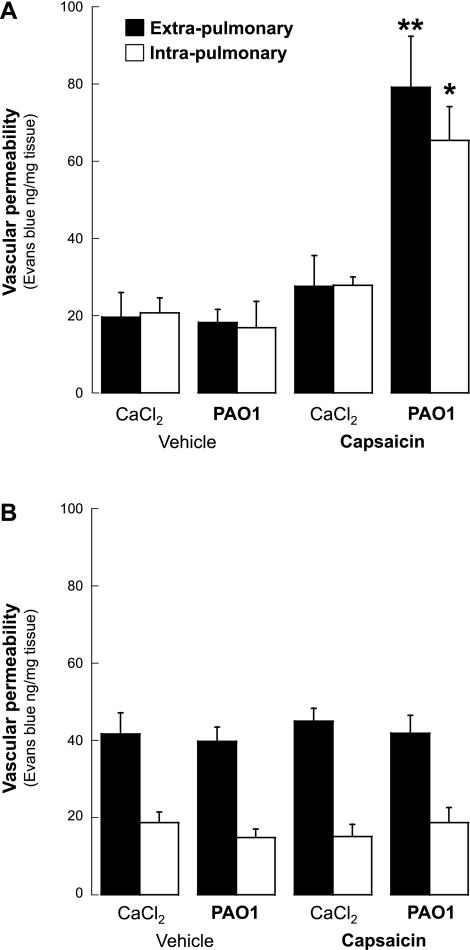
Neurogenic inflammation. Following transient receptor potential channel, vanilloid subfamily member 1 (TRPV1) stimulation with capsaicin, the exudation of Evans blue-labeled macromolecules in the airways of weanling rats infected with PAO1 was significantly increased compared with age-matched noninfected controls (A). In contrast, microvascular permeability in adult rats infected with PAO1 was not significantly different from noninfected controls (B). Data are expressed as the means ± SE (n = 5–6 rats per group). *P < 0.05, **P < 0.01 compared with noninfected controls.
Fig. 4.
Fig. 4.
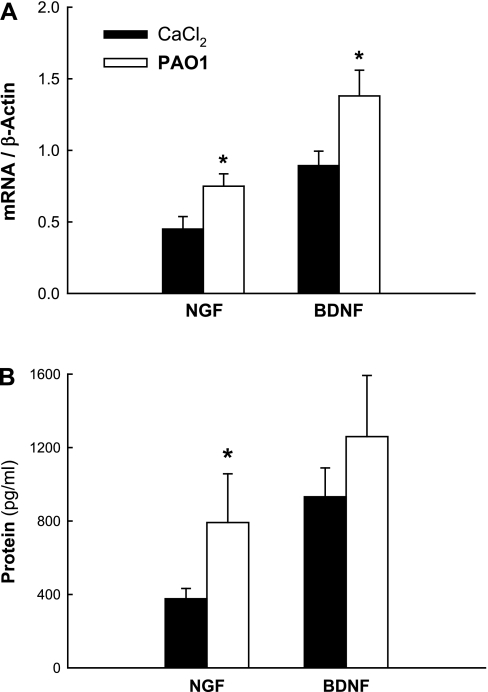
Neurotrophic factors. RT-PCR analysis of lung tissues from weanling rats infected with PAO1 revealed a significant increase in both NGF and brain-derived neurotrophic factor (BDNF) mRNA expression compared with controls (A). Immunoassay analysis of the same groups confirmed that NGF protein concentration was significantly increased in the lung tissues of PAO1-infected weanling rats (B). Means ± SE (n = 5 rats per group). *P < 0.05 compared with noninfected controls.
Fig. 5.
Fig. 5.
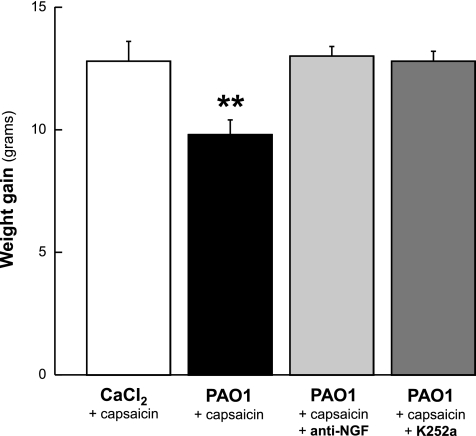
Effect of NGF inhibition on weight gain. After 5 days of PAO1 infection, average body weight gain was significantly lower in weanling rats compared with noninfected controls. In contrast, the weight gain measured in PAO1-infected rats treated with either the NGF-neutralizing antibody or with the specific receptor tyrosine kinase inhibitor K252a was not different from controls. Means ± SE (n = 6–8 rats per group). **P < 0.01 compared with noninfected controls.
Fig. 6.
Fig. 6.
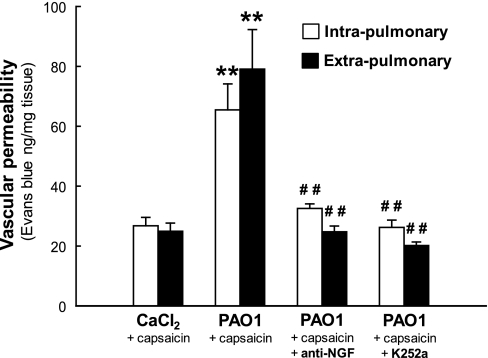
Vascular effects of NGF inhibition. Pretreatment with anti-NGF antibody markedly reduced neurogenic Evans blue exudation in the airways of PAO1-infected weanling rats, and even stronger inhibition was noted after chemical inhibition of tropomyosin-related kinase (Trk) signaling with K252a. After NGF blockade, Evans blue exudation in the respiratory tract of weanling rats infected with PAO1 was not significantly different from age-matched noninfected controls. Means ± SE (n = 6–8 rats per group). **P < 0.01 compared with noninfected controls; ##P < 0.01 compared with infected rats with intact NGF activity.
Fig. 7.
Fig. 7.
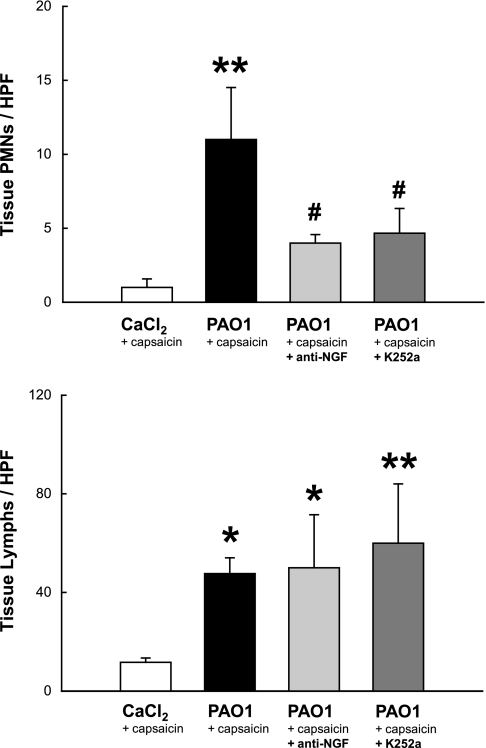
Cellular effects of NGF inhibition in lung tissues. TRPV1 stimulation with capsaicin increased >10-fold the influx of polymorphonuclear leukocytes (PMNs) and almost 5-fold lymphomononuclear cells into P. aeruginosa-infected lung tissues. The effect on PMNs was largely NGF-dependent and strongly inhibited by both anti-NGF and K252a, whereas the same inhibitors had no effect on lymphomononuclear cells. Means ± SE (n = 5–6 rats per group). *P < 0.05, **P < 0.01 compared with noninfected controls; #P < 0.05 compared with infected rats with intact NGF activity. HPF, high-power field.
Fig. 8.
Fig. 8.
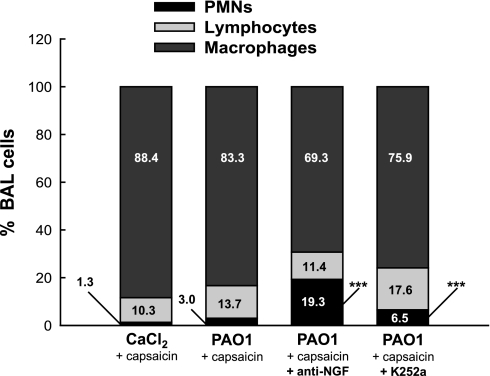
Cellular effects of NGF inhibition in airways. The cellular fraction of the bronchoalveolar lavage (BAL) from capsaicin-stimulated noninfected weanling rats was largely of the monocyte/macrophage type, with few lymphocytes and minimal PMNs. After PAO1 infection, PMNs tripled, without significant changes in the other subpopulations. However, the proportion of PMNs recovered from PAO1-infected airways by BAL increased 15-fold above control after NGF inhibition. Means ± SE (n = 5–6 rats per group). ***P < 0.001 compared with noninfected controls.
Fig. 9.
Fig. 9.
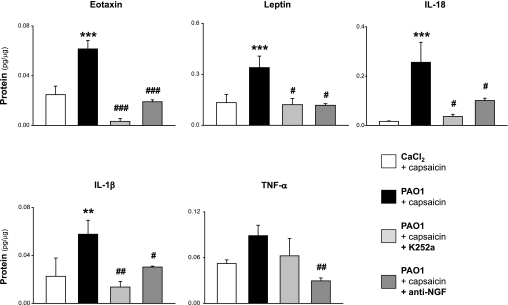
Effect of NGF inhibition on cytokines/chemokines. Neurotrophin inhibition with the specific blocking antibody or with K252a, which blocks Trk signaling, decreased significantly the concentrations of eotaxin, leptin, IL-18, and IL-1β in BAL specimens from PAO1-infected weanling rats, returning their values to noninfected control levels. A similar trend was also observed for TNF-α, but this effect was statistically significant only with the anti-NGF antibody. Means ± SE (n = 4–7 rats per group). **P < 0.01, ***P < 0.001 compared with noninfected controls; #P < 0.05, ##P < 0.01, ###P < 0.001 compared with infected rats with intact NGF activity.

References

    1. Arend WP, Palmer G, Gabay C. IL-1, IL-18, and IL-33 families of cytokines. Immunol Rev 223: 20–38, 2008 - PubMed
    1. Auais A, Adkins B, Napchan G, Piedimonte G. Immunomodulatory effects of sensory nerves during respiratory syncytial virus infection in rats. Am J Physiol Lung Cell Mol Physiol 285: L105–L113, 2003 - PubMed
    1. Bastard JP, Maachi M, Lagathu C, Kim MJ, Caron M, Vidal H, Capeau J, Feve B. Recent advances in the relationship between obesity, inflammation, and insulin resistance. Eur Cytokine Netw 17: 4–12, 2006 - PubMed
    1. Bessac BF, Jordt SE. Breathtaking TRP channels: TRPA1 and TRPV1 in airway chemosensation and reflex control. Physiology (Bethesda) 23: 360–370, 2008 - PMC - PubMed
    1. Buck H, Winter J. K252a modulates the expression of nerve growth factor-dependent capsaicin sensitivity and substance P levels in cultured adult rat dorsal root ganglion neurones. J Neurochem 67: 345–351, 1996 - PubMed

Publication types

MeSH terms