


Early immunologic response and subsequent survival among malnourished adults receiving antiretroviral therapy in Urban Zambia
- PMID: 20543657
- PMCID: PMC2919155
- DOI: 10.1097/QAD.0b013e32833b784a
Early immunologic response and subsequent survival among malnourished adults receiving antiretroviral therapy in Urban Zambia
Abstract
Objective: To evaluate the relationship between early CD4(+) lymphocyte recovery on antiretroviral therapy (ART) and subsequent survival among low body mass index (BMI) HIV-1-infected adults.
Design: Retrospective analysis of a large programmatic cohort in Lusaka, Zambia.
Methods: We evaluated ART-treated adults enrolled in care for more than 6 months. We stratified this study population according to World Health Organization (WHO) malnutrition criteria: normal (BMI >or=18.5 kg/m(2)), mild (17.00-18.49), moderate (16.00-16.99), and severe (<16.0). We used Cox proportional hazards regression to estimate the subsequent risk of death associated with absolute CD4(+) cell count change over the first 6 months on ART. To account for effect modification associated with baseline CD4(+) cell count, a weighted summary measure was calculated.
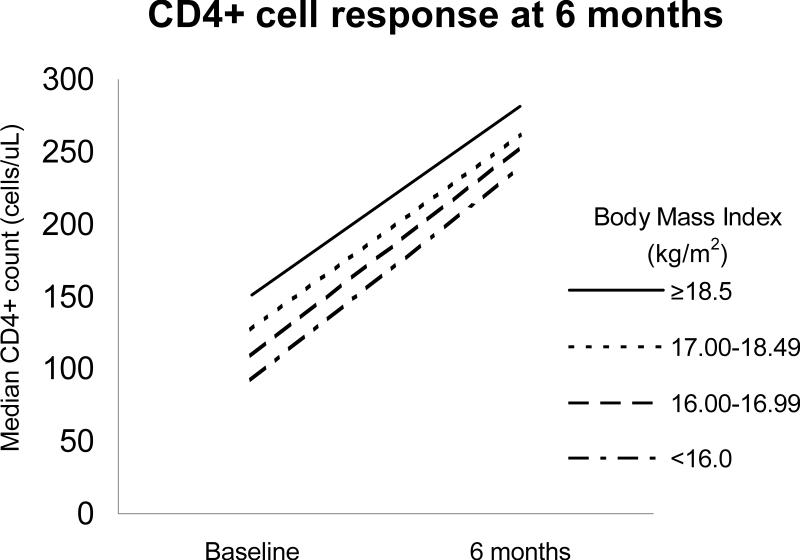
Results: From May 2004 to February 2009, 56,612 patients initiated ART at Lusaka district clinics; of these, 33 097 (58%) were included in this analysis. The median change in 0-6 month CD4(+) cell count in each baseline BMI strata varied from 127 to 131 cells/microl. There was a statistically significant, inverse association between baseline BMI and the post 6-month hazard for mortality only among those patients with less than 100 cells/microl increase in the first 6 months of ART. A CD4(+) cell count increase of at least 100 cells/microl over the first 6 months of ART was not associated with a higher hazard for mortality, regardless of baseline BMI.
Conclusions: Low baseline BMI and attenuated CD4(+) cell count response at 6 months had a compounding, negative impact on post 6-month survival. Specific guidelines for monitoring ART response using immunologic criteria may be warranted for low BMI patients.
Comment in
-
Body mass index, immune recovery and survival: an important but understudied relationship.AIDS. 2010 Aug 24;24(13):2125-6. doi: 10.1097/QAD.0b013e32833cfd76. AIDS. 2010. PMID: 20639726 No abstract available.
References
-
- UNAIDS . Report on the global AIDS epidemic. Geneva: 2008. [April 14, 2010]. Available at: http://www.unaids.org/en/KnowledgeCentre/HIVData/GlobalReport/2008/2008_....
-
- Food and Agricultural Organization of the United Nations . The State of Food Insecurity in the World 2008. FAO; Rome: 2008. [April 14, 2010]. Available at: ftp://ftp.fao.org/docrep/fao/011/i0291e/i0291e00.pdf.
-
- Stringer JS, Zulu I, Levy J, Stringer EM, Mwango A, Chi BH, et al. Rapid scale-up of antiretroviral therapy at primary care sites in Zambia: feasibility and early outcomes. JAMA. 2006;296:782–793. - PubMed
-
- Zachariah R, Fitzgerald M, Massaquoi M, Pasulani O, Arnould L, Makombe S, Harries AD. Risk factors for high early mortality in patients on antiretroviral treatment in a rural district of Malawi. AIDS. 2006;20:2355–2360. - PubMed
Publication types
MeSH terms
Grants and funding
LinkOut - more resources
Full Text Sources
Medical
Research Materials
