


Hypoglossal nerve conduction findings in obstructive sleep apnea
- PMID: 20544939
- PMCID: PMC2964343
- DOI: 10.1002/mus.21690
Hypoglossal nerve conduction findings in obstructive sleep apnea
Abstract
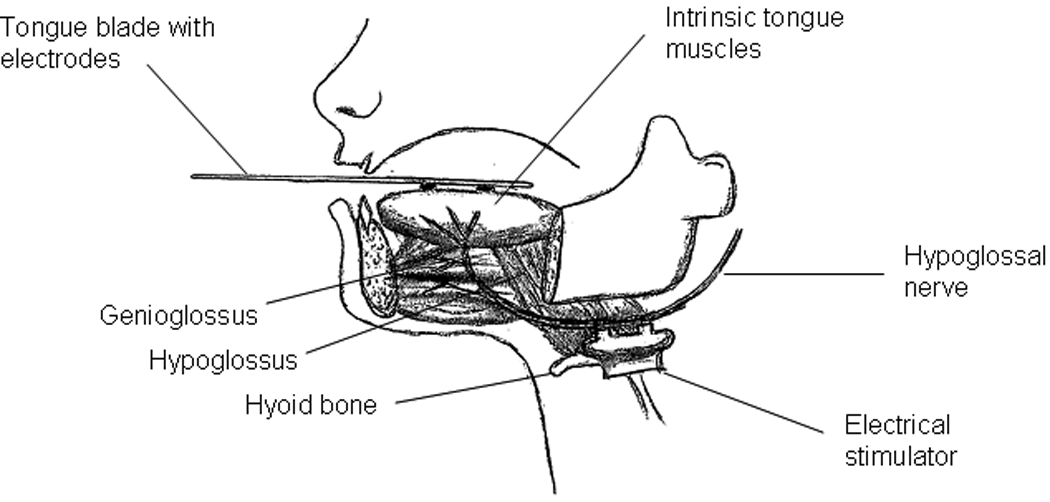
Denervation of oropharyngeal muscles in obstructive sleep apnea (OSA) has been suggested by needle electromyography (EMG) and muscle biopsy, but little is known about oropharyngeal nerve conduction abnormalities in OSA. We sought to compare hypoglossal nerve conduction studies in patients with and without OSA. Unilateral hypoglossal nerve conduction studies were performed on 20 subjects with OSA and 20 age-matched controls using standard techniques. Median age was 48 years in OSA subjects and 47 years in controls. Hypoglossal compound muscle action potential (CMAP) amplitudes were significantly reduced (P = 0.01, Wilcoxon signed-rank test), but prolongation of latencies in OSA subjects did not reach significance in comparison to those of controls. Among a subgroup of subjects without polyneuropathy (15 pairs), reduced amplitudes in OSA subjects retained borderline significance (P = 0.05). Hypoglossal nerve conduction abnormalities may distinguish patients with OSA from controls. These abnormalities could potentially contribute to, or arise from, OSA.
Figures
References
-
- Young T, Palta M, Dempsey J, Skatrud J, Weber S, Badr S. The occurrence of sleep-disordered breathing among middle-aged adults. New England Journal of Medicine. 1993;328:1230–1235. - PubMed
-
- Shahar E, Whitney CW, Redline S, Lee ET, Newman AB, Javier NF, et al. Sleep-disordered breathing and cardiovascular disease: cross-sectional results of the Sleep Heart Health Study. American Journal of Respiratory & Critical Care Medicine. 2001;163:19–25. - PubMed
-
- Carrera M, Barbé F, Sauleda J, Tomás M, Gómez C, Agustí AG. Patients with obstructive sleep apnea exhibit genioglossus dysfunction that is normalized after treatment with continuous positive airway pressure. Am J Respir Crit Care Med. 1999;159:1960–1966. - PubMed
-
- Svanborg E. Impact of obstructive apnea syndrome on upper airway respiratory muscles. Respir Physiol Neurobiol. 2005;147:263–272. - PubMed
-
- Boyd JH, Petrof BJ, Hamid Q, Fraser R, Kimoff RJ. Upper Airway Muscle Inflammation and Denervation Changes in Obstructive Sleep Apnea. Am J Respir Crit Care Med. 2004;170:541–546. - PubMed
Publication types
MeSH terms
Grants and funding
LinkOut - more resources
Full Text Sources
Other Literature Sources
