


doi: 10.1002/mus.21699.
Eccentric contractions induce rapid isometric torque drop in dystrophin-deficient dogs
Affiliations
- PMID: 20544944
- PMCID: PMC3800177
- DOI: 10.1002/mus.21699
Item in Clipboard
Eccentric contractions induce rapid isometric torque drop in dystrophin-deficient dogs
Muscle Nerve.
2010 Jul.
Abstract
We tested the hypothesis that eccentric contractions (ECCs) rapidly induce greater-than-normal isometric torque drop in dystrophin-deficient golden retriever muscular dystrophy (GRMD) muscles. ECCs were imposed by forcibly stretching activated muscles. The results indicate that isometric torque drop was greater in GRMD versus controls (P < 0.0001). Our findings support the hypothesis that ECCs induce greater-than-normal isometric torque drop in GRMD muscles. The magnitude of ECC-induced isometric torque loss may be an ideal clinical endpoint in the GRMD model.
Figures
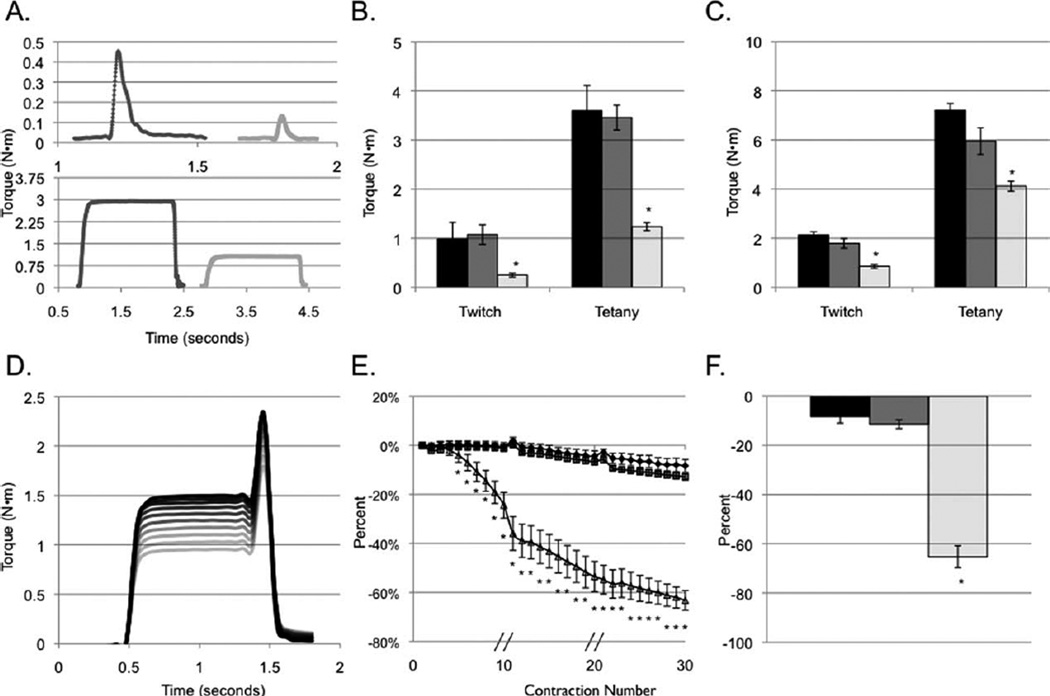
Dynamic force analysis of GRMD (n = 10), carrier (n = 7), and normal (n = 5) dogs. Representative twitch (top panel) and tetany (bottom panel) tracings from normal and GRMD dogs, respectively (A). Compared to normal and carrier dogs, affected GRMD dogs demonstrate lower twitch and tetanic torque values in tibiotarsal flexion (B) and extension (C). Note the y-axis scale. Representative torque tracings (D) during 10 ECCs. The darkest line displays the first contraction while the lightest line shows the tenth contraction. Following ECC, affected GRMD dogs rapidly lose strength as assessed by isometric torque. Temporal decrements in torque following eccentric injury (E). GRMD dogs display significantly greater-than-normal torque drop after the fifth ECC. Contractions were applied every 5 s. Broken lines through the x-axis indicate a 4-min rest period. Following completion of 30 ECCs, isometric torque varies among genotypes (F). GRMD dogs lose 63% of their original torque, whereas carriers lose 13% and normals lose 8%. Black = normal; gray = carrier; light = GRMD. *Significantly different (one-way ANCOVA) compared to the other genotypes (P < 0.05).
References
-
- Cooper BJ, Winand NJ, Stedman H, Valentine BA, Hoffman EP, Kunkel LM, et al. The homologue of the Duchenne locus is defective in X-linked muscular dystrophy of dogs. Nature. 1988;334:154–156. - PubMed
-
- Sharp NJ, Kornegay JN, Van Camp SD, Herbstreith MH, Secore SL, Kettle S, et al. An error in dystrophin mRNA processing in golden retriever muscular dystrophy, an animal homologue of Duchenne muscular dystrophy. Genomics. 1992;13:115–121. - PubMed
-
- Kornegay JN, Bogan DJ, Bogan JR, Childers MK, Cundiff DD, Petroski GF, et al. Contraction force generated by tarsal joint flexion and extension in dogs with golden retriever muscular dystrophy. J Neurol Sci. 1999;166:115–121. - PubMed
-
- Kornegay JN, Tuler SM, Miller DM, Levesque DC. Muscular dystrophy in a litter of golden retriever dogs. Muscle Nerve. 1988;11:1056–1064. - PubMed
-
- Childers MK, Okamura CS, Bogan DJ, Bogan JR, Petroski GF, McDonald K, et al. Eccentric contraction injury in dystrophic canine muscle. Arch Phys Med Rehabil. 2002;83:1572–1578. - PubMed
MeSH terms
Substances
Grants and funding
LinkOut - more resources
Full Text Sources
Other Literature Sources
