


Neutropenia dynamics in a case of T-LGL lymphoproliferation illustrate rapid turnover of granulocyte progenitors
- PMID: 20546248
- PMCID: PMC6495143
- DOI: 10.1111/j.1365-2184.2010.00678.x
Neutropenia dynamics in a case of T-LGL lymphoproliferation illustrate rapid turnover of granulocyte progenitors
Abstract
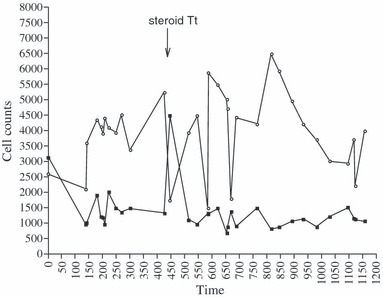
Objectives: To elucidate the natural history of T-cell large granular lymphocyte (T-LGL) lymphoproliferation, we followed changes in associated fluctuating neutropenia for 3 years in an untreated patient presenting with the disease.
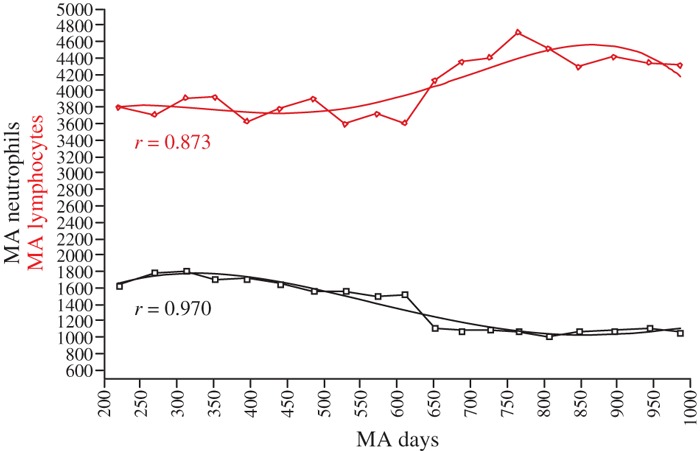
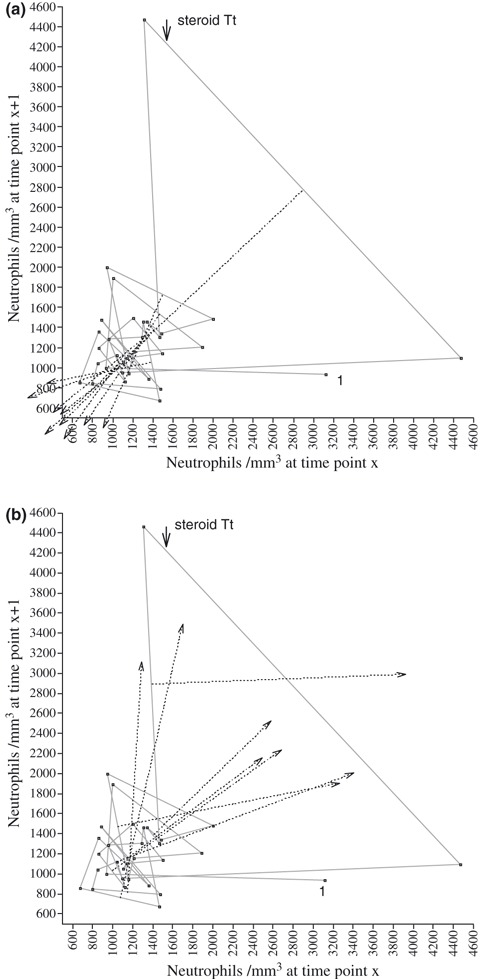
Materials and methods: We report a nonlinear mathematical analysis of irregular neutrophil fluctuation, using iterative data maps, to detect long-term regulation of the neutrophil population.
Results: This geometric analysis indicated that variations of this sequence of neutrophil counts followed bounded deterministic dynamics around a fixed low level equilibrium, a situation similar to that previously observed for cultured mouse early bone marrow progenitor cells.
Conclusion: These findings illustrate how the deleterious effect of T-LGL on neutrophils is balanced, over periods of years, by pulses of compensatory neutrophil production, potentially accounting for the commonly observed prolonged indolent course of the disease.
Figures
References
-
- Rose MG, Berliner N (2004) T‐cell large granular lymphocyte leukemia and related disorders. Oncologist 9, 247–258. - PubMed
-
- Morley AA (1966) A neutrophil cycle in healthy individuals. The Lancet 3, 1220–1222. - PubMed
-
- Von Schultess GK, Gessner U (1986) Oscillating platelet counts in healthy individuals: experimental investigation and quantitative evaluation of thrombocytopoietic feedback control. Scand. J. Haematol. 36, 473–479. - PubMed
-
- Maughan WZ, Bishop CR, Pryor TA, Athens JW (1973) The question of cycling of the blood neutrophil concentrations and pitfalls in the statistical analysis of sampled data. Blood 41, 85–91. - PubMed
Publication types
MeSH terms
LinkOut - more resources
Full Text Sources
Medical
