


Population based absolute and relative survival to 1 year of people with diabetes following a myocardial infarction: a cohort study using hospital admissions data
- PMID: 20546579
- PMCID: PMC2894776
- DOI: 10.1186/1471-2458-10-338
Population based absolute and relative survival to 1 year of people with diabetes following a myocardial infarction: a cohort study using hospital admissions data
Abstract
Background: People with diabetes who experience an acute myocardial infarction (AMI) have a higher risk of death and recurrence of AMI. This study was commissioned by the Department for Transport to develop survival tables for people with diabetes following an AMI in order to inform vehicle licensing.
Methods: A cohort study using data obtained from national hospital admission datasets for England and Wales was carried out selecting all patients attending hospital with an MI for 2003-2006 (inclusion criteria: aged 30+ years, hospital admission for MI (defined using ICD 10 code I21-I22). STATA was used to create survival tables and factors associated with survival were examined using Cox regression.
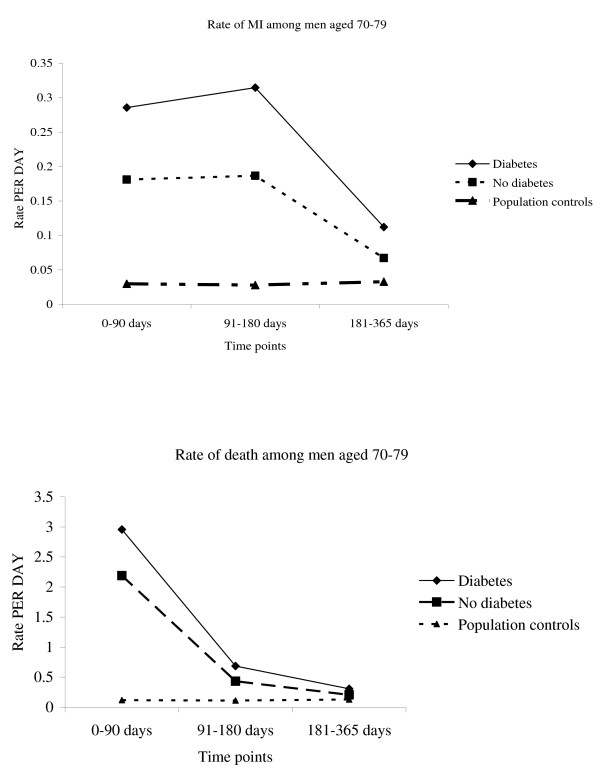
Results: Of 157,142 people with an MI in England and Wales between 2003-2006, the relative risk of death or recurrence of MI for those with diabetes (n = 30,407) in the first 90 days was 1.3 (95%CI: 1.26-1.33) crude rates and 1.16 (95%CI: 1.1-1.2) when controlling for age, gender, heart failure and surgery for MI) compared with those without diabetes (n = 129,960). At 91-365 days post AMI the risk was 1.7 (95% CI 1.6-1.8) crude and 1.50 (95%CI: 1.4-1.6) adjusted. The relative risk of death or re-infarction was higher at younger ages for those with diabetes and directly after the AMI (Relative risk; RR: 62.1 for those with diabetes and 28.2 for those without diabetes aged 40-49 [compared with population risk]).
Conclusions: This is the first study to provide population based tables of age stratified risk of re-infarction or death for people with diabetes compared with those without diabetes. These tables can be used for giving advice to patients, developing a baseline to compare intervention studies or developing license or health insurance guidelines.
Figures
References
-
- Stone PH, Muller JE, Hartwell T, York BJ, Rutherford JD, Parker CB, Turi ZG, Strauss HW, Willerson JT, Robertson T. The effect of diabetes mellitus on prognosis and serial left ventricular function after acute myocardial infarction: contribution of both coronary disease and diastolic left ventricular dysfunction to the adverse prognosis. The MILIS Study Group. J Am Coll Cardiol. 1989;14(1):49–57. doi: 10.1016/0735-1097(89)90053-3. - DOI - PubMed
-
- Molstad P, Nustad M. Acute myocardial infarction in diabetic patients. Acta Med Scand. 1987;222(5):433–7. - PubMed
-
- American Diabetes Association. Consensus statement: role of cardiovascular risk factors in prevention and treatment of macrovascular disease in diabetes. Diabetes Care. 1993;16(Supp 2):72–8. - PubMed
Publication types
MeSH terms
LinkOut - more resources
Full Text Sources
Medical
