


Efficacy of CBT for benzodiazepine discontinuation in patients with panic disorder: Further evaluation
- PMID: 20546699
- PMCID: PMC5962448
- DOI: 10.1016/j.brat.2010.04.002
Efficacy of CBT for benzodiazepine discontinuation in patients with panic disorder: Further evaluation
Abstract
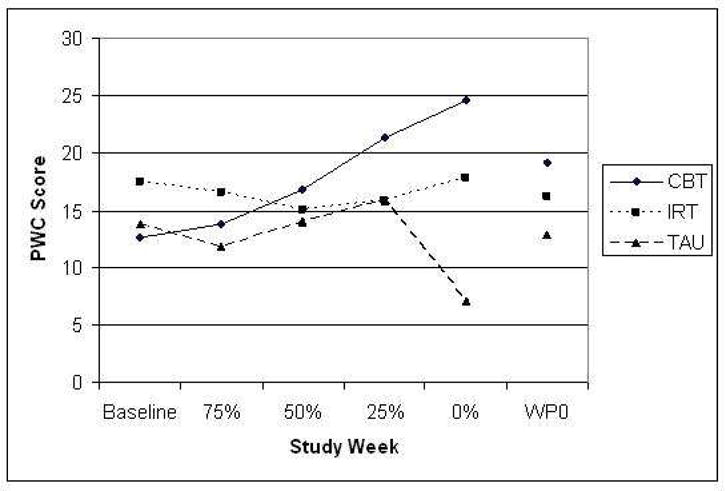
Despite its acute efficacy for the treatment of panic disorder, benzodiazepines (BZs) are associated with a withdrawal syndrome that closely mimics anxiety sensations, leading to difficulty with treatment discontinuation and often disorder relapse. An exposure-based cognitive-behavioral treatment for BZ discontinuation, Panic Control Treatment for BZ Discontinuation (CBT) targets the fear of these sensations and has demonstrated efficacy in preventing disorder relapse and facilitating successful BZ discontinuation among patients with panic disorder. In this randomized controlled trial, CBT was compared to taper alone and a taper plus a relaxation condition to control for the effect of therapist contact and support among 47 patients with panic disorder seeking taper from BZs. Based on the primary outcome of successful discontinuation of BZ use, results indicate that adjunctive CBT provided additive benefits above both taper alone and taper plus relaxation, with consistently medium and large effect sizes over time that reached significance at the six month follow-up evaluation. The efficacy of CBT relative to either of the other taper conditions reflected very large and significant effect sizes at that time. These findings suggest that CBT provides specific efficacy for the successful discontinuation from BZs, even when controlling for therapist contact and relaxation training.
Copyright 2010 Elsevier Ltd. All rights reserved.
Figures
References
-
- American Psychiatric Association. Diagnostic and statistical manual of mental disorders. 4. Washington, DC: Author; 1994.
-
- Barlow DH, Craske MG. Mastery of your anxiety and panic (MAP) Albany, NY: Graywind; 1989.
-
- Barlow DH, Craske MG, Cerny JA, Klosko JS. Behavioral treatment of panic disorder. Behavior Therapy. 1989;20:261–282.
-
- Beck AT, Epstein N, Brown G, Steer RA. An inventory for measuring clinical anxiety: Psychometric properties. Journal of Consulting and Clinical Psychology. 1988;56:893–897. - PubMed
-
- Beck AT, Steer RA. Internal consistencies of the original and revised Beck Depression Inventory. Journal of Clinical Psychology. 1984;40:1365–1367. - PubMed
Publication types
MeSH terms
Substances
Grants and funding
LinkOut - more resources
Full Text Sources
Medical
Research Materials
