


Variants in the ITPA gene protect against ribavirin-induced hemolytic anemia and decrease the need for ribavirin dose reduction
- PMID: 20547162
- PMCID: PMC3086671
- DOI: 10.1053/j.gastro.2010.06.016
Variants in the ITPA gene protect against ribavirin-induced hemolytic anemia and decrease the need for ribavirin dose reduction
Abstract
Background & aims: In a genome-wide association study of patients being treated for chronic hepatitis C, 2 functional variants in ITPA that cause inosine triphosphatase (ITPase) deficiency were shown to protect against ribavirin (RBV)-induced hemolytic anemia during early stages of treatment. We aimed to replicate this finding in an independent cohort from the Study of Viral Resistance to Antiviral Therapy of Chronic Hepatitis C and to investigate the effects of these variants beyond week 4.
Methods: Genetic material was available from 318 patients. The ITPA variants, rs1127354 (exon 2, P32T) and rs7270101 (intron 2, splice altering), were genotyped and tested for association with hemoglobin (Hb) reduction at week 4. An ITPase deficiency variable was defined that combined both ITPA variants according to documented effect on ITPase activity. We investigated the impact of ITPA variants on Hb levels over the course of therapy and on the need for RBV dose reduction.
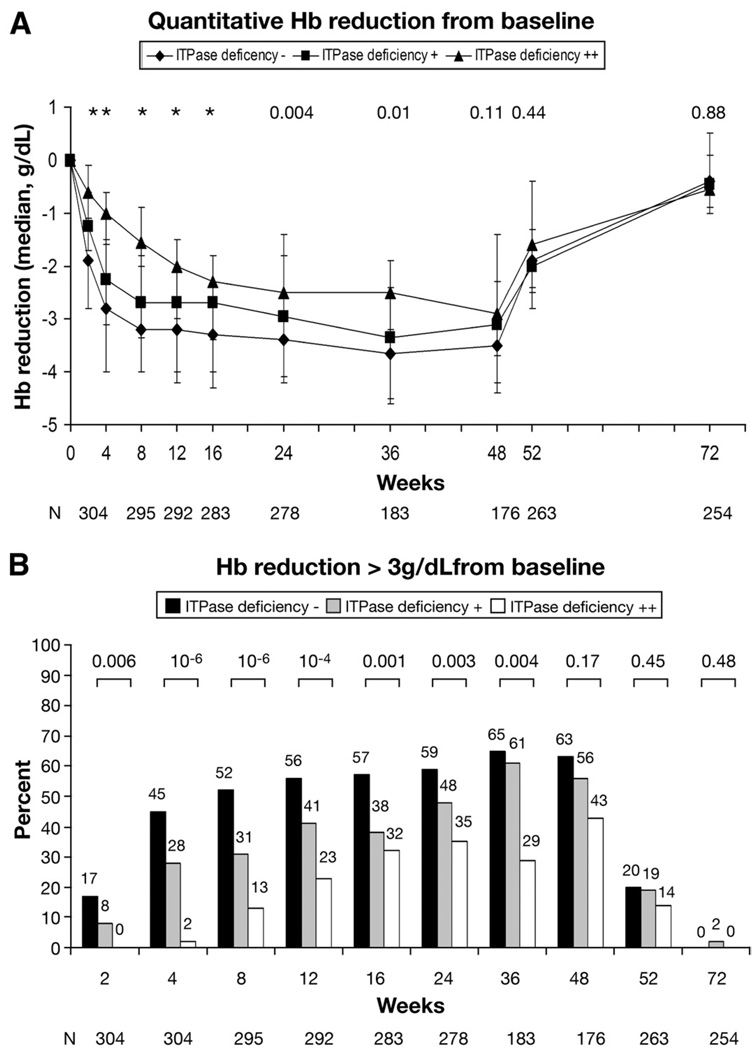
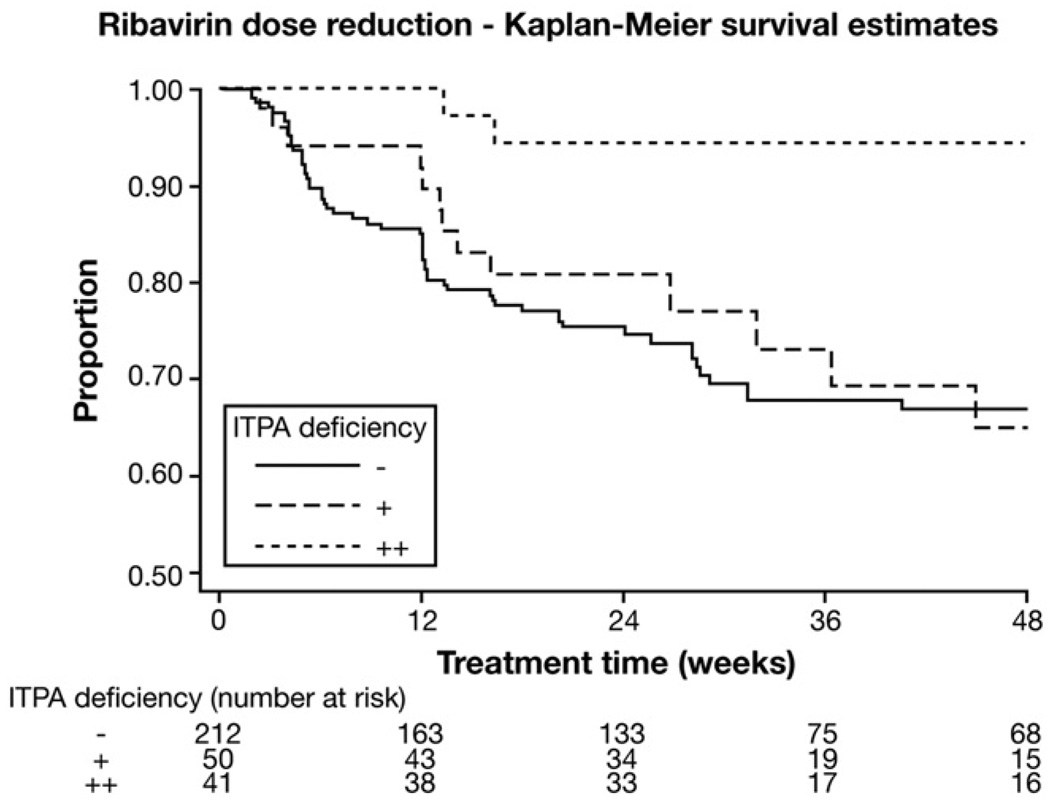
Results: The final analysis included 304 patients with genotype 1 hepatitis C virus (167 white patients and 137 black patients). The polymorphisms rs1127354 and rs7270101 were associated with Hb reduction at week 4 (P = 3.1 × 10(-13) and 1.3 × 10(-3), respectively). The minor alleles of each variant protected against Hb reduction. Combining the variants into the ITPase deficiency variable strengthened the association (P = 2.4 × 10(-18)). The ITPase deficiency variable was associated with lower rates of anemia over the entire treatment period (48 weeks), as well as a lower rate of anemia-related RBV dose reduction (hazard ratio, 0.52; P = .0037). No association with sustained virological response was observed.
Conclusions: Two polymorphisms that cause ITPase deficiency are strongly associated with protection from RBV-induced hemolytic anemia and decrease the need for RBV dose reduction.
Copyright © 2010 AGA Institute. Published by Elsevier Inc. All rights reserved.
Conflict of interest statement
Conflicts of interest
The authors disclose the following: A.J.T., J.F., D.G., T.J.U., K.V.S., D.B.G., and J.G.M. are coinventors of a patent application based on the ITPA discovery. K.P., H.L.T., S.N., A.J.M., M.W.F., and N.H.A. disclose no conflicts.
Figures
References
-
- Manns MP, McHutchison JG, Gordon SC, et al. Peginterferon alfa-2b plus ribavirin compared with interferon alfa-2b plus ribavirin for initial treatment of chronic hepatitis C: a randomised trial. Lancet. 2001;358:958–965. - PubMed
-
- Fried MW, Shiffman ML, Reddy KR, et al. Peginterferon alfa-2a plus ribavirin for chronic hepatitis C virus infection. N Engl J Med. 2002;347:975–982. - PubMed
-
- Fellay J, Thompson AJ, Ge D, et al. ITPA gene variants protect against anaemia in patients treated for chronic hepatitis C. Nature. 2010;464:405–408. - PubMed
-
- Sumi S, Marinaki AM, Arenas M, et al. Genetic basis of inosine triphosphate pyrophosphohydrolase deficiency. Hum Genet. 2002;111:360–367. - PubMed
-
- Maeda T, Sumi S, Ueta A, et al. Genetic basis of inosine triphosphate pyrophosphohydrolase deficiency in the Japanese population. Mol Genet Metab. 2005;85:271–279. - PubMed
Publication types
MeSH terms
Substances
Grants and funding
LinkOut - more resources
Full Text Sources
Medical
Molecular Biology Databases
Miscellaneous
