. 2010 Nov;59(6):380-7.
doi: 10.1016/j.neuropharm.2010.05.012. Epub 2010 Jun 12.

T-type calcium channel antagonists suppress tremor in two mouse models of essential tremor

Affiliations

T-type calcium channel antagonists suppress tremor in two mouse models of essential tremor

Adrian Handforth et al. Neuropharmacology. 2010 Nov.

Abstract

Essential tremor is a common disorder that lacks molecular targets for therapeutic development. T-type calcium channel activation has been postulated to underlie rhythmicity in the olivo-cerebellar system that is implicated in essential tremor. We therefore tested whether compounds that antagonize T-type calcium channel currents suppress tremor in two mouse models that possess an essential tremor-like pharmacological response profile. Tremor was measured using digitized spectral motion power analysis with harmaline-induced tremor and in the GABA(A) receptor α1 subunit-null model. Mice were given ethosuximide, zonisamide, the neuroactive steroid (3β,5α,17β)-17-hydroxyestrane-3-carbonitrile (ECN), the 3,4-dihydroquinazoline derivative KYS05064, the mibefradil derivative NNC 55-0396, or vehicle. In non-sedating doses, each compound reduced harmaline-induced tremor by at least 50% (range of maximal suppression: 53-81%), and in the GABA(A) α1-null model by at least 70% (range 70-93%). Because the T-type calcium channel Cav3.1 is the dominant subtype expressed in the inferior olive, we assessed the tremor response of Cav3.1-deficient mice to harmaline, and found that null and heterozygote mice exhibit as much tremor as wild-type mice. In addition, ECN and NNC 55-0396 suppressed harmaline tremor as well in Cav3.1-null mice as in wild-type mice. The finding that five T-type calcium antagonists suppress tremor in two animal tremor models suggests that T-type calcium channels may be an appropriate target for essential tremor therapy development. It is uncertain whether medications developed to block only the Cav3.1 subtype would exhibit efficacy.


Figures

Fig. 1
Fig. 1
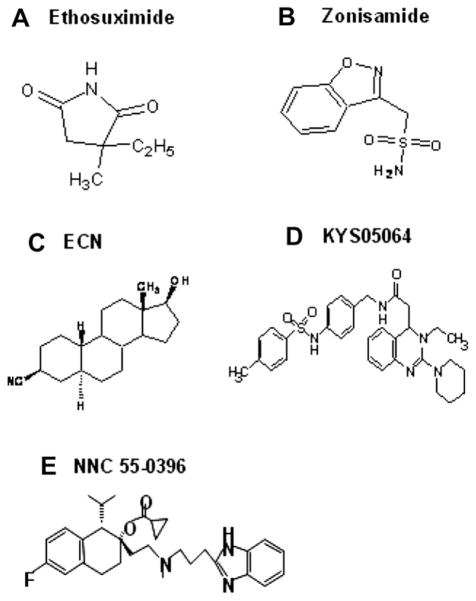
Structures of T-type calcium channel antagonists tested for anti-tremor efficacy.
Fig. 2
Fig. 2
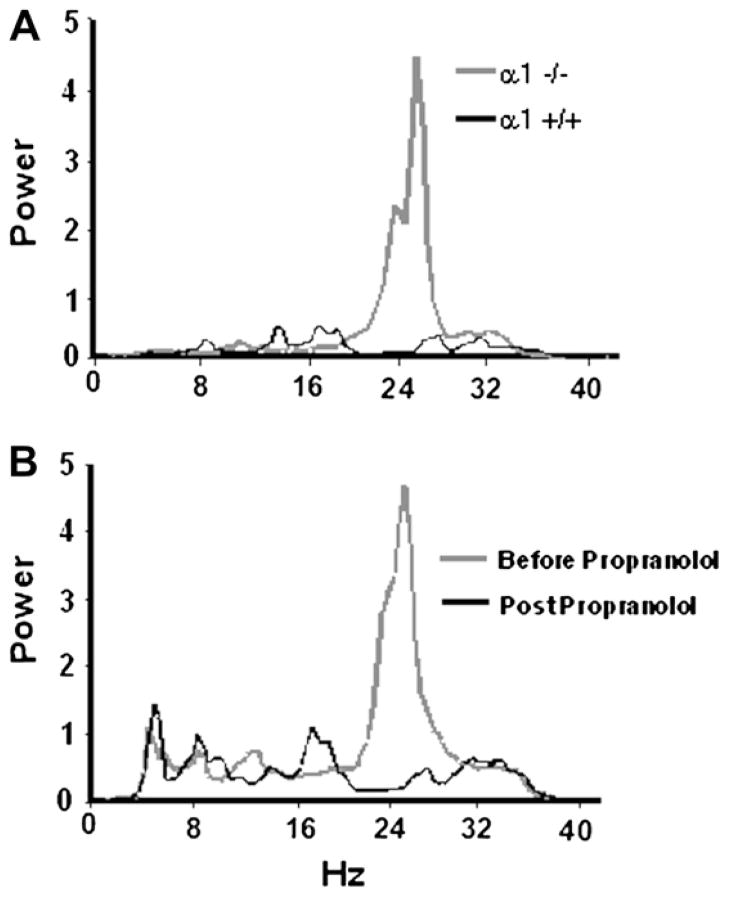
Spectral motion power in GABAA receptor α1 subunit model. (A) During a 30-s tail suspension, an α1-null mouse displays a tremor-associated motion power peak at 22–27 Hz. By comparison, a wild-type mouse does not have tremor or display this peak. (B) Motion power spectra of an α1-null mouse before and after administration of the anti-ET drug propranolol, 20 mg/kg i.p. Corresponding to tremor suppression, the 22–27 Hz motion power peak is eliminated by propranolol.
Fig. 3
Fig. 3
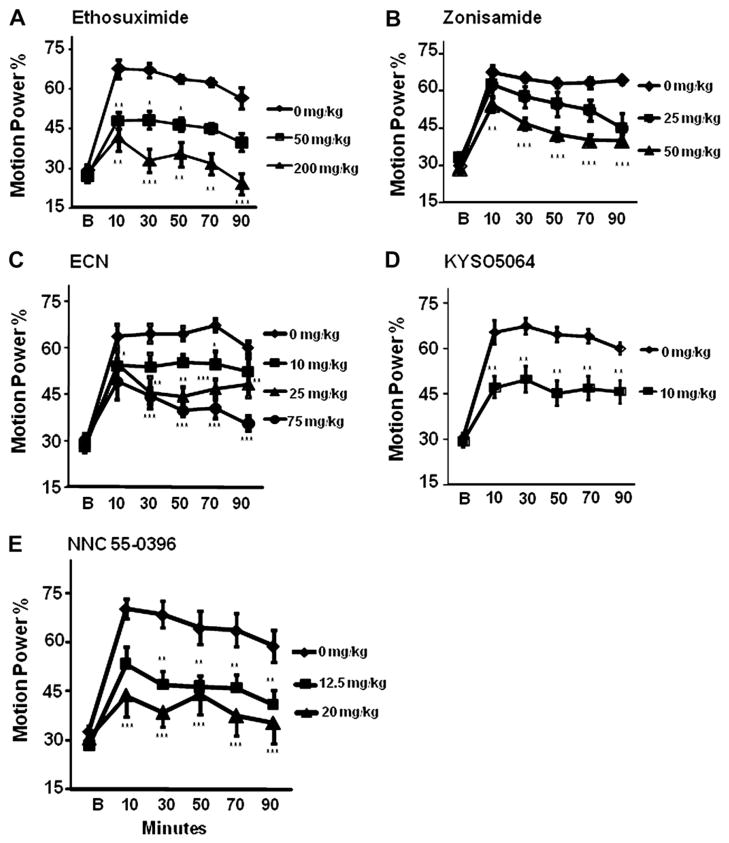
Effect of T-type calcium antagonists on tremor in harmaline mouse model. Motion data were collected in a 20-min Baseline epoch (B), then harmaline, 20 mg/kg s.c. administered, followed by compounds or vehicle i.p. 15 min later (at time 0). The panels display motion power in the tremor bandwidth (10–16 Hz) as a percent of overall motion power (0–34 Hz) for Baseline and post-drug 20-min epochs (mid-epoch times shown). Doses of ethosuximide and other drugs employed in these experiments were those that had been determined not to cause sedation or motor impairment as assessed in the horizontal wire test in separate ICR mice not administered harmaline. (A) Ethosuximide, (B) zonisamide, (C) ECN, (D) KYS05064, (E) NNC 55-0396 each significantly suppressed harmaline tremor. n = 6 per group. Error bars = SEM. *p < 0.05 **p < 0.005 ***p < 0.001.
Fig. 4
Fig. 4
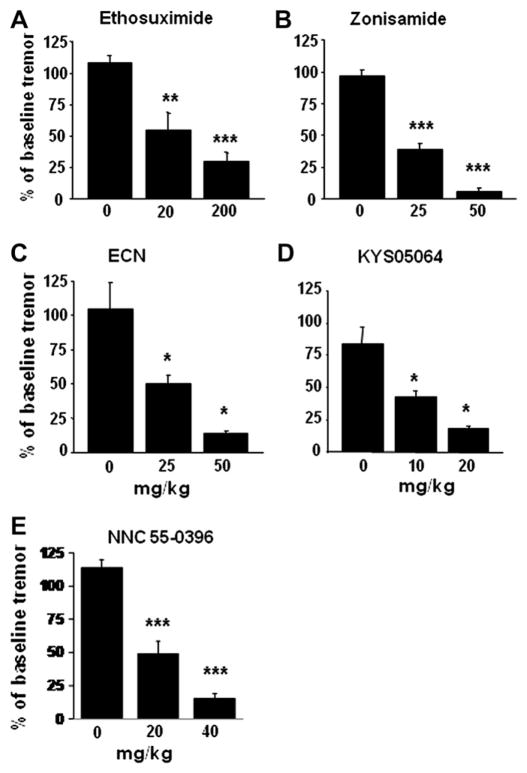
Response of tremor in GABAA receptor α1-null mice to treatments during re-test compared to pre-drug baseline tremor. Tremor was assessed at 30 min (zonisamide, KYS05064, ECN, NNC 55-0396, or vehicle) or at 60 min post-injection (etho-suximide or vehicle). Each compound suppressed tremor compared to the vehicle treatment. n = 5–8 animals. Error bars = SEM. +p < 0.01, **p < 0.001, ***p < 0.0001.
Fig. 5
Fig. 5
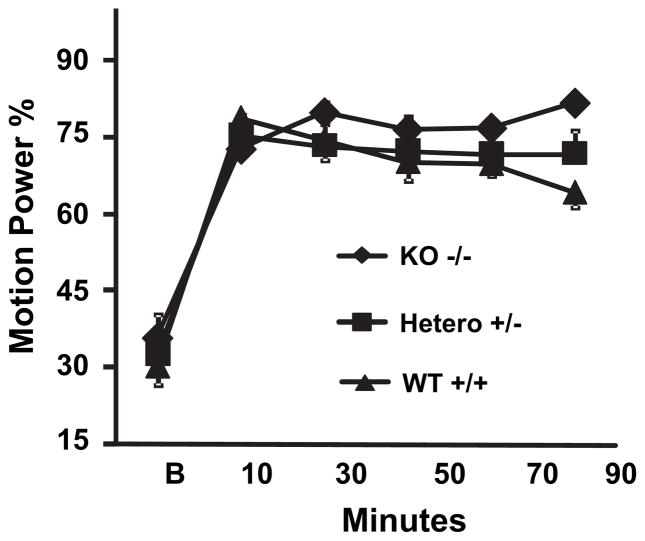
Effect of Cav3.1 genotype on tremor response to harmaline. Cav3.1+/+, Cav3.1+/−, and Cav−/− mice were injected will harmaline, 20 mg/kg s.c. and motion power accessed in successive 20-min epochs starting at 15 min post-injection, as described in Fig. 3. Heterozygote and null Cav3.1-deficient mice displayed as much tremor as wild-type controls. n = 6 per group. Error bars = SEM.
Fig. 6
Fig. 6
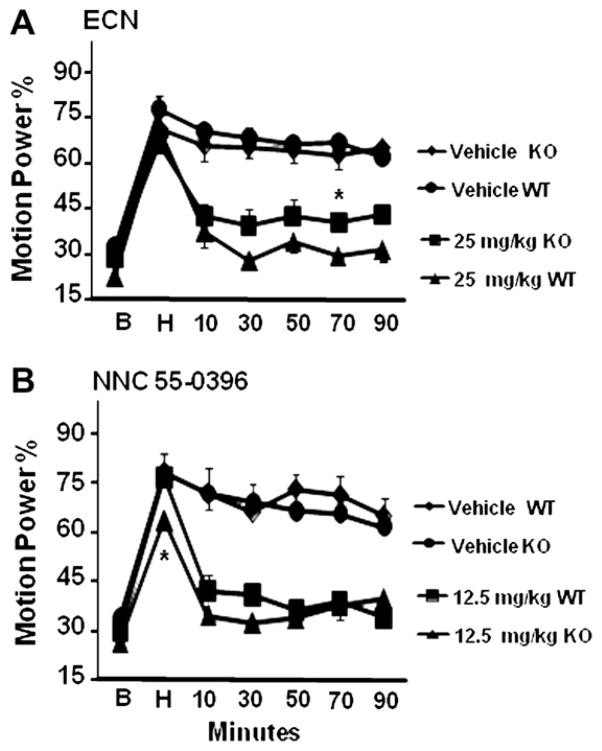
Effect of Cav3.1 genotype on harmaline tremor suppression by ECN and NNC 55-0396. Cav3.1 wild-type (WT) or knockout (KO) mice were administered harmaline and motion power measured as described in Fig. 3, but tremor was also measured during a 20-min post-harmaline-injection (H) epoch prior to treatments with drugs or vehicle. (A) Harmaline-induced tremor was comparable in KO and WT mice before treatments and after vehicle treatment. ECN, 25 mg/kg, potently suppressed tremor in both WT and KO groups to a comparable degree. (B) NNC 55-0396, 12.5 mg/kg, potently and similarly suppressed tremor in WT and KO mice. n = 6 per group. Error bars = SEM. *p < 0.05.
Fig. 7
Fig. 7
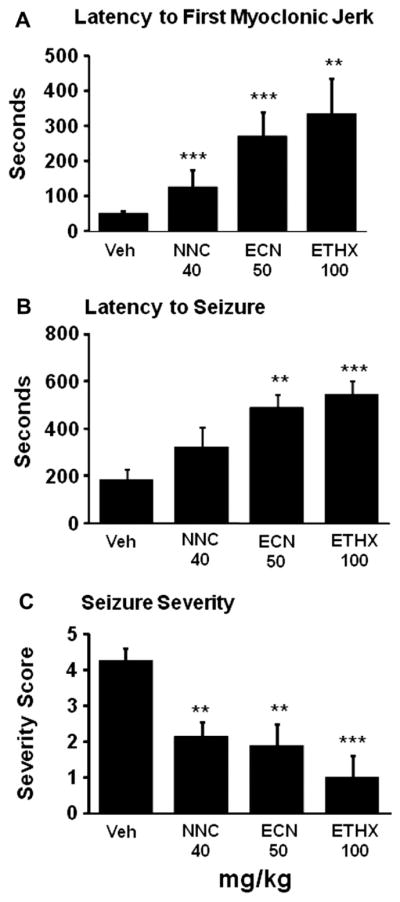
Effect of T-type calcium channel antagonists on epileptiform activity measures in the pentylenetetrazole seizure model. Vehicle (VEH), NNC 55-0396 (NNC), 40 mg/kg, ECN, 50 mg/kg, ethosuximide (ETHX), 100 mg/kg, were administered 30 min prior to pentylenetetrazole, 70 mg/kg, and behavior recorded for 600 s. n = 8–11 per group. Means and SEMs are shown. **p < 0.01, ***p < 0.001, Wilcoxon rank sum.

References

    1. Aizawa M, Ito Y, Fukuda H. Pharmacological profiles of generalized absence seizures in lethargic, stargazer and γ-hydroxybutyrate-treated model mice. Neuroscience Research. 1997;29:17–25. - PubMed
    1. Alviňa K, Ellis-Davies G, Khodakhah K. T-type calcium channels mediate rebound firing in intact deep cerebellar neurons. Neuroscience. 2009;158:635–641. - PMC - PubMed
    1. Axelrad JE, Louis ED, Honig LS, Flores I, Ross GW, Pahwa R, Lyons KE, Faust PL, Vonsattel JP. Reduced Purkinje cell number in essential tremor: a postmortem study. Archives of Neurology. 2008;65:101–107. - PMC - PubMed
    1. Baulac M. Introduction to zonisamide. Epilepsy Research. 2006;68 (Suppl 2):S3–S9. - PubMed
    1. Bernard JF, Buisseret-Delmas C, Compoint C, Laplante S. Harmaline induced tremor. III. A combined simple units, horseradish peroxidase, and 2-deoxyglucose study of the olivocerebellar system in the rat. Experimental Brain Research. 1984;57:128–137. - PubMed

Publication types

MeSH terms

LinkOut - more resources