. 2010 Jul;16(7):1436-45.
doi: 10.1261/rna.2001610.

High-performance quantification of mature microRNAs by real-time RT-PCR using deoxyuridine-incorporated oligonucleotides and hemi-nested primers

Affiliations

High-performance quantification of mature microRNAs by real-time RT-PCR using deoxyuridine-incorporated oligonucleotides and hemi-nested primers

Guoqiang Wan et al. RNA. 2010 Jul.

Abstract

MicroRNAs are small noncoding RNAs that serve as important regulators of eukaryotic gene expression and are emerging as novel diagnostic and therapeutic targets for human diseases. Robust and reliable detection of miRNAs is an essential step for understanding the functional significance of these small RNAs in both physiological and pathological processes. Existing methods for miRNA quantification rely on fluorescent probes for optimal specificity. In this study, we developed a high-performance real-time reverse transcriptase-polymerase chain reaction (RT-PCR) assay that allows specific and rapid detection of mature miRNAs using a fast thermocycling profile (10 sec per cycle). This assay exhibited a wide dynamic range (>7 logs) and was capable of detecting miRNAs from as little as 1 pg of the total RNA or as few as 10 cells. The use of modified reverse-transcription oligonucleotides with a secondary structure and hemi-nested reverse PCR primers allowed excellent discrimination of mature miRNAs from their precursors and highly homologous family members using SYBR Green I. Using a novel approach involving uracil-DNA glycosylase treatment, we showed that carryover of the reverse transcription oligonucleotide to the PCR can be successfully eliminated and discrimination between miRNA homologs could be further enhanced. These assays were further extended for multiplexed detection of miRNAs directly from cell lysates without laborious total RNA isolation. With the robust performance of these assays, we identified several miRNAs that were regulated by glial cell-line-derived neurotrophic factor in human glioblastoma cells. In summary, this method could provide a useful tool for rapid, robust, and cost-effective quantification of existing and novel miRNAs.


Figures
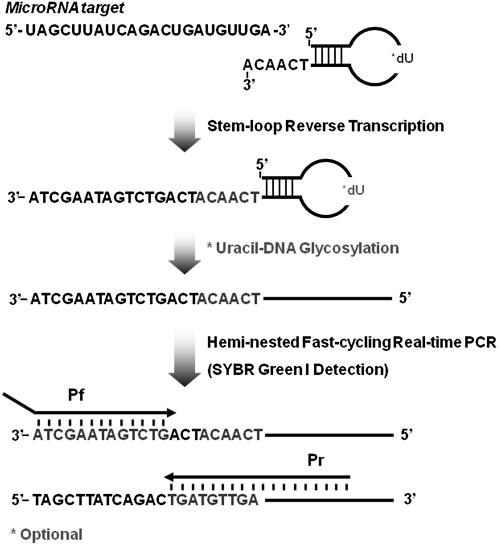
FIGURE 1.
FIGURE 1.
Schematics for the design of a hemi-nested real-time RT-PCR assay. Pf, forward primer; Pr, reverse primer; dU, deoxyuridine.
FIGURE 2.
FIGURE 2.
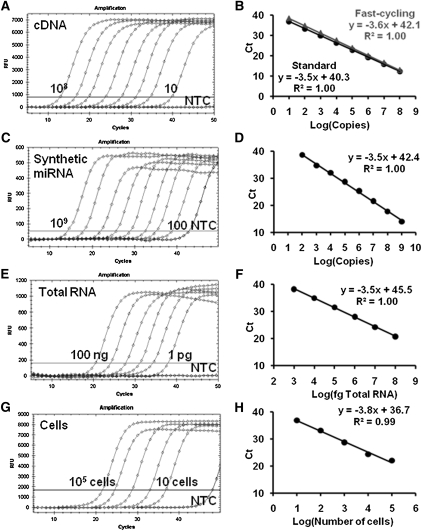
Performance of the miR-21 hemi-nested real-time RT-PCR assay. (A,B) miR-21 cDNA (108–10 copies) were amplified by real-time PCR assay under fast-cycling conditions compared with standard cycling protocol. (C,D) Dilutions of the synthetic miR-21 miRNA (109–102 copies), (E,F) dilutions of total RNA from A172 cells (from 100 ng to 1 pg), and (G,H) total RNA isolated from dilutions of U251 cells (100,000–10 cells) were reverse transcribed with the miR-21 RT oligonucleotide. The cDNA samples (10% v/v) were amplified by real-time PCR along with the nontemplate control (NTC). Amplification plots (A,C,E,G) and standard curves (B,D,F,H) of the assay are shown. Standard curves are plotted as Ct versus Log (starting material per RT).
FIGURE 3.
FIGURE 3.
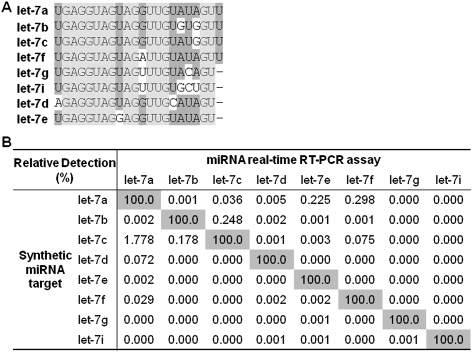
Discrimination of human let-7 homologs. (A) Sequence alignment of the eight let-7 family miRNAs. (B) Relative detection (%) of each let-7 miRNA by specific hemi-nested real-time RT-PCR assays.
FIGURE 4.
FIGURE 4.
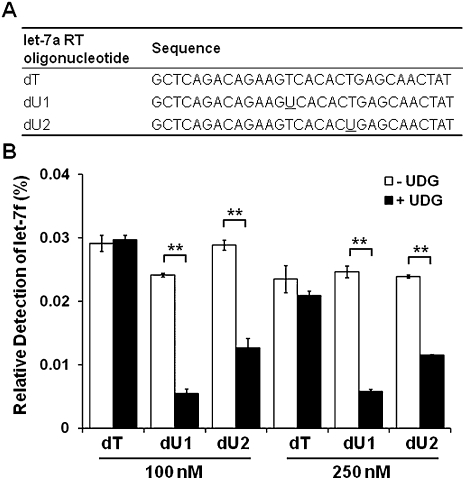
Specificity of the hemi-nested real-time RT-PCR assay using dU-incorporated RT oligonucleotides. (A) Sequence comparison of dT and dU RT oligonucleotides. The dU residues are underlined. (B) Relative detection of the let-7f miRNA by the let-7a assay. Copies (109) of let-7a or let-7f were reverse transcribed using 100 or 250 nM of the dT, dU1, or dU2 RT oligonucleotide. The cDNA samples (10% v/v) were treated with or without UDG and amplified using let-7a-specific PCR primers. Nonspecific amplification of the let-7f miRNA was calculated and expressed as a percentage of relative detection. Error bars indicate standard deviations of quadruplicate measurements. Significant differences in relative detection between the UDG treated and nontreated samples were calculated by Student's t-test; **P < 0.001.
FIGURE 5.
FIGURE 5.
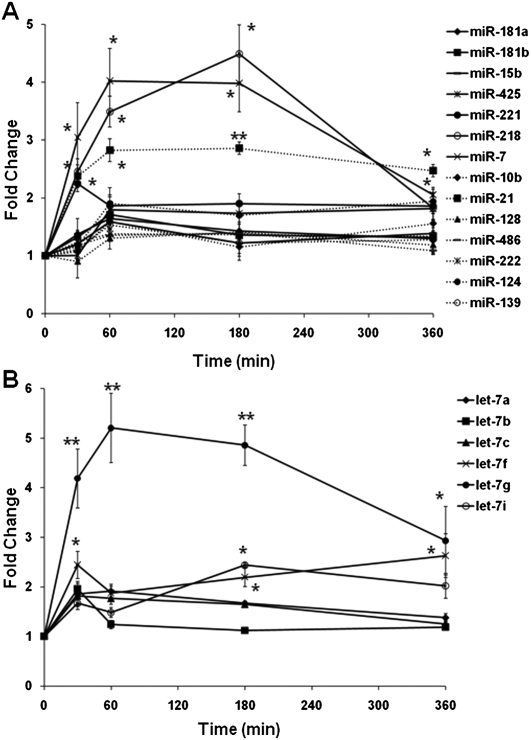
GDNF regulated miRNA expressions in U251 cells. Regulation of selected mature miRNAs (A,B) were quantified by hemi-nested real-time RT-PCR and expressed as fold changes to nonstimulated control samples. Error bars indicate standard deviations of triplicate measurements. Significant differences in gene expression between treated and control samples were calculated by Student's t-test; *P < 0.01; **P < 0.001.
FIGURE 6.
FIGURE 6.
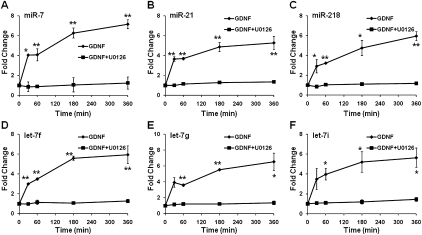
Multiplexed quantification of the six GDNF regulated miRNAs. Expressions of miR-7 (A), miR-21 (B), miR-218 (C), let-7f (D), let-7g (E), and let-7i (F) were quantified by multiplexed real-time RT-PCR assays of 24 miRNAs. Regulation of these miRNAs was expressed as fold changes to nonstimulated control samples. Error bars indicate standard deviations of triplicate measurements. Significant differences in gene expression between treated and control samples were calculated by Student's t-test; *P < 0.01; **P < 0.001.
FIGURE 7.
FIGURE 7.
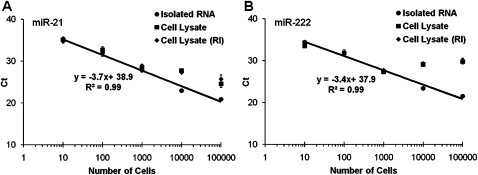
Direct and multiplexed detection of miRNAs from cell lysates. U251 cells cultured in 96-wells at various densities (10, 100, 1000, 10,000 and 100,000 cells per well) were directly lysed and reverse transcribed in a reaction mixture containing 24 miRNA RT oligonucleotides. The cDNA samples (2.5% v/v) generated from isolated RNA or cell lysates were amplified by (A) miR-21 and (B) miR-222 real-time PCR assays. Standard curves for isolated RNA were plotted as Ct versus Log (cells per RT); RI, RNase inhibitor.

References

    1. Ambros V, Lee RC, Lavanway A, Williams PT, Jewell D 2003. MicroRNAs and other tiny endogenous RNAs in C. elegans. Curr Biol 13: 807–818 - PubMed
    1. Anwar A, August JT, Too HP 2006. A stem–loop-mediated reverse transcription real-time PCR for the selective detection and quantification of the replicative strand of an RNA virus. Anal Biochem 352: 120–128 - PubMed
    1. Bar M, Wyman SK, Fritz BR, Qi J, Garg KS, Parkin RK, Kroh EM, Bendoraite A, Mitchell PS, Nelson AM, et al. 2008. MicroRNA discovery and profiling in human embryonic stem cells by deep sequencing of small RNA libraries. Stem Cells 26: 2496–2505 - PMC - PubMed
    1. Bartel DP 2004. MicroRNAs: Genomics, biogenesis, mechanism, and function. Cell 116: 281–297 - PubMed
    1. Bartel DP 2009. MicroRNAs: Target recognition and regulatory functions. Cell 136: 215–233 - PMC - PubMed

Publication types

MeSH terms

LinkOut - more resources