Affinity of the new cephalosporin CXA-101 to penicillin-binding proteins of Pseudomonas aeruginosa
- PMID: 20547785
- PMCID: PMC2934984
- DOI: 10.1128/AAC.00296-10
Affinity of the new cephalosporin CXA-101 to penicillin-binding proteins of Pseudomonas aeruginosa
Abstract
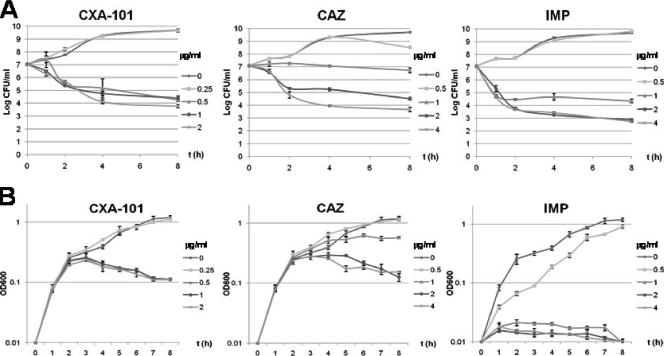
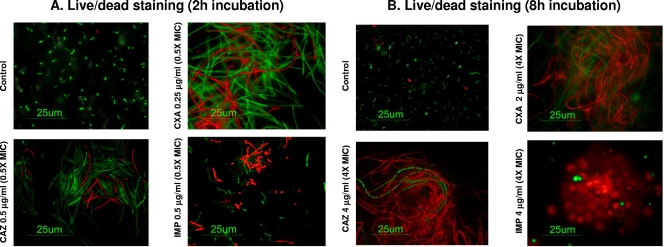
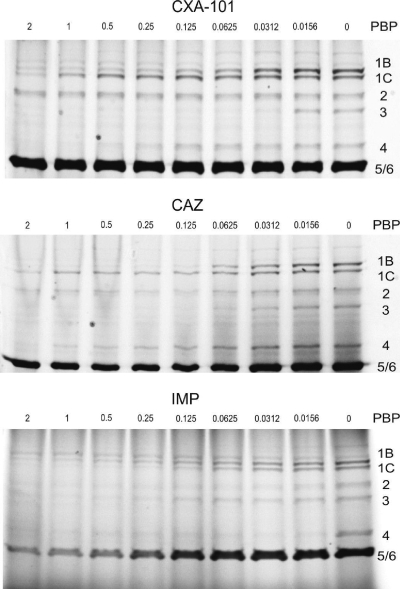
CXA-101, previously designated FR264205, is a new antipseudomonal cephalosporin. The objective of this study was to determine the penicillin-binding protein (PBP) inhibition profile of CXA-101 compared to that of ceftazidime (PBP3 inhibitor) and imipenem (PBP2 inhibitor). Killing kinetics, the induction of AmpC expression, and associated changes on cell morphology were also investigated. The MICs for CXA-101, ceftazidime, and imipenem were 0.5, 1, and 1 microg/ml, respectively. Killing curves revealed that CXA-101 shows a concentration-independent bactericidal activity, with concentrations of 1x the MIC (0.5 microg/ml) producing a > 3-log reduction in bacterial load after 8 h of incubation. Live-dead staining showed that concentrations of CXA-101 as low as 0.5x the MIC stopped bacterial septation and induced an intense filamentation, which is consistent with the documented high affinity of PBP3. CXA-101 was found to be a potent PBP3 inhibitor and showed affinities > or = 2-fold higher than those of ceftazidime for all of the essential PBPs (1b, 1c, 2, and 3). Compared to imipenem, in addition to the obvious inverse PBP2/PBP3 affinities, CXA-101 showed a significantly higher affinity for PBP1b but a lower affinity for PBP1c. Furthermore, CXA-101, like ceftazidime and in contrast to imipenem, was found to be a very weak inducer of AmpC expression, consistent with the low PBP4 affinity documented.
Figures
References
-
- Blázquez, J., J. M. Gómez-Gómez, A. Oliver, C. Juan, V. Kapur, and V. Marin. 2006. PBP3 inhibition elicits adaptive responses in Pseudomonas aeruginosa. Mol. Microbiol. 62:84-99. - PubMed
-
- Curtis, N. A., D. Orr, G. W. Ross, and M. G. Boulton. 1979. Competition of beta-lactam antibiotics for the penicillin-binding proteins of Pseudomonas aeruginosa, Enterobacter cloacae, Klebsiella aerogenes, Proteus rettgeri, and Escherichia coli: comparison with antibacterial activity and effects upon bacterial morphology. Antimicrob. Agents Chemother. 16:325-328. - PMC - PubMed
Publication types
MeSH terms
Substances
LinkOut - more resources
Full Text Sources
Other Literature Sources
Medical
Research Materials
Miscellaneous