


Proteomic identification of phosphatidylinositol (3,4,5) triphosphate-binding proteins in Dictyostelium discoideum
- PMID: 20547830
- PMCID: PMC2900710
- DOI: 10.1073/pnas.1006153107
Proteomic identification of phosphatidylinositol (3,4,5) triphosphate-binding proteins in Dictyostelium discoideum
Abstract
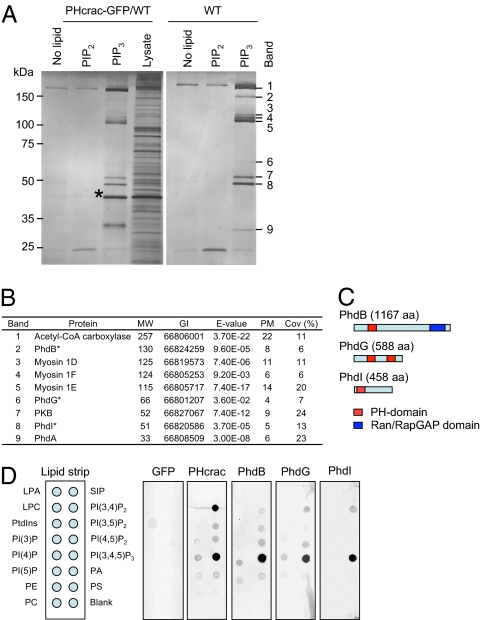
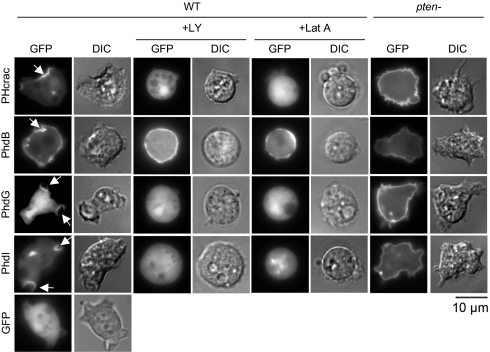
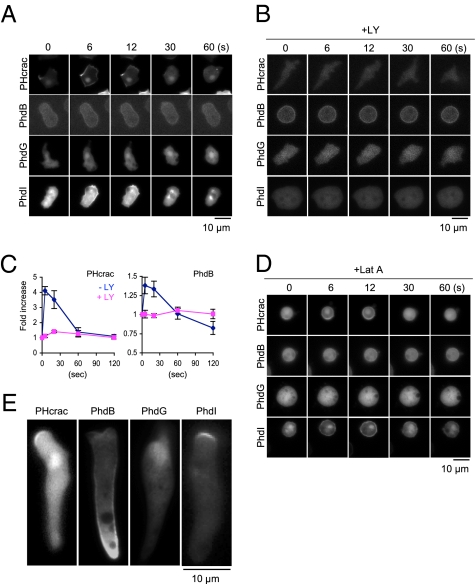
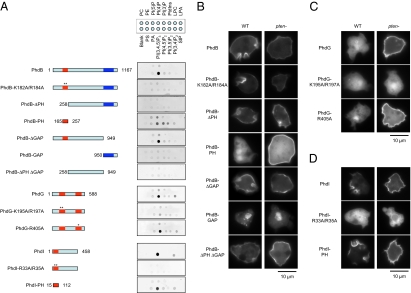
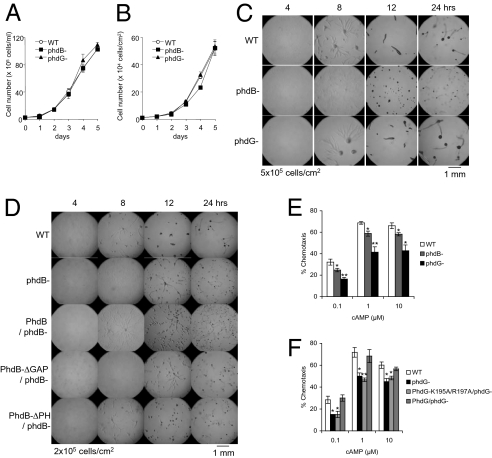
Phosphatidylinositol (3,4,5)-triphosphate (PtdInsP(3)) mediates intracellular signaling for directional sensing and pseudopod extension at the leading edge of migrating cells during chemotaxis. How this PtdInsP(3) signal is translated into remodeling of the actin cytoskeleton is poorly understood. Here, using a proteomics approach, we identified multiple PtdInsP(3)-binding proteins in Dictyostelium discoideum, including five pleckstrin homology (PH) domain-containing proteins. Two of these, the serine/threonine kinase Akt/protein kinase B and the PH domain-containing protein PhdA, were previously characterized as PtdInsP(3)-binding proteins. In addition, PhdB, PhdG, and PhdI were identified as previously undescribed PH domain-containing proteins. Specific PtdInsP(3) interactions with PhdB, PhdG, and PhdI were confirmed using an in vitro lipid-binding assay. In cells, PhdI associated with the plasma membrane in a manner dependent on both the PH domain and PtdInsP(3). Consistent with this finding, PhdI located to the leading edge in migrating cells. In contrast, PhdG was found in the cytosol in WT cells. However, when PtdInsP(3) was overproduced in pten(-) cells, PhdG located to the plasma membrane, suggesting its weak affinity for PtdInsP(3). PhdB was found to bind to the plasma membrane via both PtdInsP(3)-dependent and -independent mechanisms. The PtdInsP(3)-independent interaction was mediated by the middle domain, independent of the PH domain. In migrating cells, the majority of PhdB was found at the lagging edge. Finally, we deleted the genes encoding PhdB and PhdG and demonstrated that both proteins are required for efficient chemotaxis. Thus, this study advances our understanding of the PtdInsP(3)-mediated signaling mechanisms that control directed cell migration in chemotaxis.
Conflict of interest statement
The authors declare no conflict of interest.
Figures
References
-
- Iijima M, Huang YE, Devreotes P. Temporal and spatial regulation of chemotaxis. Dev Cell. 2002;3:469–478. - PubMed
-
- Van Haastert PJ, Devreotes PN. Chemotaxis: Signalling the way forward. Nat Rev Mol Cell Biol. 2004;5:626–634. - PubMed
-
- Fey P, Kowal AS, Gaudet P, Pilcher KE, Chisholm RL. Protocols for growth and development of Dictyostelium discoideum. Nat Protoc. 2007;2:1307–1316. - PubMed
-
- Willard SS, Devreotes PN. Signaling pathways mediating chemotaxis in the social amoeba, Dictyostelium discoideum. Eur J Cell Biol. 2006;85:897–904. - PubMed
-
- Chung CY, Firtel RA. Signaling pathways at the leading edge of chemotaxing cells. J Muscle Res Cell Motil. 2002;23:773–779. - PubMed
Publication types
MeSH terms
Substances
Grants and funding
LinkOut - more resources
Full Text Sources
Other Literature Sources
Molecular Biology Databases
Research Materials
