


Bacteria dispersal by hitchhiking on zooplankton
- PMID: 20547852
- PMCID: PMC2900670
- DOI: 10.1073/pnas.1000668107
Bacteria dispersal by hitchhiking on zooplankton
Abstract
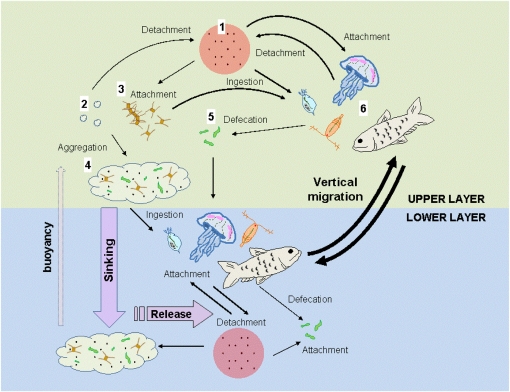
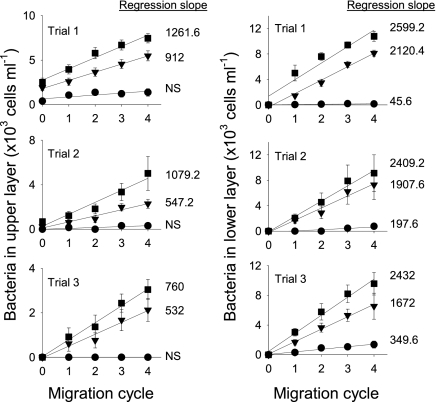
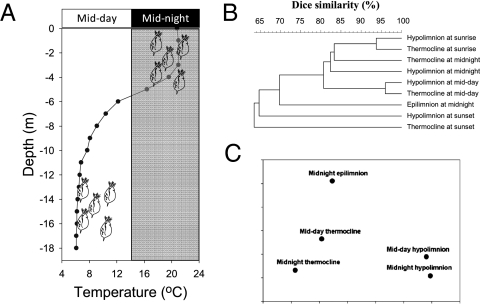
Microorganisms and zooplankton are both important components of aquatic food webs. Although both inhabit the same environment, they are often regarded as separate functional units that are indirectly connected through nutrient cycling and trophic cascade. However, research on pathogenic and nonpathogenic bacteria has shown that direct association with zooplankton has significant influences on the bacteria's physiology and ecology. We used stratified migration columns to study vertical dispersal of hitchhiking bacteria through migrating zooplankton across a density gradient that was otherwise impenetrable for bacteria in both upward and downward directions (conveyor-belt hypothesis). The strength of our experiments is to permit quantitative estimation of transport and release of associated bacteria: vertical migration of Daphnia magna yielded an average dispersal rate of 1.3 x 10(5) x cells x Daphnia(-1) x migration cycle(-1) for the lake bacterium Brevundimonas sp. Bidirectional vertical dispersal by migrating D. magna was also shown for two other bacterial species, albeit at lower rates. The prediction that diurnally migrating zooplankton acquire different attached bacterial communities from hypolimnion and epilimnion between day and night was subsequently confirmed in our field study. In mesotrophic Lake Nehmitz, D. hyalina showed pronounced diel vertical migration along with significant diurnal changes in attached bacterial community composition. These results confirm that hitchhiking on migrating animals can be an important mechanism for rapidly relocating microorganisms, including pathogens, allowing them to access otherwise inaccessible resources.
Conflict of interest statement
The authors declare no conflict of interest.
Figures
References
-
- Azam F. Microbial control of oceanic carbon flux: The plot thickens. Science. 1998;280:694–696.
-
- Baas-Becking LGM. In: Geobiological Introduction to Environmental Sciences. Van Stockum WP, Zoon NV, editors. The Hague: Diligentia Wetensch Series 18/19, Van Stockum's Gravenhange; 1934. pp. 249–254.
-
- Finlay BJ, Clarke KJ. Ubiquitous dispersal of microbial species. Nature. 1999;400:828.
-
- Finlay BJ. Global dispersal of free-living microbial eukaryote species. Science. 2002;296:1061–1063. - PubMed
-
- Fenchel T, Finlay BJ. Bacteria and island biogeography. Science. 2005;309:1997–1999. - PubMed
Publication types
MeSH terms
Substances
LinkOut - more resources
Full Text Sources
Other Literature Sources
