


Intellectual enrichment lessens the effect of brain atrophy on learning and memory in multiple sclerosis
- PMID: 20548040
- PMCID: PMC2905894
- DOI: 10.1212/WNL.0b013e3181e396be
Intellectual enrichment lessens the effect of brain atrophy on learning and memory in multiple sclerosis
Abstract
Objective: Learning and memory impairments are prevalent among persons with multiple sclerosis (MS); however, such deficits are only weakly associated with MS disease severity (brain atrophy). The cognitive reserve hypothesis states that greater lifetime intellectual enrichment lessens the negative impact of brain disease on cognition, thereby helping to explain the incomplete relationship between brain disease and cognitive status in neurologic populations. The literature on cognitive reserve has focused mainly on Alzheimer disease. The current research examines whether greater intellectual enrichment lessens the negative effect of brain atrophy on learning and memory in patients with MS.
Methods: Forty-four persons with MS completed neuropsychological measures of verbal learning and memory, and a vocabulary-based estimate of lifetime intellectual enrichment. Brain atrophy was estimated with third ventricle width measured from 3-T magnetization-prepared rapid gradient echo MRIs. Hierarchical regression was used to predict learning and memory with brain atrophy, intellectual enrichment, and the interaction between brain atrophy and intellectual enrichment.
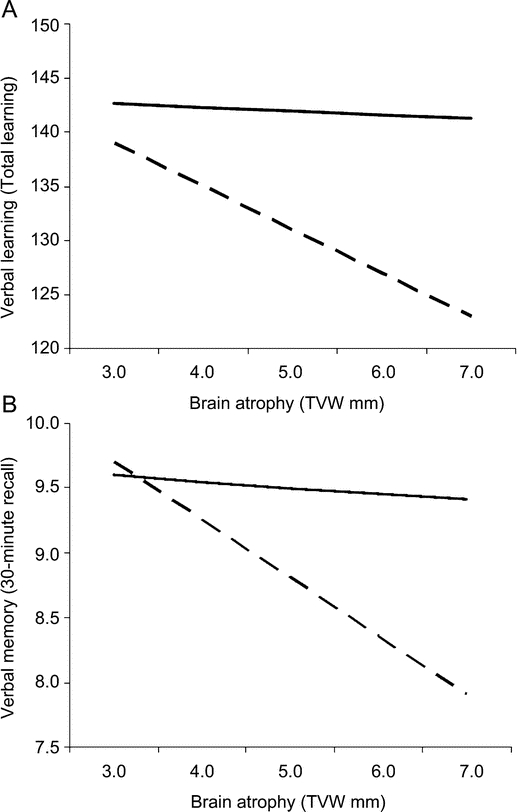
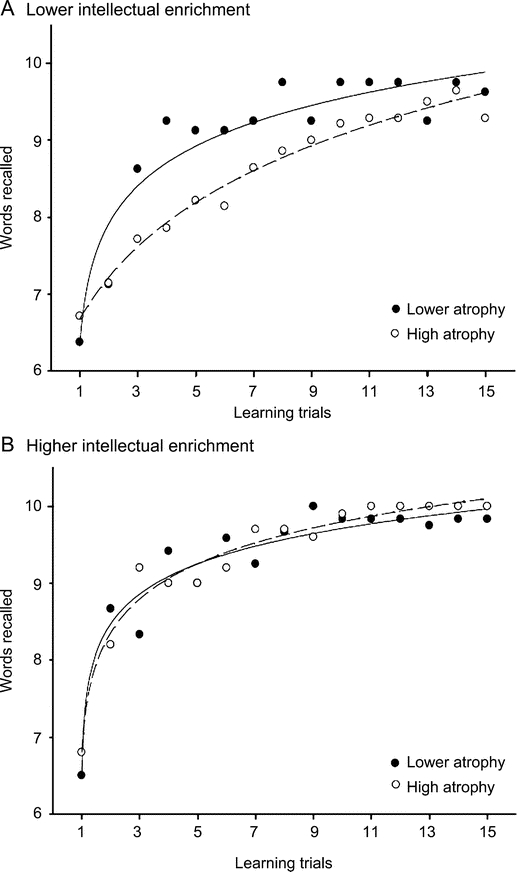
Results: Brain atrophy predicted worse learning and memory, and intellectual enrichment predicted better learning; however, these effects were moderated by interactions between brain atrophy and intellectual enrichment. Specifically, higher intellectual enrichment lessened the negative impact of brain atrophy on both learning and memory.
Conclusion: These findings help to explain the incomplete relationship between multiple sclerosis disease severity and cognition, as the effect of disease on cognition is attenuated among patients with higher intellectual enrichment. As such, intellectual enrichment is supported as a protective factor against disease-related cognitive impairment in persons with multiple sclerosis.
Figures
Comment in
-
Does cognitive reserve apply to multiple sclerosis?Neurology. 2010 Jun 15;74(24):1934-5. doi: 10.1212/WNL.0b013e3181e4fc52. Neurology. 2010. PMID: 20548039 No abstract available.
-
Intellectual enrichment lessens the effect of brain atrophy on learning and memory in multiple sclerosis.Neurology. 2011 Mar 1;76(9):847; author reply 847-8. doi: 10.1212/WNL.0b013e3182068e2a. Neurology. 2011. PMID: 21357839 No abstract available.
References
-
- Chiaravalloti ND, DeLuca J. Cognitive impairment in multiple sclerosis. Lancet Neurol 2008;7:1139–1151. - PubMed
-
- Benedict RH, Bruce JM, Dwyer MG, et al. Neocortical atrophy, third ventricular width, and cognitive dysfunction in multiple sclerosis. Arch Neurol 2006;63:1301–1306. - PubMed
-
- Benedict RH, Weinstock-Guttman B, Fishman I, Sharma J, Tjoa CW, Bakshi R. Prediction of neuropsychological impairment in multiple sclerosis: comparison of conventional magnetic resonance imaging measures of atrophy and lesion burden. Arch Neurol 2004;61:226–230. - PubMed
-
- Katzman R, Terry R, DeTeresa R, et al. Clinical, pathological, and neurochemical changes in dementia: a subgroup with preserved mental status and numerous neocortical plaques. Ann Neurol 1988;23:138–144. - PubMed
Publication types
MeSH terms
Grants and funding
LinkOut - more resources
Full Text Sources
Medical
Research Materials
