


Cognitive-behavioral therapy for psychogenic nonepileptic seizures: a pilot RCT
- PMID: 20548043
- PMCID: PMC2905892
- DOI: 10.1212/WNL.0b013e3181e39658
Cognitive-behavioral therapy for psychogenic nonepileptic seizures: a pilot RCT
Abstract
Objective: To compare cognitive-behavioral therapy (CBT) and standard medical care (SMC) as treatments for psychogenic nonepileptic seizures (PNES).
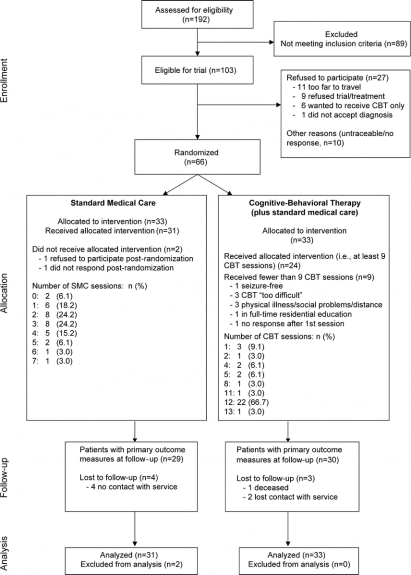
Methods: Our randomized controlled trial (RCT) compared CBT with SMC in an outpatient neuropsychiatric setting. Sixty-six PNES patients were randomized to either CBT (plus SMC) or SMC alone, scheduled to occur over 4 months. PNES diagnosis was established by video-EEG telemetry for most patients. Exclusion criteria included comorbid history of epilepsy, <2 PNES/month, and IQ <70. The primary outcome was seizure frequency at end of treatment and at 6-month follow-up. Secondary outcomes included 3 months of seizure freedom at 6-month follow-up, measures of psychosocial functioning, health service use, and employment.
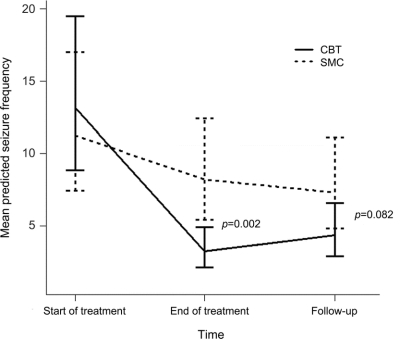
Results: In an intention-to-treat analysis, seizure reduction following CBT was superior at treatment end (group x time interaction p < 0.0001; large to medium effect sizes). At follow-up, the CBT group tended to be more likely to have experienced 3 months of seizure freedom (odds ratio 3.125, p = 0.086). Both groups improved in some health service use measures and on the Work and Social Adjustment Scale. Mood and employment status showed no change.
Conclusions: Our findings suggest that cognitive-behavioral therapy is more effective than standard medical care alone in reducing seizure frequency in PNES patients.
Classification of evidence: This study provides Class III evidence that CBT in addition to SMC, as compared to SMC alone, significantly reduces seizure frequency in patients with PNES (change in median monthly seizure frequency: baseline to 6 months follow-up, CBT group, 12 to 1.5; SMC alone group, 8 to 5).
Figures

References
-
- World Health Organisation. The ICD-10 Classification of Mental and Behavioural Disorders: Clinical Description and Diagnostic Guidelines. Geneva: World Health Organization; 1992.
-
- American Psychiatric Association. Diagnostic and Statistical Manual of Mental Disorders: DSM-IV. Washington, DC: American Psychiatric Association; 1994.
-
- Benbadis SR, Agrawal V, Tatum WO. How many patients with psychogenic nonepileptic seizures also have epilepsy? Neurology 2001;57:915–917. - PubMed
-
- Reuber M. Psychogenic nonepileptic seizures: answers and questions. Epilepsy Behav 2008;12:622–635. - PubMed
Publication types
MeSH terms
LinkOut - more resources
Full Text Sources
Other Literature Sources
Medical
Research Materials
