


Update on hypertrophic cardiomyopathy
Affiliations
- PMID: 20548812
- PMCID: PMC2879188
Item in Clipboard
Update on hypertrophic cardiomyopathy
Tex Heart Inst J.
2010.
No abstract available
Figures
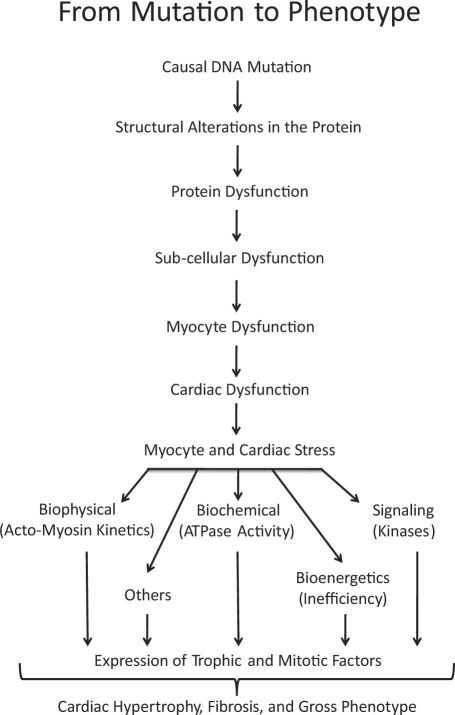
Fig. 1 Pathogenesis of hypertrophic cardiomyopathy. The causal mutations alter the structure and function of the sarcomeres and impart various stresses on cardiac myocytes (mechanical, biochemical, bioenergetic, and others). The stress leads to the activation of signaling molecules that mediate the induction of cardiac myocyte hypertrophy, fibrosis, and other aspects of the gross cardiac phenotype.
References
-
- Maron BJ. Hypertrophic cardiomyopathy: a systematic review. JAMA 2002;287(10):1308–20. - PubMed
-
- Maron BJ, Doerer JJ, Haas TS, Tierney DM, Mueller FO. Sudden deaths in young competitive athletes: analysis of 1866 deaths in the United States, 1980–2006. Circulation 2009;119 (8):1085–92. - PubMed
-
- Marian AJ. Pathogenesis of diverse clinical and pathological phenotypes in hypertrophic cardiomyopathy. Lancet 2000; 355(9197):58–60. - PubMed
MeSH terms
Substances
LinkOut - more resources
Full Text Sources