Rapid transition towards the Division of Labor via evolution of developmental plasticity
- PMID: 20548941
- PMCID: PMC2883585
- DOI: 10.1371/journal.pcbi.1000805
Rapid transition towards the Division of Labor via evolution of developmental plasticity
Abstract
A crucial step in several major evolutionary transitions is the division of labor between components of the emerging higher-level evolutionary unit. Examples include the separation of germ and soma in simple multicellular organisms, appearance of multiple cell types and organs in more complex organisms, and emergence of casts in eusocial insects. How the division of labor was achieved in the face of selfishness of lower-level units is controversial. I present a simple mathematical model describing the evolutionary emergence of the division of labor via developmental plasticity starting with a colony of undifferentiated cells and ending with completely differentiated multicellular organisms. I explore how the plausibility and the dynamics of the division of labor depend on its fitness advantage, mutation rate, costs of developmental plasticity, and the colony size. The model shows that the transition to differentiated multicellularity, which has happened many times in the history of life, can be achieved relatively easily. My approach is expandable in a number of directions including the emergence of multiple cell types, complex organs, or casts of eusocial insects.
Conflict of interest statement
The author has declared that no competing interests exist.
Figures
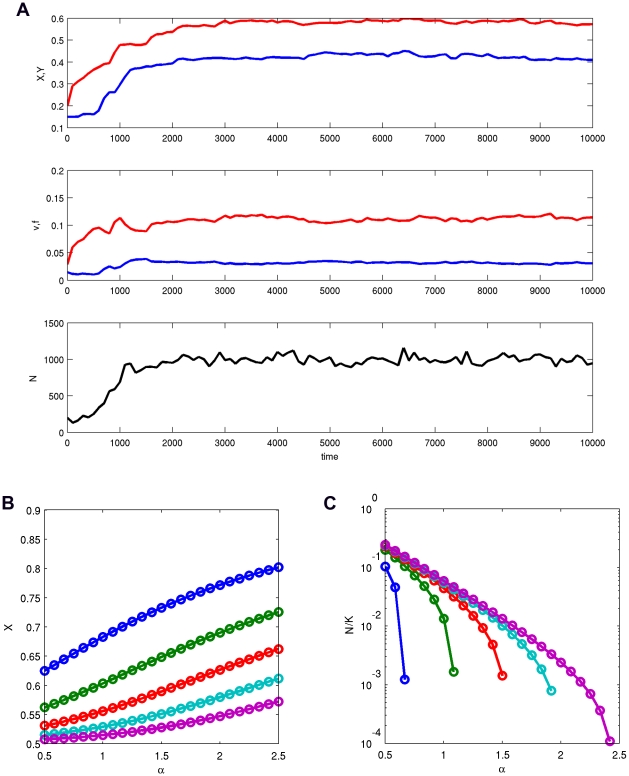
 . Shown are at top: the average values of
  (red) and
  (blue), middle: the average fertility
  (red) and viability
  (blue), and bottom: the number of colonies
  in the system. (B) The equilibrium values of
  for different
  and
and  (blue),8, 16, 32 and 64 (pink).
  , so that
  . (C) The relative equilibrium population size
  for the same values of parameters as in (b).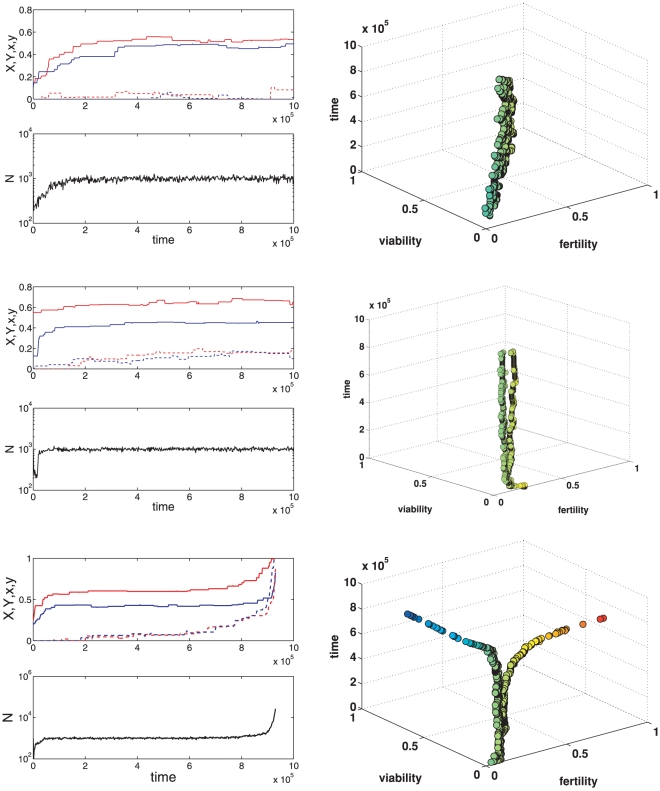
 . Second row:
  . Third row:
  .
.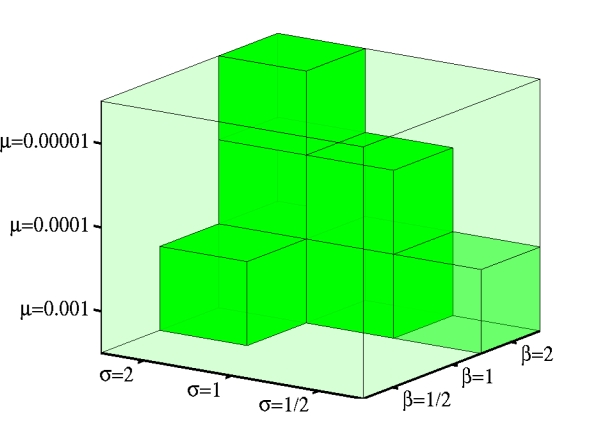
 . For
. For  , and
, and  (lightly colored subcube), the major locus effects
  and
and  evolved very close to
  but the modifier effects
  and
and  were around
  .
.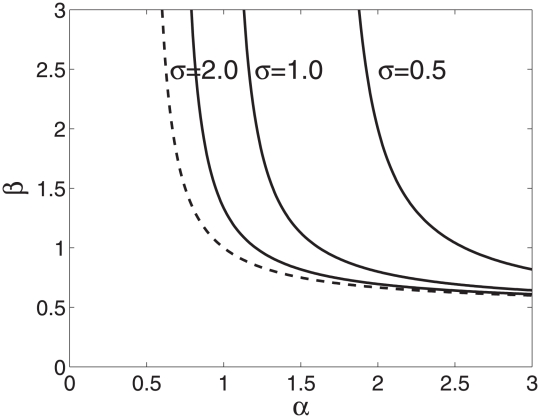
 and
and  values on the left of the corresponding curve. The dashed curve corresponds to no costs of gene supression (
 ).
).References
-
- Buss LW. The Evolution of Individuality. Princeton: Princeton University Press; 1987.
-
- Maynard Smith J, Szathmary E. The Major Transitions in Evolution. Oxford: Oxford University Press; 1998.
-
- Grosberg RK, Strathmann RR. The evolution of multicellularity: A minor major transition? Ann Rev Ecol Syst. 2007;38:621–654.
-
- Bonner JT. Dividing the labor in cells and societies. Curr Sci. 1993;64:459–466.
Publication types
MeSH terms
Grants and funding
LinkOut - more resources
Full Text Sources
Other Literature Sources