


Dose-response relationship between physical activity and dyslipidemia in youth
- PMID: 20548982
- PMCID: PMC2903992
- DOI: 10.1016/s0828-282x(10)70400-1
Dose-response relationship between physical activity and dyslipidemia in youth
Abstract
Background: The minimal and optimal amount of physical activity associated with cardiovascular health benefits in young people is unknown.
Objective: To determine the dose-response relationship between moderate-to-vigorous physical activity (MVPA) with high-risk low-density lipoprotein (LDL) cholesterol, high-density lipoprotein (HDL) cholesterol and triglyceride values in youth.
Methods: The study sample consisted of 1235 adolescents (12 to 19 years of age) from the 20032004 and 20052006 cycles of the United States National Health and Nutrition Examination Survey. Objective measures of MVPA were obtained over seven days with accelerometers. LDL cholesterol, HDL cholesterol and triglycerides were measured from a fasting blood sample. High-risk values for these lipidslipoproteins were determined using age- and sex-specific thresholds. Logistic regression models were used to determine the dose-response relationships between MVPA and high-risk lipid levels.
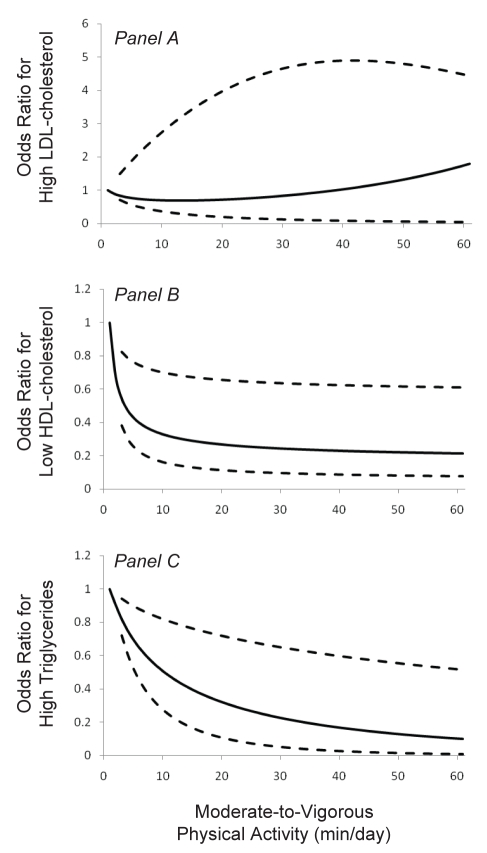
Results: ORs for high-risk HDL cholesterol and triglyceride values decreased in a curvilinear manner with increasing minutes of MVPA. Compared with no MVPA (0 min), the ORs for high-risk HDL cholesterol values at 15 min, 30 min and 60 min per day of MVPA were 0.29 (95% CI 0.13 to 0.67), 0.24 (95% CI 0.10 to 0.64) and 0.21 (95% CI 0.07 to 0.61), respectively. The corresponding ORs for high-risk triglyceride values were 0.40 (95% CI 0.18 to 0.76), 0.22 (95% CI 0.06 to 0.66) and 0.10 (95% CI 0.01 to 0.51). There was no discernible dose-response relationship between MVPA and LDL cholesterol.
Conclusions: Small amounts of MVPA were associated with a large reduction in the likelihood of having high-risk HDL cholesterol and triglyceride values in this representative sample of adolescents.
HISTORIQUE :: On ne connaît pas la quantité minimale et optimale d’activité physique qui s’associe à des bienfaits sur la santé cardiovasculaire chez les jeunes.
OBJECTIF :: Déterminer la relation dose-effet entre une activité physique modérée à vigoureuse (APMV) et les valeurs de cholestérol à lipoprotéines de basse densité (LDL), de cholestérol à lipoprotéines de haute densité (HDL) et de triglycérides chez les jeunes.
MÉTHODOLOGIE :: L’échantillon de l’étude se composait de 1 235 adolescents (de 12 à 19 ans) ayant participé aux cycles 2003–2004 et 2005–2006 de la National Health and Nutrition Examination Survey des États-Unis. Les chercheurs ont obtenu des mesures objectives de l’APMV pendant sept jours à l’aide d’accéléromètres. Ils ont mesuré le cholestérol LDL, le cholestérol HDL et les triglycérides à partir d’un échantillon de glycémie à jeun. Ils ont déterminé les valeurs à haut risque de ces lipides et lipoprotéines au moyen de seuils propres à l’âge et au sexe. Ils ont utilisé les modèles de régression logistique pour déterminer la relation dose-effet entre l’APMV et les taux de lipides à haut risque.
RÉSULTATS :: Les RRR des valeurs de cholestérol HDL et de triglycérides à haut risque ont diminué de manière curvilinéaire avec l’augmentation des minutes d’APMV. Par rapport à l’absence d’APMV (0 min), les valeurs du RRR de cholestérol HDL à haut risque en cas d’APMV 15 min, 30 min et 60 min par jour s’élevaient à 0,29 (95 % IC 0,13 à 0,67), 0,24 (95 % IC 0,10 à 0,64) et 0,21 (95 % IC 0,07 à 0,61), respectivement. Les RRR correspondant aux valeurs des triglycérides à haut risque s’élevaient à 0,40 (95 % IC 0,18 à 0,76), 0,22 (95 % IC 0,06 à 0,66) et 0,10 (95 % IC 0,01 à 0,51). Il n’y avait pas de relation dose-effet discernable entre l’APMV et le cholestérol LDL.
CONCLUSIONS :: De petites quantités d’APMV s’associaient à une importante réduction de la probabilité de présenter des valeurs de cholestérol HDL et de triglycérides à haut risque dans cet échantillon représentatif d’adolescents.
Figures
References
-
- Natural history of aortic and coronary atherosclerotic lesions in youth. Findings from the PDAY Study. Pathobiological Determinants of Atherosclerosis in Youth (PDAY) Research Group. Arterioscler Thromb. 1993;13:1291–8. - PubMed
-
- Eisemann J, Welk G, Wickel E, Blair S. Stability of variables associated with the metabolic syndrome from adolescence to adulthood: The aerobics center longitudinal study. Am J Hum Biol. 2004;16:690–6. - PubMed
-
- Bao W, Srinivasan SR, Valdez R, Greenlund KJ, Wattigney WA, Berenson GS. Longitudinal changes in cardiovascular risk from childhood to young adulthood in offspring of parents with coronary artery disease: The Bogalusa Heart Study. JAMA. 1997;278:1749–54. - PubMed
-
- Katzmarzyk PT, Malina RM, Bouchard C. Physical activity, physical fitness, and coronary heart disease risk factors in youth: The Quebec Family Study. Prev Med. 1999;29:555–62. - PubMed
-
- Guo S, Beckett L, Chumlea WC, Roche AF, Siervogel RM. Serial analysis of plasma lipids and lipoproteins from individuals 9–21 y of age. Am J Clin Nutr. 1993;58:61–7. - PubMed
Publication types
MeSH terms
Substances
Grants and funding
LinkOut - more resources
Full Text Sources
