


An enantioselective Claisen rearrangement catalyzed by N-heterocyclic carbenes
- PMID: 20550127
- PMCID: PMC2902991
- DOI: 10.1021/ja103631u
An enantioselective Claisen rearrangement catalyzed by N-heterocyclic carbenes
Abstract
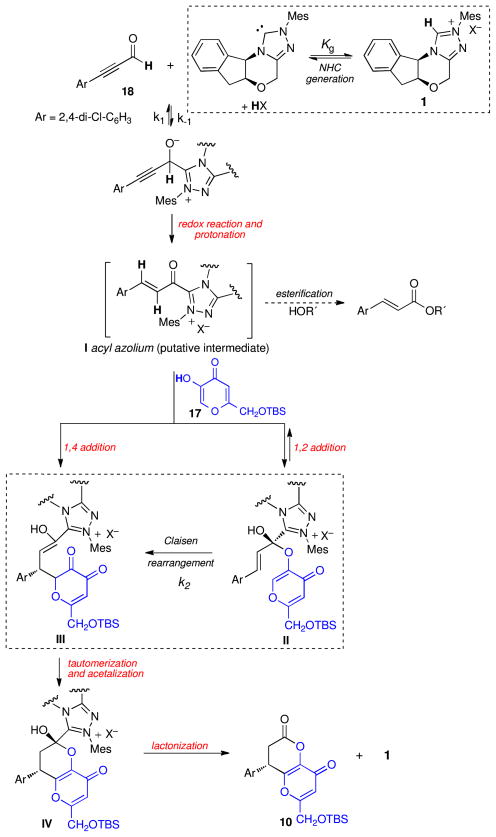
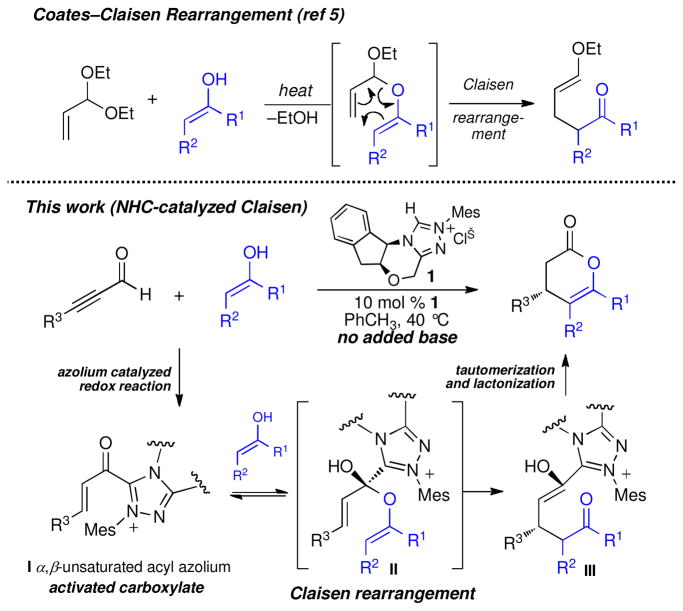
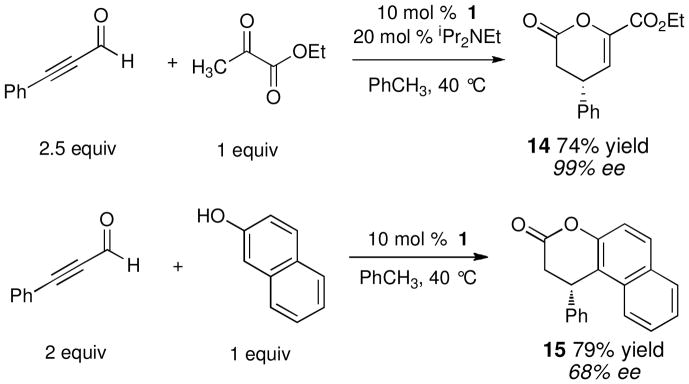
In the presence of a chiral azolium salt (10 mol %), enols and ynals undergo a highly enantioselective annulation reaction to form enantiomerically enriched dihydropyranones via an N-heterocyclic carbene catalyzed variant of the Claisen rearrangement. Unlike other azolium-catalyzed reactions, this process requires no added base to generate the putative NHC-catalyst, and our investigations demonstrate that the counterion of the azolium salt plays a key role in the formation of the catalytically active species. Detailed kinetic studies eliminate a potential 1,4-addition as the mechanistic pathway; the observed rate law and activation parameters are consistent with a Claisen rearrangement as the rate-limiting step. This catalytic system was applied to the synthesis of enantioenriched kojic acid derivatives, a reaction of demonstrated synthetic utility for which other methods for catalytic enantioselective Claisen rearrangements have not provided a satisfactory solution.
Figures
Similar articles
-
Chiral N-Heterocyclic Carbene Catalyzed Annulations of Enals and Ynals with Stable Enols: A Highly Enantioselective Coates-Claisen Rearrangement.ACS Catal. 2012;2(2):494-503. doi: 10.1021/cs300020t. Epub 2012 Feb 29. ACS Catal. 2012. PMID: 22468232 Free PMC article.
-
On the mechanism of N-heterocyclic carbene-catalyzed reactions involving acyl azoliums.Acc Chem Res. 2014 Feb 18;47(2):696-707. doi: 10.1021/ar400239v. Epub 2014 Jan 10. Acc Chem Res. 2014. PMID: 24410291
-
Kinetic resolution of 1,1'-biaryl-2,2'-diols and amino alcohols through NHC-catalyzed atroposelective acylation.Angew Chem Int Ed Engl. 2014 Oct 6;53(41):11041-5. doi: 10.1002/anie.201406192. Epub 2014 Aug 21. Angew Chem Int Ed Engl. 2014. PMID: 25145856
-
Bifunctional N-Heterocyclic Carbenes Derived from l-Pyroglutamic Acid and Their Applications in Enantioselective Organocatalysis.Acc Chem Res. 2020 Mar 17;53(3):690-702. doi: 10.1021/acs.accounts.9b00635. Epub 2020 Mar 6. Acc Chem Res. 2020. PMID: 32142245 Review.
-
N-Heterocyclic Carbene (NHC)-Catalyzed Transformations Involving Azolium Enolates.Chem Rec. 2022 Aug;22(8):e202200054. doi: 10.1002/tcr.202200054. Epub 2022 May 13. Chem Rec. 2022. PMID: 35562645 Review.
Cited by
-
Oxyanion steering and CH-π interactions as key elements in an N-heterocyclic carbene-catalyzed [4 + 2] cycloaddition.J Am Chem Soc. 2012 Jul 25;134(29):12098-103. doi: 10.1021/ja302761d. Epub 2012 Jul 16. J Am Chem Soc. 2012. PMID: 22765294 Free PMC article.
-
Catalytic asymmetric Claisen rearrangement of enolphosphonates: construction of vicinal tertiary and all-carbon quaternary centers.Angew Chem Int Ed Engl. 2012 Aug 13;51(33):8264-7. doi: 10.1002/anie.201203092. Epub 2012 Jul 23. Angew Chem Int Ed Engl. 2012. PMID: 22821885 Free PMC article.
-
A tandem dearomatization/rearomatization strategy: enantioselective N-heterocyclic carbene-catalyzed α-arylation.Chem Sci. 2018 Dec 27;10(8):2501-2506. doi: 10.1039/c8sc04601h. eCollection 2019 Feb 28. Chem Sci. 2018. PMID: 30881680 Free PMC article.
-
A continuum of progress: applications of N-hetereocyclic carbene catalysis in total synthesis.Angew Chem Int Ed Engl. 2012 Nov 19;51(47):11686-98. doi: 10.1002/anie.201203704. Epub 2012 Oct 16. Angew Chem Int Ed Engl. 2012. PMID: 23074146 Free PMC article. Review.
-
Asymmetric catalytic [1,3]- or [3,3]-sigmatropic rearrangement of 3-allyloxy-4H-chromenones and their analogues.Chem Sci. 2024 Jun 19;15(28):11005-11012. doi: 10.1039/d4sc02201g. eCollection 2024 Jul 17. Chem Sci. 2024. PMID: 39027306 Free PMC article.
References
-
- Ito H, Taguchi T. Chem Soc Rev. 1999;28:43–50.
- Hiersemann M, Abraham L. Eur J Org Chem. 2002;9:1461–1471.
- Hiersemann M, Nubbemeyer U, editors. The Claisen Rearrangment. Wiley-VCH; Weinheim, Germany: 2007.
-
- Maruoka K, Banno H, Yamamoto H. J Am Chem Soc. 1990;112:7791–7793.
- Yoon TP, MacMillan DWC. J Am Chem Soc. 2001;123:2911–2912. - PubMed
-
- Abraham L, Czerwonka R, Hiersemann M. Angew Chem, Int Ed. 2001;40:4700–4703. - PubMed
-
- Coates RM, Shah SK, Mason RW. J Am Chem Soc. 1982;104:2198–2208.
- Coates RM, Hobbes SJ. J Org Chem. 1984;49:140–152.
- Coates RM, Rogers BD, Hobbs SJ, Peck DR, Curran DP. J Am Chem Soc. 1987;109:1160–1170.
Publication types
MeSH terms
Substances
Grants and funding
LinkOut - more resources
Full Text Sources
