. 2010 Jun 15:5:37.
doi: 10.1186/1749-799X-5-37.

Transcriptional regulation of bone formation by the osteoblast-specific transcription factor Osx

Affiliations

Transcriptional regulation of bone formation by the osteoblast-specific transcription factor Osx

Chi Zhang. J Orthop Surg Res. .

Abstract

Bone formation is a complex developmental process involving the differentiation of mesenchymal stem cells to osteoblasts. Osteoblast differentiation occurs through a multi-step molecular pathway regulated by different transcription factors and signaling proteins. Osx (also known as Sp7) is the only osteoblast-specific transcriptional factor identified so far which is required for osteoblast differentiation and bone formation. Osx knock-out mice lack bone completely and cartilage is normal. This opens a new window to the whole research field of bone formation. Osx inhibits Wnt pathway signaling, a possible mechanism for Osx to inhibit osteoblast proliferation. These reports demonstrate that Osx is the master gene that controls osteoblast lineage commitment and the subsequent osteoblast proliferation and differentiation. This review is to highlight recent progress in understanding the molecular mechanisms of transcriptional regulation of bone formation by Osx.


Figures
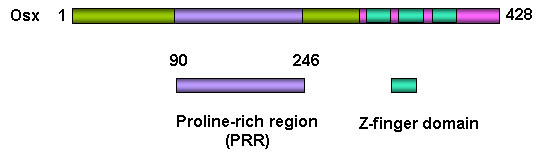
Figure1
Figure1
Domain structure of osteoblast-specific transcription factor Osx. The DNA-binding domain of Osx is located at its C terminus containing three Z-finger domains and there is a proline-rich region (PRR) close to N terminus in Osx.
Figure2
Figure2
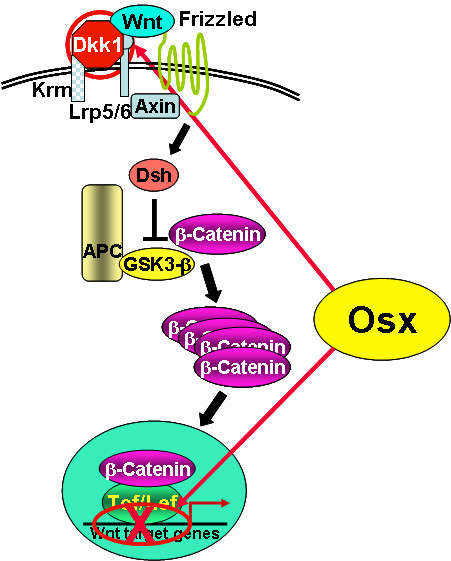
Model of mechanisms of the Osx inhibitory effect on Wnt pathway. Osx negatively controls Wnt pathway by two different mechanisms: activates the expression of Wnt antagonist Dkk1 and disrupts Tcf binding to DNA to inhibit the transcriptional activity of β-catenin/Tcf.
Figure3
Figure3
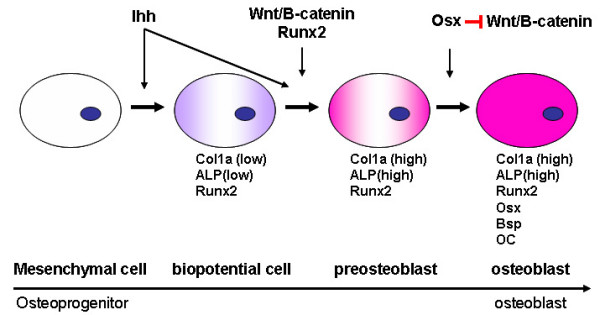
The proposed model of coordinated regulation of osteoblast differentiation and proliferation during bone formation by Osx and Wnt/β-catenin signaling. Ihh is the initiator of endochondral ossification. The Runx2-expressing biopotential progenitors can differentiate into either osteoblast or chondrocyte. Then cells differentiate into preosteoblasts, in which Runx2 play an essential role. In the next step, preosteoblasts differentiate into mature osteoblast, a process in which Osx plays a critical role. Wnt/β-catenin signaling has an essential role in osteoblast differentiation and osteoblast proliferation. The inhibition of Wnt/β-catenin signaling activity by Osx constitutes a possible mechanism for the inhibition by Osx of osteoblast proliferation.

References

    1. St-Jacques B, Hammerschmidt M, McMahon AP. Indian hedgehog signaling regulates proliferation and differentiation of chondrocytes and is essential for bone formation. Genes Dev. 1999;13:2072–2086. doi: 10.1101/gad.13.16.2072. - DOI - PMC - PubMed
    1. Komori T, Yagi H, Nomura S, Yamaguchi A, Sasaki K, Deguchi K, Shimizu Y, Bronson RT, Gao YH, Inada M, Sato M, Okamoto R, Kitamura Y, Yoshiki S, Kishimoto T. Targeted disruption of Cbfa1 results in a complete lack of bone formation owing to maturational arrest of osteoblasts. Cell. 1997;89:755–764. doi: 10.1016/S0092-8674(00)80258-5. - DOI - PubMed
    1. Nakashima K, Zhou X, Kunkel G, Zhang Z, Deng JM, Behringer RR, de Crombrugghe B. The novel zinc finger-containing transcription factor osterix is required for osteoblast differentiation and bone formation. Cell. 2002;108:17–29. doi: 10.1016/S0092-8674(01)00622-5. - DOI - PubMed
    1. Day TF, Guo X, Garrett-Beal L, Yang Y. Wnt/beta-catenin signaling in mesenchymal progenitors controls osteoblast and chondrocyte differentiation during vertebrate skeletogenesis. Dev Cell. 2005;8:739–750. doi: 10.1016/j.devcel.2005.03.016. - DOI - PubMed
    1. Hill TP, Spater D, Taketo MM, Birchmeier W, Hartmann C. Canonical Wnt/beta-catenin signaling prevents osteoblasts from differentiating into chondrocytes. Dev Cell. 2005;8:727–738. doi: 10.1016/j.devcel.2005.02.013. - DOI - PubMed

LinkOut - more resources