


Exercise and the Prevention of Oesophageal Cancer (EPOC) study protocol: a randomized controlled trial of exercise versus stretching in males with Barrett's oesophagus
- PMID: 20550712
- PMCID: PMC2903528
- DOI: 10.1186/1471-2407-10-292
Exercise and the Prevention of Oesophageal Cancer (EPOC) study protocol: a randomized controlled trial of exercise versus stretching in males with Barrett's oesophagus
Abstract
Background: Chronic gastro-oesophageal reflux disease and excessive body fat are considered principal causes of Barrett's oesophagus (a metaplastic change in the cells lining the oesophagus) and its neoplastic progression, oesophageal adenocarcinoma. Metabolic disturbances including altered levels of obesity-related cytokines, chronic inflammation and insulin resistance have also been associated with oesophageal cancer development, especially in males. Physical activity may have the potential to abrogate metabolic disturbances in males with Barrett's oesophagus and elicit beneficial reductions in body fat and gastro-oesophageal reflux symptoms. Thus, exercise may be an effective intervention in reducing oesophageal adenocarcinoma risk. However, to date this hypothesis remains untested.The 'Exercise and the Prevention of Oesophageal Cancer Study' will determine whether 24 weeks of exercise training will lead to alterations in risk factors or biomarkers for oesophageal adenocarcinoma in males with Barrett's oesophagus. Our primary outcomes are serum concentrations of leptin, adiponectin, tumour necrosis factor-alpha, C-reactive protein and interleukin-6 as well as insulin resistance. Body composition, gastro-oesophageal reflux disease symptoms, cardiovascular fitness and muscular strength will also be assessed as secondary outcomes.
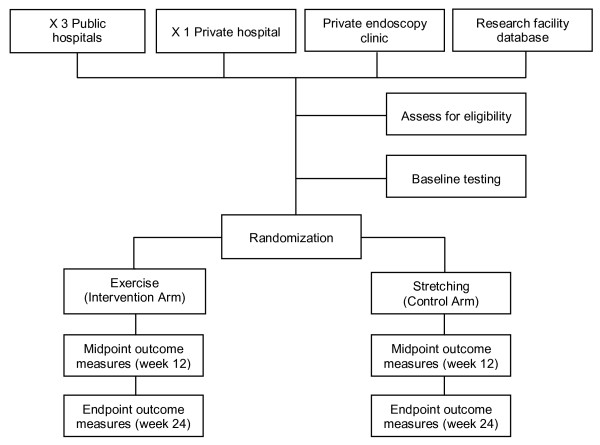
Methods/design: A randomized controlled trial of 80 overweight or obese, inactive males with Barrett's oesophagus will be conducted in Brisbane, Australia. Participants will be randomized to an intervention arm (60 minutes of moderate-intensity aerobic and resistance training, five days per week) or a control arm (45 minutes of stretching, five days per week) for 24 weeks. Primary and secondary endpoints will be measured at baseline (week 0), midpoint (week 12) and at the end of the intervention (week 24).
Discussion: Due to the increasing incidence and very high mortality associated with oesophageal adenocarcinoma, interventions effective in preventing the progression of Barrett's oesophagus are urgently needed. We propose that exercise may be successful in reducing oesophageal adenocarcinoma risk. This primary prevention trial will also provide information on whether the protective association between physical activity and cancer is causal.
Trial registration: ACTRN12609000401257.
Figures

Similar articles
-
The feasibility of an exercise intervention in males at risk of oesophageal adenocarcinoma: a randomized controlled trial.PLoS One. 2015 Feb 23;10(2):e0117922. doi: 10.1371/journal.pone.0117922. eCollection 2015. PLoS One. 2015. PMID: 25706622 Free PMC article. Clinical Trial.
-
Dietary factors and the risks of oesophageal adenocarcinoma and Barrett's oesophagus.Nutr Res Rev. 2010 Dec;23(2):230-46. doi: 10.1017/S0954422410000132. Epub 2010 Jul 13. Nutr Res Rev. 2010. PMID: 20624335 Free PMC article. Review.
-
Diagnosis and treatment of Barrett's oesophagus. A general survey.Acta Chir Belg. 2001 Mar-Apr;101(2):53-8. Acta Chir Belg. 2001. PMID: 11396051 Review.
-
National Institute for Health and Care Excellence (NICE) guidance on monitoring and management of Barrett's oesophagus and stage I oesophageal adenocarcinoma.Gut. 2024 May 10;73(6):897-909. doi: 10.1136/gutjnl-2023-331557. Gut. 2024. PMID: 38553042 Free PMC article.
-
Barrett's oesophagus: Current controversies.World J Gastroenterol. 2017 Jul 28;23(28):5051-5067. doi: 10.3748/wjg.v23.i28.5051. World J Gastroenterol. 2017. PMID: 28811703 Free PMC article. Review.
Cited by
-
The feasibility of an exercise intervention in males at risk of oesophageal adenocarcinoma: a randomized controlled trial.PLoS One. 2015 Feb 23;10(2):e0117922. doi: 10.1371/journal.pone.0117922. eCollection 2015. PLoS One. 2015. PMID: 25706622 Free PMC article. Clinical Trial.
-
Visceral Obesity, Metabolic Syndrome, and Esophageal Adenocarcinoma.Front Oncol. 2021 Mar 12;11:627270. doi: 10.3389/fonc.2021.627270. eCollection 2021. Front Oncol. 2021. PMID: 33777773 Free PMC article. Review.
-
Association between markers of obesity and progression from Barrett's esophagus to esophageal adenocarcinoma.Clin Gastroenterol Hepatol. 2013 Aug;11(8):934-43. doi: 10.1016/j.cgh.2013.02.017. Epub 2013 Mar 1. Clin Gastroenterol Hepatol. 2013. PMID: 23466711 Free PMC article.
-
Physical activity is associated with reduced risk of esophageal cancer, particularly esophageal adenocarcinoma: a systematic review and meta-analysis.BMC Gastroenterol. 2014 May 30;14:101. doi: 10.1186/1471-230X-14-101. BMC Gastroenterol. 2014. PMID: 24886123 Free PMC article.
-
Energy balance and gastrointestinal cancer: risk, interventions, outcomes and mechanisms.Nat Rev Gastroenterol Hepatol. 2018 Nov;15(11):683-698. doi: 10.1038/s41575-018-0053-2. Nat Rev Gastroenterol Hepatol. 2018. PMID: 30158569 Free PMC article. Review.
References
Publication types
MeSH terms
Substances
LinkOut - more resources
Full Text Sources
Medical
Research Materials
