. 2010 Jun 29;107(26):12040-5.
doi: 10.1073/pnas.0914149107. Epub 2010 Jun 15.

A distinct type of glycerol-3-phosphate acyltransferase with sn-2 preference and phosphatase activity producing 2-monoacylglycerol

Affiliations

A distinct type of glycerol-3-phosphate acyltransferase with sn-2 preference and phosphatase activity producing 2-monoacylglycerol

Weili Yang et al. Proc Natl Acad Sci U S A. .

Abstract

The first step in assembly of membrane and storage glycerolipids is acylation of glycerol-3-phosphate (G3P). All previously characterized membrane-bound, eukaryotic G3P acyltransferases (GPATs) acylate the sn-1 position to produce lysophosphatidic acid (1-acyl-LPA). Cutin is a glycerolipid with omega-oxidized fatty acids and glycerol as integral components. It occurs as an extracellular polyester on the aerial surface of all plants, provides a barrier to pathogens and resistance to stress, and maintains organ identity. We have determined that Arabidopsis acyltransferases GPAT4 and GPAT6 required for cutin biosynthesis esterify acyl groups predominantly to the sn-2 position of G3P. In addition, these acyltransferases possess a phosphatase domain that results in sn-2 monoacylglycerol (2-MAG) rather than LPA as the major product. Such bifunctional activity has not been previously described in any organism. The possible roles of 2-MAGs as intermediates in cutin synthesis are discussed. GPAT5, which is essential for the accumulation of suberin aliphatics, also exhibits a strong preference for sn-2 acylation. However, phosphatase activity is absent and 2-acyl-LPA is the major product. Clearly, plant GPATs can catalyze more reactions than the sn-1 acylation by which they are currently categorized. Close homologs of GPAT4-6 are present in all land plants, but not in animals, fungi or microorganisms (including algae). Thus, these distinctive acyltransferases may have been important for evolution of extracellular glycerolipid polymers and adaptation of plants to a terrestrial environment. These results provide insight into the biosynthetic assembly of cutin and suberin, the two most abundant glycerolipid polymers in nature.


Conflict of interest statement

The authors declare no conflict of interest.

Figures
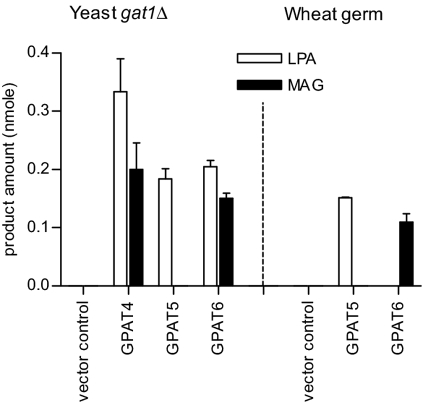
Fig. 1.
Fig. 1.
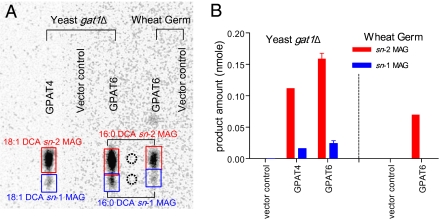
Product distribution of GPAT assays in either GPAT-transformed yeast (gat1Δ) microsomes or wheat germ cell-free translation system. GPAT assays were conducted using 14C-G3P and DCA-CoA substrates as described under Methods. C18:1/22:0/16:0 DCA-CoAs were acyl donors for GPAT4/5/6 assays, respectively, with empty vector as control. Products (nmol) were LPA and MAG. Values are mean ± SD (n = 3) for yeast assays, and duplicates were done in wheat germ system (error bars represent range).
Fig. 2.
Fig. 2.
Regiospecificity of DCA-MAGs formed in GPAT4 and GPAT6 assays. GPAT assays were conducted using 14C-G3P and DCA-CoA substrates as described under Methods. (A) Separation of MAGs by borate-TLC (solvent system, chloroform:acetone 1:1). GPAT4 assay was performed in yeast system with C18:1 DCA-CoA as acyl donor. GPAT6 was assayed in both yeast and wheat germ systems with C16:0 DCA-CoA as acyl donor. MAGs were identified by comigration with C18:1 DCA sn-1 and sn-2 MAG standards (dotted circle). (B) Quantification of GPAT products. Values are mean ± SD (n = 3) for GPAT6 yeast assays. DCA sn-2 MAGs predominate over sn-1 MAGs in both GPAT4 and GPAT6 assays.
Fig. 3.
Fig. 3.
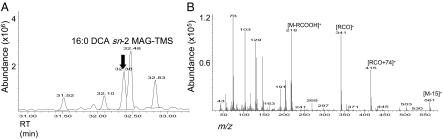
Identification of C16:0 DCA sn-2 MAG from GPAT6 assay by GC-MS. GPAT6 assay product C16:0 DCA sn-2 MAG was isolated and identified as described under Methods and SI Appendix, SI Methods. (A) GC chromatogram of TLC fraction containing C16:0 DCA sn-2 MAG. (B) Corresponding EI-MS spectrum of C16:0 DCA sn-2 MAG-Tris-trimethylsilyl derivative (peak at 32.38 min). See SI Appendix, Fig. S3 for spectrum of standard.
Fig. 4.
Fig. 4.
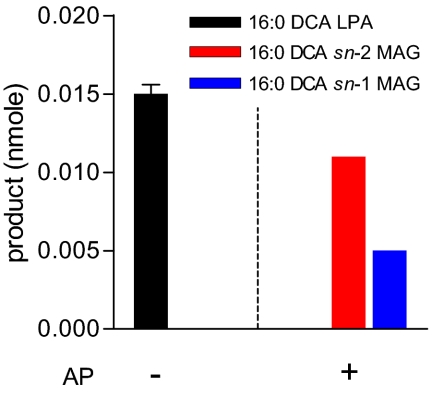
Positional analysis of GPAT5 assay product C16:0 DCA-LPA. GPAT assays were conducted using 14C-G3P and C16:0 DCA-CoA as substrates. Immediately after assay, the reaction mixture was either directly spotted onto TLC plate to separate and quantify labeled LPA, or incubated with 0.25 unit of alkaline phosphatase (AP) before TLC analysis. The resulting MAGs were separated on borate-TLC and identified by comparison with C18:1 DCA sn-1 and sn-2 MAG standards. Products quantification was performed as described under Methods. Values are mean ± SD (n = 3) for GPAT5 yeast assays without AP treatment.
Fig. 5.
Fig. 5.
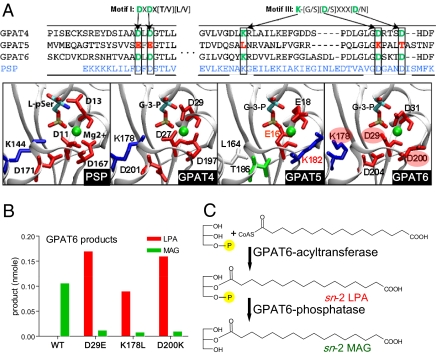
Site-directed mutagenesis analysis of GPAT6. (A) Sequence alignment of GPAT4, -5, and -6 with MJ-PSP and active-site close-up for MJ-PSP and predicted structures of N-terminal domain of GPAT4, -5, and -6. The critical amino acid residues required for PSP activity in motif I and III are labeled with arrows. Those amino acid residues are conserved in GPAT4 and GPAT6, but not in GPAT5. MJ-PSP structure from 1F5S is shown with L-phosphoserine ligand from MJ-PSP-ligand complex from Protein Data Bank structure 1L7P. The GPAT models shown were generated in the absence of any ligand but are shown with G3P aligned in active site. Acidic residues are shown in red, basic residues in blue, polar residues in green, and nonpolar residues in white. Mg2+ is shown in green. (B) Product distribution of GPAT6 assay in wheat germ translation system. Assays were conducted using 14C-G3P and C16:0 DCA-CoA as the substrates for three GPAT6 single mutants (D29E, K178L, or D200K) and GPAT6-WT control. Products (nmol) were predominantly sn-2 MAG for GPAT6-WT, whereas sn-2 LPA is the major product of GPAT6-phosphatase mutants (see SI Appendix, Fig. S9 for regiospecific data).Values are duplicates, error bars represent range. (C) Reactions catalyzed by the bifunctional enzyme GPAT6 to produce sn-2 MAG.

References

    1. Wendel AA, Lewin TM, Coleman RA. Glycerol-3-phosphate acyltransferases: Rate limiting enzymes of triacylglycerol biosynthesis. Biochim Biophys Acta. 2009;1791:501–506. - PMC - PubMed
    1. Zhang YM, Rock CO. Acyltransferases in bacterial glycerophospholipid synthesis. J Lipid Res. 2008;49:1867–1874. - PMC - PubMed
    1. Gimeno RE, Cao J. Mammalian glycerol-3-phosphate acyltransferases: New genes for an old activity. J Lipid Res. 2008;49:2079–2088. - PubMed
    1. Zheng Z, Zou J. The initial step of the glycerolipid pathway: Identification of glycerol 3-phosphate/dihydroxyacetone phosphate dual substrate acyltransferases in Saccharomyces cerevisiae. J Biol Chem. 2001;276:41710–41716. - PubMed
    1. Murata N, Tasaka Y. Glycerol-3-phosphate acyltransferase in plants. Biochim Biophys Acta. 1997;1348:10–16. - PubMed

Publication types

MeSH terms