


Attitudes and cardiovascular disease
- PMID: 20554132
- PMCID: PMC2943009
- DOI: 10.1016/j.maturitas.2010.04.020
Attitudes and cardiovascular disease
Abstract
Psychological attitudes are prospectively related to cardiovascular disease (CVD), but a causal relationship has not been demonstrated. Trait optimism/pessimism (positive or negative future expectation, respectively), and cynical hostility (mistrust of people), are attitudes with features of personality traits. These attitudes may affect CVD risk in several ways, by influencing an individual's (1) adoption of health behaviors, (2) maladaptive stress responding resulting in direct alteration of physiology (i.e., autonomic dysfunction, thrombosis, arrhythmias), (3) development of traditional CVD risk factors, and (4) lack of adherence to therapy in both primary and secondary prevention. More adaptive attitudes may favorably influence CVD risk at each of these critical junctures. The genetic and environmental (i.e., social, economic, racial/ethnic) determinants of attitudes have not been extensively studied. In addition, it is important to understand how some of these environmental determinants may also moderate the association between attitudes and CVD. Clinical trials to modify attitudes for CVD risk reduction (either by reducing negative attitudes or by increasing positive attitudes) are difficult to conduct, but are necessary to determine whether attitudes can indeed be modified, and if, so, to quantify any CVD-related benefits. To address these questions we present a broad, multidisciplinary research agenda utilizing mixed methods and integrating principles of epidemiology, genetics, psychophysiology, and behavioral medicine over the lifecourse (first figure). This overview focuses on attitudes and CVD, but has broader implications for understanding how psychological factors relate to chronic diseases of adulthood.
Copyright © 2010 Elsevier Ireland Ltd. All rights reserved.
Conflict of interest statement
The authors report no conflicts of interest.
Figures
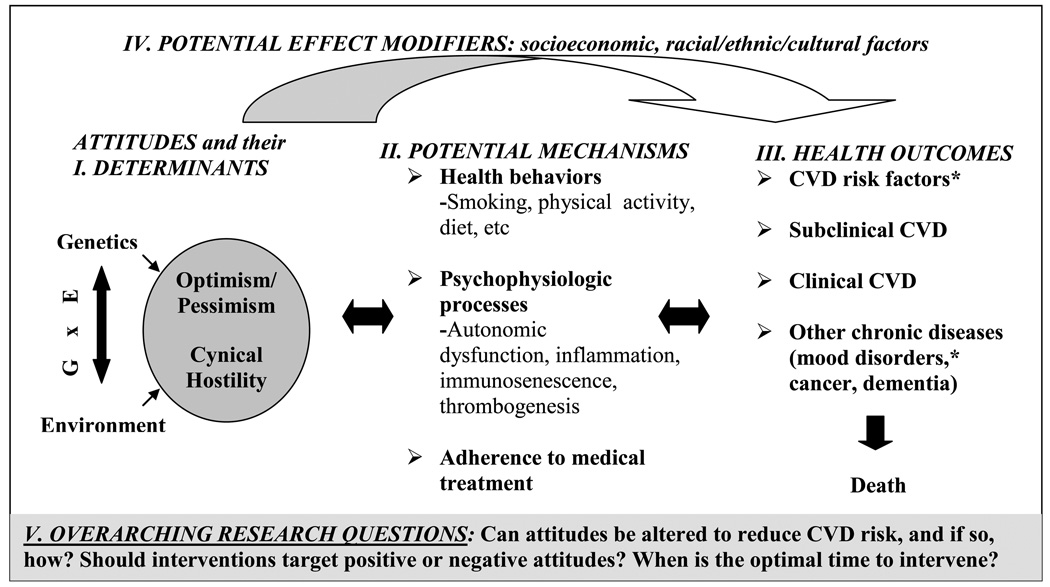
*Note that some factors, such as traditional CVD risk factors and mood disorders (e.g., depression), are included under “Health Outcomes” but may also be in the causal pathway between attitudes and disease.
Bidirectional arrows between sections underscore the potential for bidirectional relationships between attitudes, intermediate factors, and clinical disease.
References
-
- Rozanski A, Blumenthal JA, Kaplan J. Impact of psychological factors on the pathogenesis of cardiovascular disease and implications for therapy. Circulation. 1999 Apr 27;99(16):2192–2217. - PubMed
-
- Rozanski A, Blumenthal JA, Davidson KW, Saab PG, Kubzansky L. The epidemiology, pathophysiology, and management of psychosocial risk factors in cardiac practice: the emerging field of behavioral cardiology. J Am Coll Cardiol. 2005 Mar 1;45(5):637–651. - PubMed
-
- Matthews KA. Psychological perspectives on the development of coronary heart disease. Am Psychol. 2005 Nov;60(8):783–796. - PubMed
-
- Chida Y, Steptoe A. The Association of Anger and Hostility With Future Coronary Heart Disease: A Meta-Analytic Review of Prospective Evidence. J Am Coll Cardiol. 2009;53(11):936–946. - PubMed
-
- Chida Y, Hamer M, Wardle J, Steptoe A. Do stress-related psychosocial factors contribute to cancer incidence and survival? Nature clinical practice Oncology. 2008 Aug;5(8):466–475. - PubMed
Publication types
MeSH terms
Grants and funding
LinkOut - more resources
Full Text Sources
Molecular Biology Databases
