


Corticosterone, testosterone and life-history strategies of birds
- PMID: 20554550
- PMCID: PMC2982062
- DOI: 10.1098/rspb.2010.0673
Corticosterone, testosterone and life-history strategies of birds
Abstract
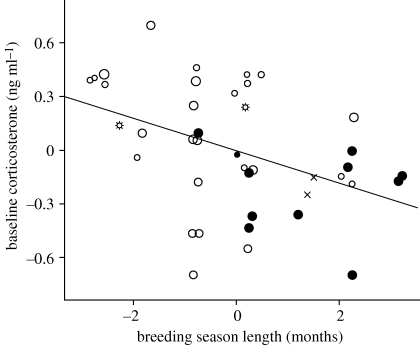
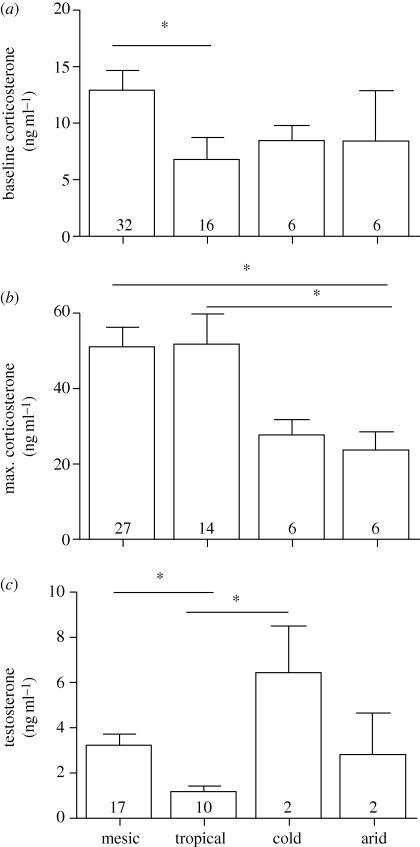
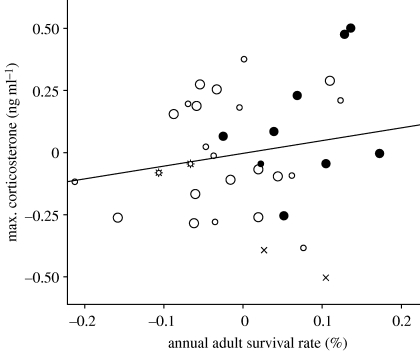
Steroid hormones have similar functions across vertebrates, but circulating concentrations can vary dramatically among species. We examined the hypothesis that variation in titres of corticosterone (Cort) and testosterone (T) is related to life-history traits of avian species. We predicted that Cort would reach higher levels under stress in species with higher annual adult survival rates since Cort is thought to promote physiological and behavioural responses that reduce risk to the individual. Conversely, we predicted that peak T during the breeding season would be higher in short-lived species with high mating effort as this hormone is known to promote male fecundity traits. We quantified circulating hormone concentrations and key life-history traits (annual adult survival rate, breeding season length, body mass) in males of free-living bird species during the breeding season at a temperate site (northern USA) and a tropical site (central Panama). We analysed our original data by themselves, and also combined with published data on passerine birds to enhance sample size. In both approaches, variation in baseline Cort (Cort0) among species was inversely related to breeding season length and body mass. Stress-induced corticosterone (MaxCort) also varied inversely with body mass and, as predicted, also varied positively with annual adult survival rates. Furthermore, species from drier and colder environments exhibited lower MaxCort than mesic and tropical species; T was lowest in species from tropical environments. These findings suggest that Cort0, MaxCort and T modulate key vertebrate life-history responses to the environment, with Cort0 supporting energetically demanding processes, MaxCort promoting survival and T being related to mating success.
Figures
References
-
- Balthazart J., Hendrick J. C.1979Relationships between the daily variations of social behavior and of plasma FSH, LH and testosterone levels in the domestic duck Anas platyrhynchos L. Behav. Proc. 4, 107–128 (doi:10.1016/0376-6357(79)90027-5) - DOI - PubMed
-
- Bókony V., Lendvai A. Z., Liker A., Angelier F., Wingfield J. C., Chastel O.2009Stress response and the value of reproduction: are birds prudent parents? Am. Nat. 173, 589–598 (doi:10.1086/597610) - DOI - PubMed
-
- Brawn J. D., Karr J. R., Nichols J. D., Robinson W. D.1999Demography of tropical forest birds in Panama: how do transients affect estimates of survival rates? Proc. Int. Ornithol. Conf. 22, 297–305
-
- Breuner C. W., Greenberg A. L., Wingfield J. C.1998Noninvasive corticosterone treatment rapidly increases activity in Gambel's white-crowned sparrows (Zonotrichia leucophrys gambelii). Gen. Comp. Endocrinol. 111, 386–394 (doi:10.1006/gcen.1998.7128) - DOI - PubMed
-
- Buchanan K. L., Evans M. R., Goldsmith A. R.2003Testosterone, dominance signalling and immunosuppression in the house sparrow, Passer domesticus. Behav. Ecol. Sociobiol. 55, 50–59 (doi:10.1007/s00265-003-0682-4) - DOI
Publication types
MeSH terms
Substances
LinkOut - more resources
Full Text Sources
