


Short signalling distances make plant communication a soliloquy
- PMID: 20554558
- PMCID: PMC3001381
- DOI: 10.1098/rsbl.2010.0440
Short signalling distances make plant communication a soliloquy
Abstract
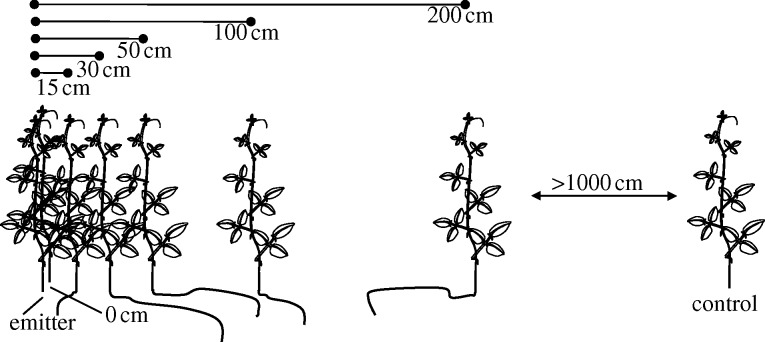
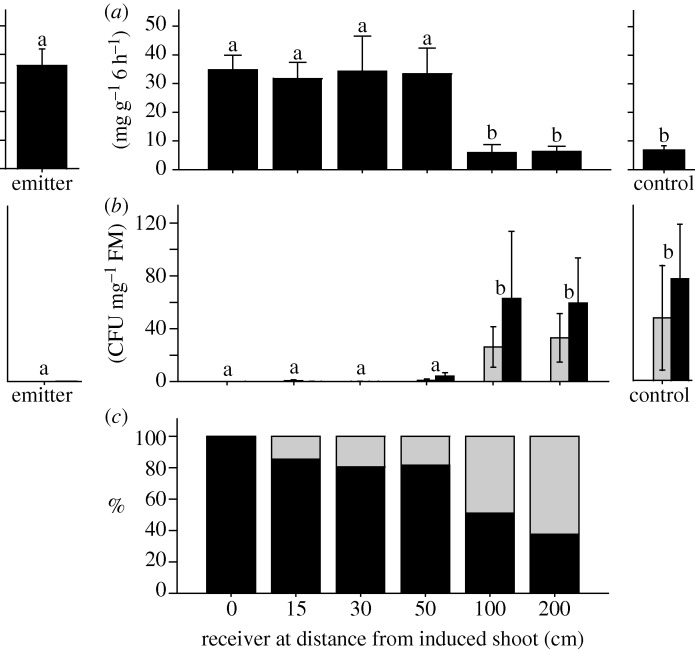
Plants respond to attack by herbivores or pathogens with the release of volatile organic compounds. Neighbouring plants can receive these volatiles and consecutively induce their own defence arsenal. This 'plant communication', however, appears counterintuitive when it benefits independent and genetically unrelated receivers, which may compete with the emitter. As a solution to this problem, a role for volatile compounds in within-plant signalling has been predicted. We used wild-type lima bean (Phaseolus lunatus) to quantify under field conditions the distances over which volatile signals move, and thereby determine whether these cues will mainly trigger resistance in other parts of the same plant or in independent plants. Independent receiver plants exhibited airborne resistance to herbivores or pathogens at maximum distances of 50 cm from a resistance-expressing emitter. In undisturbed clusters of lima bean, over 80 per cent of all leaves that were located around a single leaf at this distance were other leaves of the same plant, whereas this percentage dropped below 50 per cent at larger distances. Under natural conditions, resistance-inducing volatiles of lima bean move over distances at which most leaves that can receive the signal still belong to the same plant.
Figures
References
-
- Baldwin I. T., Schultz J. C.1983Rapid changes in tree leaf chemistry induced by damage: evidence for communication between plants. Science 221, 277–279 (doi:10.1126/science.221.4607.277) - DOI - PubMed
-
- Farmer E. E.2001Surface-to-air signals. Nature 411, 854–856 (doi:10.1038/35081189) - DOI - PubMed
-
- Farmer E. E., Ryan C. A.1990Interplant communication: airborne methyl jasmonate induces synthesis of proteinase inhibitors in plant leaves. Proc. Natl Acad. Sci. USA 87, 7713–7716 (doi:10.1073/pnas.87.19.7713) - DOI - PMC - PubMed
-
- Frost C., Appel H., Carlson J., De Moraes C., Mescher M., Schultz J.2007Within-plant signalling by volatiles overcomes vascular constraints on systemic signalling and primes responses against herbivores. Ecol. Lett. 10, 490–498 (doi:10.1111/j.1461-0248.2007.01043.x) - DOI - PubMed
-
- Frost C., Mescher M. C., Carlson J., De Moraes C. M.2008Plant defense priming against herbivores: getting ready for a different battle. Plant Physiol. 146, 818–824 (doi:10.1104/pp.107.113027) - DOI - PMC - PubMed
Publication types
MeSH terms
Substances
LinkOut - more resources
Full Text Sources
Research Materials
