Topographic mapping--the olfactory system
- PMID: 20554703
- PMCID: PMC2908763
- DOI: 10.1101/cshperspect.a001776
Topographic mapping--the olfactory system
Abstract
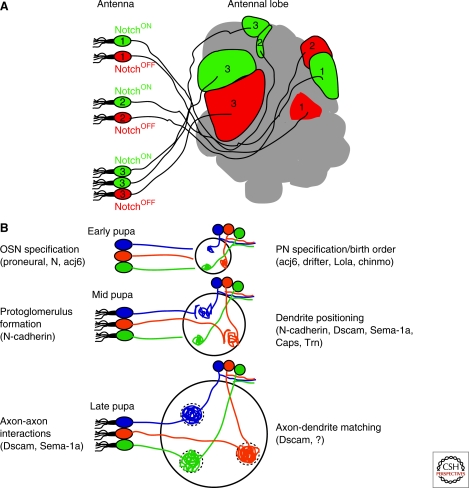
Sensory systems must map accurate representations of the external world in the brain. Although the physical senses of touch and vision build topographic representations of the spatial coordinates of the body and the field of view, the chemical sense of olfaction maps discontinuous features of chemical space, comprising an extremely large number of possible odor stimuli. In both mammals and insects, olfactory circuits are wired according to the convergence of axons from sensory neurons expressing the same odorant receptor. Synapses are organized into distinctive spherical neuropils--the olfactory glomeruli--that connect sensory input with output neurons and local modulatory interneurons. Although there is a strong conservation of form in the olfactory maps of mammals and insects, they arise using divergent mechanisms. Olfactory glomeruli provide a unique solution to the problem of mapping discontinuous chemical space onto the brain.
Figures
References
-
- Alenius M, Bohm S 1997. Identification of a novel neural cell adhesion molecule-related gene with a potential role in selective axonal projection. J Biol Chem 272: 26083–26086 - PubMed
-
- Axel R 1995. The molecular logic of smell. Sci Am 273: 154–159 - PubMed
-
- Barnea G, O’Donnell S, Mancia F, Sun X, Nemes A, Mendelsohn M, Axel R 2004. Odorant receptors on axon termini in the brain. Science 304: 1468. - PubMed
-
- Belluscio L, Gold GH, Nemes A, Axel R 1998. Mice deficient in G(olf) are anosmic. Neuron 20: 69–81 - PubMed
Publication types
MeSH terms
Substances
Grants and funding
LinkOut - more resources
Full Text Sources
Molecular Biology Databases