. 2010 Aug;104(2):922-31.
doi: 10.1152/jn.00413.2010. Epub 2010 Jun 16.

Sensitization of rapid dopamine signaling in the nucleus accumbens core and shell after repeated cocaine in rats

Affiliations

Sensitization of rapid dopamine signaling in the nucleus accumbens core and shell after repeated cocaine in rats

Nii A Addy et al. J Neurophysiol. 2010 Aug.

Abstract

Repeated cocaine exposure and withdrawal leads to long-term changes, including behavioral and dopamine sensitization to an acute cocaine challenge, that are most pronounced after long withdrawal periods. However, the changes in dopamine neurotransmission after short withdrawal periods are less well defined. To study dopamine neurotransmission after 1-day withdrawal, we used fast-scan cyclic voltammetry (FSCV) to determine whether repeated cocaine alters rapid dopamine release and uptake in the nucleus accumbens (NAc) core and shell. FSCV was performed in urethane anesthetized male Sprague-Dawley rats that had previously received one or seven daily injections of saline or cocaine (15 mg/kg, ip). In response to acute cocaine, subjects showed increased dopamine overflow that resulted from both increased dopamine release and slowed dopamine uptake. One-day cocaine pre-exposure, however, did not alter dopaminergic responses to a subsequent cocaine challenge. In contrast, 7-day cocaine-treated subjects showed a potentiated rapid dopamine response in both the core and shell after an acute cocaine challenge. In addition, kinetic analysis during the cocaine challenge showed a greater increase in apparent K(m) of 7-day cocaine exposed subjects. Together, the data provide the first in vivo demonstration of rapid dopamine sensitization in the NAc core and shell after a short withdrawal period. In addition, the data clearly delineate cocaine's release and uptake effects and suggest that the observed sensitization results from greater uptake inhibition in cocaine pre-exposed subjects.


Figures
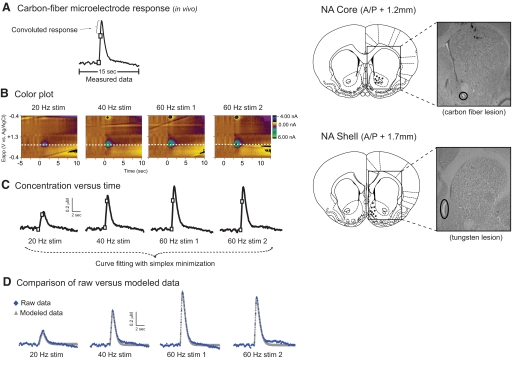
Fig. 1.
Fig. 1.
In vivo rapid dopamine overflow at the carbon-fiber microelectrode. A: dopamine overflow in the nucleus accumbens (NAc) shell after electrical stimulation of the ventral tegmental area (VTA). At high stimulation frequencies, a continual rise in dopamine concentration even after the stimulation has ceased (2nd white box on trace). This slowed, or convoluted, response is caused by the kinetics of the electrode response time and can be accounted for using a mathematical algorithm. B: predrug rapid dopamine responses at multiple stimulation frequencies represented in a 3-demenisional image in which current is indicated in false color. C: dopamine concentration vs. time plots obtained using the 0.6-V current (dashed line in B) associated with the oxidation of dopamine and calculated using postcalibration values. A simplex minimization algorithm was used to determine values for [DA]p, Vmax, and Km. D: comparison of modeled data (obtained with simplex minimization) to data measured in vivo.
Fig. 2.
Fig. 2.
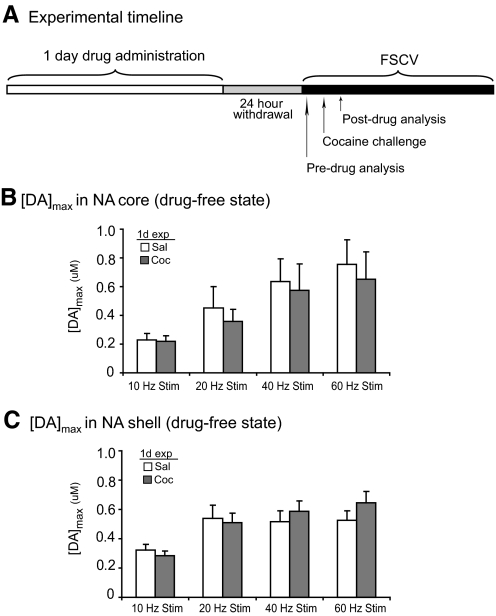
Drug-free [DA]max responses after 1-day saline or cocaine followed by 24-h withdrawal. A: experimental timeline for 1-day drug-exposure and fast-scan cyclic voltammetry (FSCV) recordings. B and C: pre-exposure to 1-day cocaine did not alter peak dopamine responses in the NAc core or shell compared with 1-day saline-treated subjects. [DA]max in the NAc core (n = 9) (B) and NAc shell (n = 16) (C) after 10-, 20-, 40-, and 60-Hz stimulations of the VTA. [DA]max data presented as ±SE.
Fig. 3.
Fig. 3.
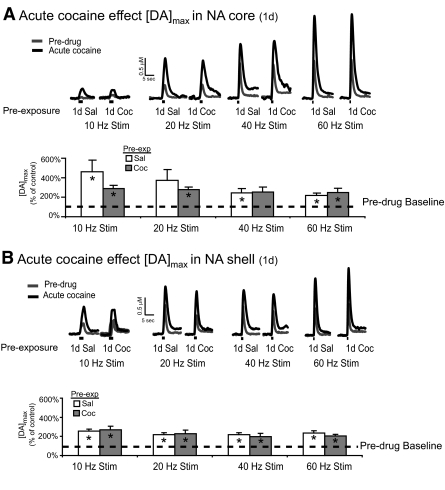
Cocaine pre-exposure for 1 day does not alter rapid dopamine responses in the NAc core or shell after an acute cocaine challenge. A: rapid dopamine responses in the NAc core after application of various stimulation frequencies to the VTA (n = 9). Dopamine responses are represented as concentration vs. time for both the predrug state (gray trace) and after an acute cocaine challenge (black trace). Both pre-exposure groups showed an increase in [DA]max after acute cocaine at all frequencies tested (*P < 0.05 vs. baseline, 1-sample t-test), with the exception of the 20-Hz response in the saline-treated subjects (+P < 0.07 vs. baseline, 1-sample t-test). No significant differences were observed when comparing acute cocaine responses in 1-day saline vs. 1-day cocaine-treated subjects (P > 0.05, independent samples t-test). B: rapid dopamine responses in the NAc shell after application of various stimulation frequencies to the VTA (n = 16). Both 1-day saline- and 1-day cocaine-treated subjects showed increased [DA]max after an acute cocaine challenge at all frequencies tested (*P < 0.05, 1-sample t-test), with no difference between the two treatment groups (P > 0.05, 1-sample t-test). [DA]max data presented as ±SE.
Fig. 4.
Fig. 4.
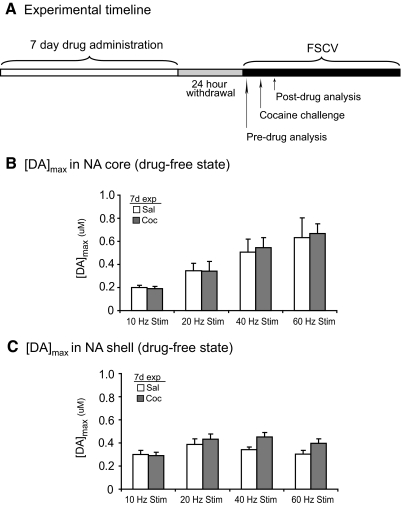
Drug-free [DA]max responses after 7-day saline or cocaine followed by 24-h withdrawal. A: experimental timeline for 1-day drug-exposure and FSCV recordings. B and C: pre-exposure to 7-day cocaine did not alter peak dopamine responses in the NAc core or shell compared with 7-day saline-treated subjects. [DA]max in the NAc core (n = 9) (B) and NAc shell (n = 17) (C) in response to electrical stimulation of the VTA. [DA]max data presented as ±SE.
Fig. 5.
Fig. 5.
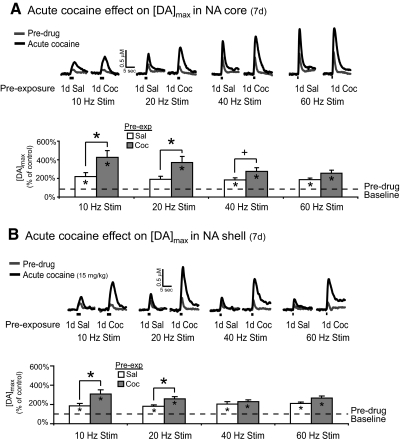
Cocaine pre-exposure for 7 days potentiates the NAc core and shell rapid dopamine response to an acute cocaine challenge. A: concentration vs. time traces of rapid dopamine responses in the NAc core obtained after application of various stimulation frequencies to the VTA (n = 9). Both groups showed increases in [DA]max after an acute cocaine challenge at all frequencies tested (*P < 0.05 vs. baseline, 1-sample t-test) with the exception of the 20-Hz stimulation frequency in 7-day saline-treated subjects (P < 0.06 vs. baseline, 1-sample t-test). Subjects previously exposed to 7-day cocaine showed a potentiated response to the cocaine challenge compared with 7-day saline-treated subjects (*P < 0.05 for 10- and 20-Hz stimulations, independent samples t-test). B: concentration vs. time traces in the NAc shell after application of various stimulation frequencies to the VTA (n = 17). An acute cocaine challenge led to an increased [DA]max response at all frequencies tested in both 7-day saline- and 7-day cocaine-treated subjects (P < 0.05 vs. baseline, 1-sample t-test). Subjects that were pre-exposed to 7-day cocaine also showed a potentiated response to the acute cocaine challenge at 10- and 20-Hz stimulation frequencies compared with 7-day saline-treated subjects (*P < 0.05, independent samples t-test). [DA]max data presented as ±SE.
Fig. 6.
Fig. 6.
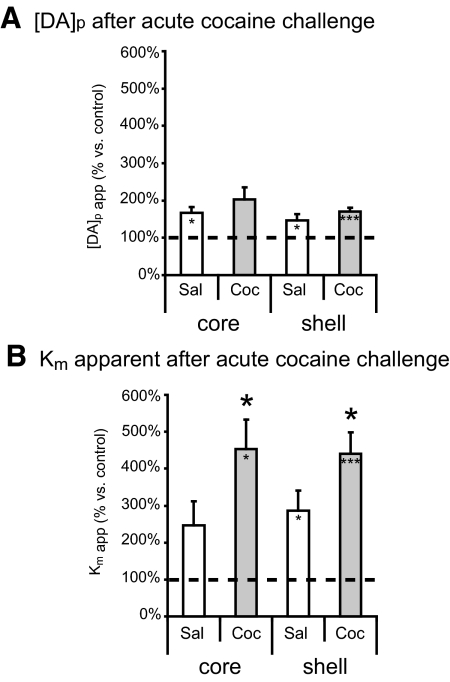
Cocaine pre-exposure for 7 days leads to a greater uptake inhibition during an acute cocaine challenge. A: 1-day saline- and cocaine-treated subjects showed increased [DA]p in response to an acute cocaine challenge (*P < 0.05 vs. baseline, **P < 0.005 vs. baseline, ***P < 0.001 vs. baseline, 1-sample t-test). B: all groups also showed a significant increase in apparent Km after the acute cocaine challenge (*P < 0.05 vs. baseline, **P < 0.005 vs. baseline, 1-sample t-test) with the exception of the NAc core response in 1-day cocaine subjects. In addition, 7-day cocaine-treated subjects showed a potentiated change in apparent Km while cocaine was on board, as shown by a main effect of cocaine (F3,25 = 5.942, *P < 0.05, univariate ANOVA). Data presented as ±SE.

References

    1. Aragona BJ, Cleaveland NA, Stuber GD, Day JJ, Carelli RM, Wightman RM. Preferential enhancement of dopamine transmission within the nucleus accumbens shell by cocaine is attributable to a direct increase in phasic dopamine release events.J Neurosci 28: 8821–8831, 2008 - PMC - PubMed
    1. Argilli E, Sibley DR, Malenka RC, England PM, Bonci A. Mechanism and time course of cocaine-induced long-term potentiation in the ventral tegmental area.J Neurosci 28: 9092–9100, 2008 - PMC - PubMed
    1. Bibb JA, Chen J, Taylor JR, Svenningsson P, Nishi A, Snyder GL, Yan Z, Sagawa ZK, Ouimet CC, Nairn AC, Nestler EJ, Greengard P. Effects of chronic exposure to cocaine are regulated by the neuronal protein Cdk5.Nature 410: 376–380, 2001 - PubMed
    1. Borgland SL, Malenka RC, Bonci A. Acute and chronic cocaine-induced potentiation of synaptic strength in the ventral tegmental area: electrophysiological and behavioral correlates in individual rats.J Neurosci 24: 7482–7490, 2004 - PMC - PubMed
    1. Cahill PS, Walker QD, Finnegan JM, Mickelson GE, Travis ER, Wightman RM. Microelectrodes for the measurement of catecholamines in biological systems.Analyt Chem 68: 3180–3186, 1996 - PubMed

Publication types

MeSH terms

LinkOut - more resources