. 2010 Oct;24(10):4047-57.
doi: 10.1096/fj.10-158378. Epub 2010 Jun 16.

A novel FcεRIβ-chain truncation regulates human mast cell proliferation and survival

Affiliations

A novel FcεRIβ-chain truncation regulates human mast cell proliferation and survival

Glenn Cruse et al. FASEB J. 2010 Oct.

Abstract

Mast cells contribute to allergy through IgE-dependent activation via the high-affinity IgE receptor FcεRI. The role of the FcεRIβ chain (MS4A2) in mast cell function is not understood fully, although it serves to amplify FcεRI-dependent signaling. We demonstrate the expression of a novel MS4A2 truncation lacking exon 3 in human mast cells termed MS4A2(trunc). MS4A2(trunc) gene expression was regulated negatively by the mast cell growth factor stem cell factor (SCF), and its expression was not detected in the SCF receptor gain-of-function human mast cell line HMC-1. Unlike MS4A2, MS4A2(trunc) did not traffic to the cytoplasmic membrane but instead was associated with the nuclear membrane. Overexpression of MS4A2(trunc) induced human lung mast cell death and profoundly inhibited HMC-1 cell proliferation by inducing G(2)-phase cell cycle arrest and apoptosis. Thus, we have identified a novel splice variant of MS4A2 that might be important in the regulation of human mast cell proliferation and survival. This finding demonstrates that the MS4A2 gene has multiple roles, extending beyond the regulation of acute allergic responses. By understanding the mechanisms regulating its function, it might be possible to induce its expression in mast cells in vivo, which could lead to better treatments for diseases such as mastocytosis and asthma.


Figures
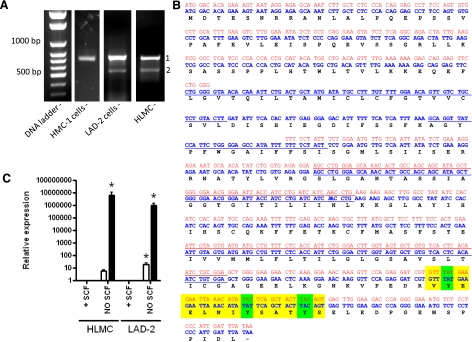
Figure 1.
Figure 1.
Identification and regulation of a novel MS4A2 variant. A) RT-PCR cloning of MS4A2 from HMC-1 cells, LAD-2 cells, and HLMCs. Two bands were present in the LAD-2 cells and HLMCs but not in the HMC-1 cells. An expected band of ∼750 bp (band 1) and a shorter band of ∼600 bp (band 2). Each panel is from a different gel. B) Nucleotide and predicted amino acid sequence of MS4A2 (blue) and MS4A2trunc (red). Sequence remains in frame so MS4A2trunc would retain both N and C termini of MS4A2, including the noncanonical ITAM (highlighted in yellow). Predicted transmembrane regions are underscored. C) Quantitative real-time RT-PCR of MS4A2 (open bars) and MS4A2trunc expression (solid bars) in HLMCs and LAD-2 cells. Data are presented as means ± se; n = 10 from 5 separate donors for HLMCs, n = 7 for LAD-2 cells. *P < 0.001 vs. control; ANOVA with Tukey's posttest.
Figure 2.
Figure 2.
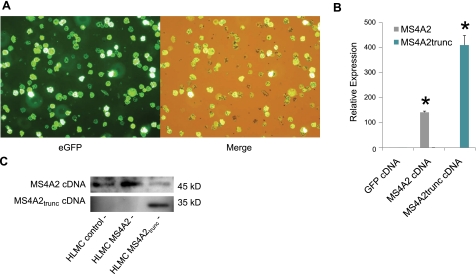
MS4A2 and MS4A2trunc can be successfully transduced into human mast cells. A) Adenovirus Ad5C20Att01 efficiently transduces eGFP cDNA into primary ex vivo HLMCs. Merged image (right panel) demonstrates that no GFP cells are evident under visible light. B) Using viruses constructed to contain the full-length ORF of MS4A2 and MS4A2trunc, transduction leads to overexpression of the corresponding mRNA for each variant assessed using quantitative real-time RT-PCR. Data are means ± se of 8 experiments from 4 donors. *P < 0.0001 vs. control. C) Western blot demonstrating that transduction of the cDNA for each MS4A2 variant leads to the overexpression of the corresponding protein. Each panel is from a separate gel with different antibodies.
Figure 3.
Figure 3.
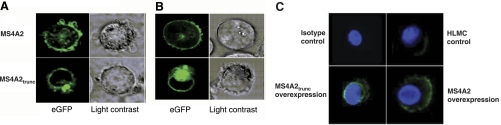
MS4A2trunc localizes to the nuclear membrane rather than the cytoplasmic membrane. A) Confocal micrographs of LAD-2 cells transfected with MS4A2 (top panels) and MS4A2trunc (bottom panels) tagged with eGFP (pEGFP-N1) using nucleofection. MS4A2 localized to the cytoplasmic membrane. However, the truncated variant localized to the perinuclear region. B) Similar results were seen using lipofection of HMC-1 cells. C) A similar staining pattern was observed in HLMCs after overexpression with adenoviral transduction of untagged MS4A2 variants stained using FITC immunofluorescence. Images from Olympus FV1000 confocal laser scanning microscope analyzed using Fluoview FV10-ASW v1.6 software. View ×600 at 37°C.
Figure 4.
Figure 4.
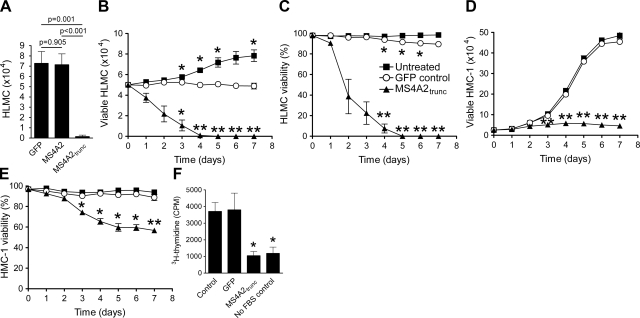
MS4A2trunc inhibits proliferation and initiates cell death in human mast cells. A) Transduction of MS4A2 had no effect on HLMC viability after 7 d when compared to the GFP control virus. However, transduction of MS4A2trunc leads to cell death by d 7. B) Time course study shows that HLMCs had died by 5 d after transduction of MS4A2trunc. GFP control virus had a minor effect on cell number compared to no-transduction control but did not induce HLMC death. C) In parallel, HLMC viability declined rapidly following MS4A2trunc transduction. D) In HMC-1 cells, transduction of MS4A2trunc profoundly inhibited proliferation. E) HMC-1 viability was reduced by ∼50% by d 7. F) Antiproliferative effect of MS4A2trunc in HMC-1 was also evident when measuring 3H-thymidine incorporation into DNA. Data are means ±se from 6 (A) or 4 (B–F) experiments. *P < 0.05, **P < 0.01; ANOVA with Tukey's posttest.
Figure 5.
Figure 5.
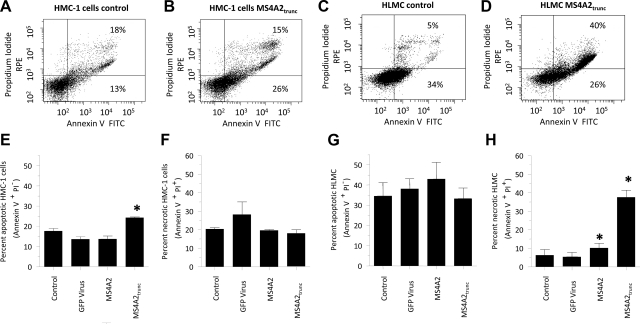
Transduction of MS4A2trunc induces HMC-1 apoptosis and HLMC death. A) Scatter plot of HMC-1 adenoviral-treated control cells stained for annexin V (x axis) and propidium iodide (y axis) 48 h after transduction. B) Transduction of MS4A2trunc increases the proportion of annexin V+ PI cells present at 48 h, which is indicative of apoptosis. C) At 48 h after transduction, HLMC annexin binding was relatively high in the control cells (34% stained). D) HLMC annexin V staining did not change with the addition of MS4A2trunc, but the percentage of dead PI+ cells increased markedly. E–H) Graphical representation of the means ±se of 3 separate experiments in annexin V+ PI (E, G) and annexin V+ PI+ (F, H) HMC-1 cells (E, F) and HLMCs (G, H), demonstrating the changes in annexin V and PI expression in the different cell populations. *P < 0.05.
Figure 6.
Figure 6.
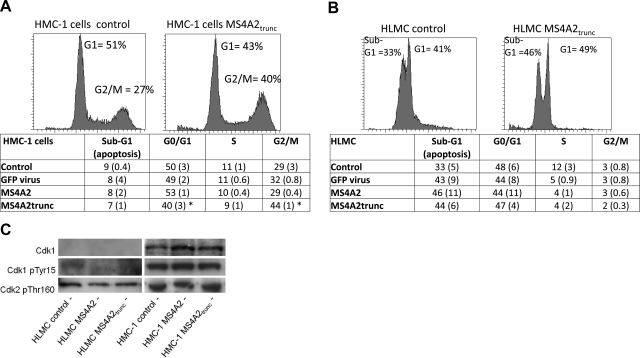
Antiproliferative effect of MS4A2trunc in HMC-1 cells is due to G2/M phase arrest. A) Transduction of MS4A2trunc in HMC-1 cells induced an increase in the number of cells in G2/M phase when compared to control. This was accompanied by a decrease in cells in G1 phase consistent with G2 arrest. Notably, this effect was not evident with either GFP control virus or overexpression of MS4A2. Data in the table are means and se (in parentheses) of 3 separate experiments undertaken 48 h after transduction. B) No significant difference in the cell cycle was evident in HLMCs, probably attributable to very few cells progressing through to S and G2/M phases. C) No difference was found among the level of Cdk1, phosphorylated Cdk1 (Tyr15), or phosphorylated Cdk2 (Thr160) with the overexpression of either MS4A2 or MS4A2trunc in HMC-1 cells.
Figure 7.
Figure 7.
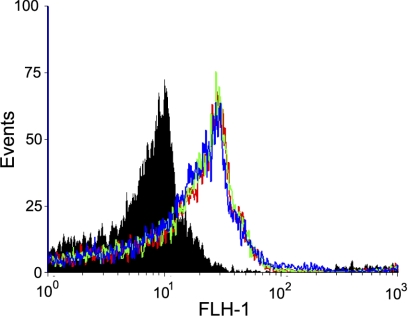
Overexpression of MS4A2trunc does not reduce FcεRI expression in HLMCs. Histogram shows the fluorescence intensity of cells stained for FcεRIα. No significant difference was found between MS4A2trunc-overexpressing cells (blue), when compared to either MS4A2-overexpressing cells (green) or virus-treated control cells (red). Solid filled histogram is the isotype control. Data are representative of 5 donors.

References

    1. Bradding P., Cruse G. (2008) Mast cells: Biological properties and role in health and allergic diseases. In Allergy and Allergic Diseases (Kay A. B., Kaplan A. P., Bousquet J., Holt P. eds) pp. 217–257, Wiley-Blackwell, Hoboken, NJ, USA
    1. Echtenacher B., Mannel D. N., Hultner L. (1996) Critical protective role of mast cells in a model of acute septic peritonitis. Nature 381, 75–77 - PubMed
    1. Bradding P., Walls A. F., Holgate S. T. (2006) The role of the mast cell in the pathophysiology of asthma. J. Allergy Clin. Immunol. 117, 1277–1284 - PubMed
    1. Tetlow L. C., Woolley D. E. (1995) Distribution, activation and tryptase/chymase phenotype of mast cells in the rheumatoid lesion. Ann. Rheum. Dis. 54, 549–555 - PMC - PubMed
    1. Wu Y., Liu Z., Hu W., Li L. (2005) Mast cell infiltration associated with tubulointerstitial fibrosis in chronic aristolochic acid nephropathy. Hum. Exp. Toxicol. 24, 41–47 - PubMed

Publication types

LinkOut - more resources