. 2010 Sep 23;116(12):2057-60.
doi: 10.1182/blood-2010-02-266411. Epub 2010 Jun 16.

Human FANCC is hypomorphic in murine Fancc-deficient cells

Affiliations

Human FANCC is hypomorphic in murine Fancc-deficient cells

Laura E Hays et al. Blood. .

Abstract

Fancc suppresses cross-linker-induced genotoxicity, modulates growth-inhibitory cytokine responses, and modulates endotoxin responses. Although loss of the latter function is known to account for endotoxin-induced marrow failure in murine Fancc (mFancc)-deficient mice, some argue that cytokine and endotoxin hypersensitivities devolve simply from genomic instability. Seeking to resolve this question, we planned to ectopically express instructive human FANCC (hFANCC) mutants in murine Fancc-deficient hematopoietic stem cells. To first assure that hFANCC cDNA was competent in murine cells, we compared hFANCC and mFancc in complementation assays for cross-linking agent hypersensitivity and endotoxin hypersensitivity. We found that mFancc complemented murine Fancc-deficient cells in both assays, but that hFANCC fully suppressed only endotoxin hypersensitivity, not cross-linking agent hypersensitivity. These results support the notions that Fancc is multifunctional and that structural prerequisites for its genoprotective functions differ from those required to constrain endotoxin responses known to lead to marrow failure in Fancc-deficient mice.


Figures
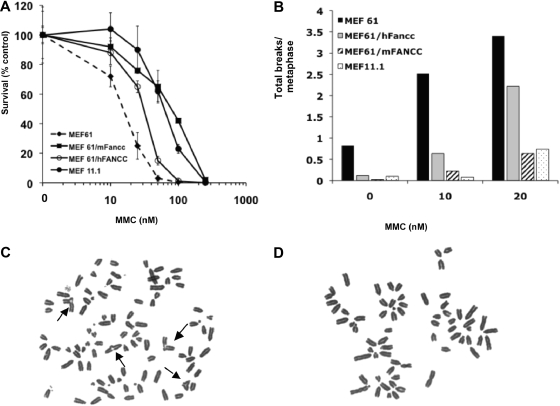
Figure 1
Figure 1
Human FANCC does not fully correct Fancc-deficient MEFs. (A) Survivals of transformed Fancc-deficient MEFS (MEF61) transduced with human FANCC (MEF61/hFANCC) or murine Fancc (MEF61/mFancc) that were treated with MMC for 5 days (mean ± SD from one representative experiment of 3 performed in triplicate). MEF61/hFANCC cells were significantly more sensitive than MEF61/mFancc or wild-type (MEF11.1) cells (P < .001; analysis of variance [ANOVA]). MEF61/hFANCC cells were significantly more resistant to MMC than MEF61 cells (P < .001; ANOVA). (B) The average number of breaks per metaphase of the displayed MEFs treated with indicated concentrations of MMC for 24 hours; 50 metaphases were scored per cell line. Quadriradial forms were counted as 2 breaks per cell. (C-D) Metaphase spreads of MEF61/hFANCC (C) or MEF61/mFancc (D) cells treated with 20 ng/mL MMC for 24 hours. Arrows indicate radials.
Figure 2
Figure 2
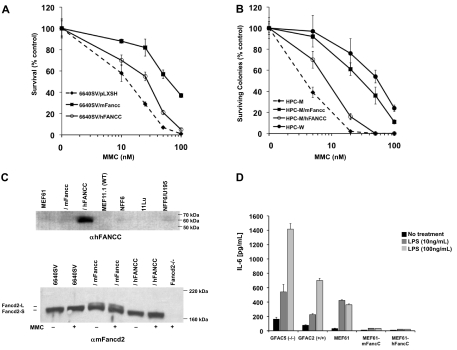
Human FANCC fails to complement DNA repair defects in Fancc-deficient cells but is sufficient for suppression of cytokine production. (A) Survivals of transformed Fancc-deficient tongue epithelial cells (6640SV/pLXSH) transduced with hFANCC (6640SV/hFANCC) or mFancc (6640SV/mFancc) and treated with MMC for 5 days (mean ± SD from one similar experiment of 3 performed in triplicate). 6640SV/hFANCC cells were significantly more sensitive to MMC than 6640SV/mFancc cells (P < .001; ANOVA). 6640SV/hFANCC cells were significantly more resistant to MMC than 6640SV cells (P < .001; ANOVA). (B) Colony assays of Fancc−/− hematopoietic progenitor cells (HPC-M) transduced with hFANCC (HPC-M/hFANCC) or mFancc (HPC-M/mFancc) and treated with MMC for 7 days (mean ± SD from one similar experiment of 2 performed in triplicate). HPC-M/hFANCC cells were 3-fold more sensitive to MMC than HPC-M/mFancc cells (P < .001; ANOVA), 6-fold more sensitive than wild-type cells (HPC-W; P < .001; ANOVA), and 3-fold more resistant to MMC than untransduced cells (HPC-M; P < .001; ANOVA). Transduction efficiencies of hFANCC/mFancc were measured by polymerase chain reaction with primers directed against green fluorescence protein and were similar (74% vs 79% for hFANCC and mFancc, respectively). (C) Immunoblots of fibroblast (top) or tongue epithelial (bottom) cell lines treated ± 150nM MMC for 24 hours. Lysates were blotted with either anti-FANCC antibody (top) or anti-Fancd2 antibody (bottom). (Top) Lanes 5 to 7 (NFF6, 11Lu, and NFF6/U195) represent normal human fibroblasts. The expression of hFANCC in transduced-murine fibroblasts (MEF61/hFANCC; lane 3) was more than 8-fold higher (by comparative densitometric analysis of lanes 3 and 7) than the level of expression required for a normal MMC response. WT indicates wild-type. (Bottom) Fancd2-L indicates mono-ubiquitinated Fancd2; and Fancd2-S, nonubiquitinated Fancd2. Fancd2−/− cells were isolated from Fancd2-deficient mice. (D) Primary (GFAC5 and 2) and transformed MEFs (MEF61) were treated with indicated concentrations of LPS for 24 hours. IL-6 secretion was measured in the supernatants by ELISA (mean ± SD from one similar experiment of 3 performed in triplicate). Fancc-deficient MEFs produced significantly higher levels of IL-6 than wild-type or transduced cells (P < .001 for both cell types).

References

    1. de Winter JP, Joenje H. The genetic and molecular basis of Fanconi anemia. Mutat Res. 2009;668(1):11–19. - PubMed
    1. Vaz F, Hanenberg H, Schuster B, et al. Mutation of the RAD51C gene in a Fanconi anemia-like disorder. Nat Genet. 201;42(5):406–409. - PubMed
    1. Pang Q, Christianson TA, Keeble W, et al. The Fanconi anemia complementation group C gene product: structural evidence of multifunctionality. Blood. 2001;98(5):1392–1401. - PubMed
    1. Bagby GC, Alter BP. Fanconi anemia. Semin Hematol. 2006;43(3):147–156. - PubMed
    1. Chen M, Tomkins DJ, Auerbach W, et al. Inactivation of Fac in mice produces inducible chromosomal instability and reduced fertility reminiscent of Fanconi anaemia. Nat Genet. 1996;12(4):448–451. - PubMed

Publication types

MeSH terms

Substances