


Surgery for cervical intraepithelial neoplasia
- PMID: 20556751
- PMCID: PMC4170911
- DOI: 10.1002/14651858.CD001318.pub2
Surgery for cervical intraepithelial neoplasia
Update in
-
Surgery for cervical intraepithelial neoplasia.Cochrane Database Syst Rev. 2013 Dec 4;2013(12):CD001318. doi: 10.1002/14651858.CD001318.pub3. Cochrane Database Syst Rev. 2013. PMID: 24302546 Free PMC article.
Abstract
Background: Cervical intraepithelial neoplasia (CIN) is the most common pre-malignant lesion. Atypical squamous changes occur in the transformation zone of the cervix with mild, moderate or severe changes described by their depth (CIN 1, 2 or 3). Cervical intraepithelial neoplasia is treated by local ablation or lower morbidity excision techniques. Choice of treatment depends on the grade and extent of the disease.
Objectives: To assess the effectiveness and safety of alternative surgical treatments for CIN.
Search strategy: We searched the Cochrane Gynaecological Cancer Group Trials Register, Cochrane Central Register of Controlled Trials (CENTRAL) (The Cochrane Library), MEDLINE and EMBASE (up to April 2009). We also searched registers of clinical trials, abstracts of scientific meetings and reference lists of included studies.
Selection criteria: Randomised controlled trials (RCTs) of alternative surgical treatments in women with cervical intraepithelial neoplasia.
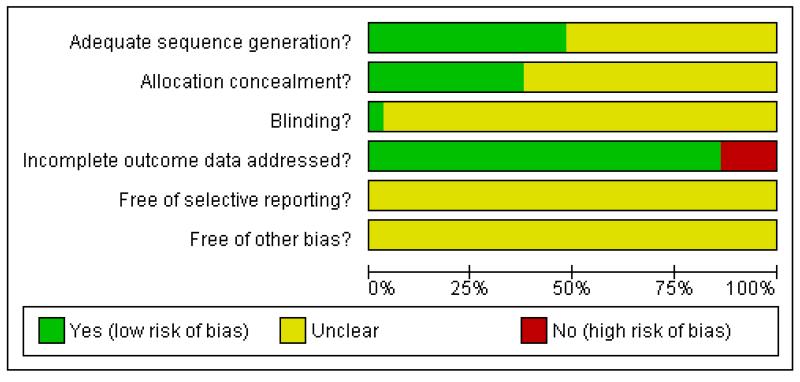
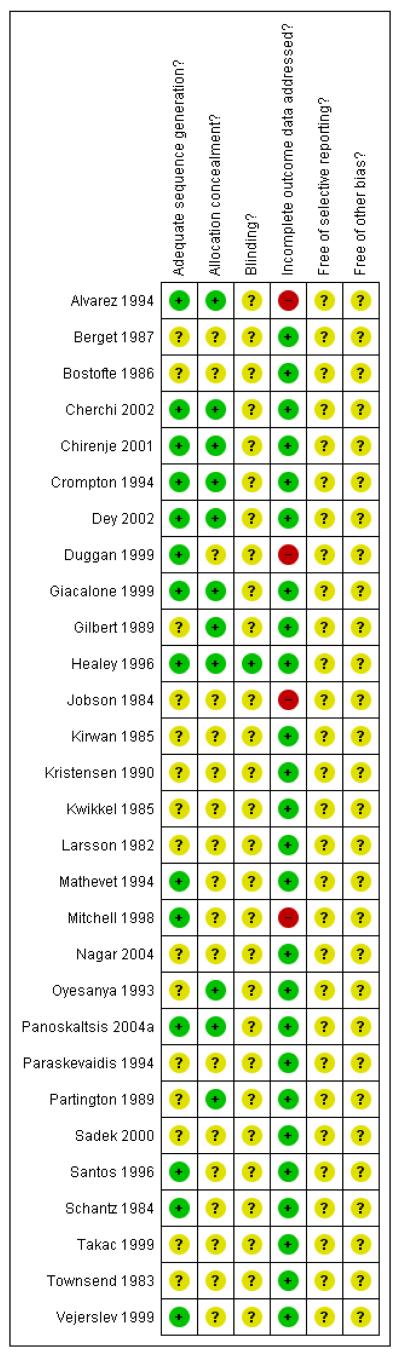
Data collection and analysis: Two review authors independently abstracted data and assessed risks of bias. Risk ratios that compared residual disease after the follow-up examination and adverse events in women who received one of either laser ablation, laser conisation, large loop excision of the transformation zone (LLETZ), knife conisation or cryotherapy were pooled in random-effects model meta-analyses.
Main results: Twenty-nine trials were included. Seven surgical techniques were tested in various comparisons. No significant differences in treatment failures were demonstrated in terms of persistent disease after treatment. Large loop excision of the transformation zone appeared to provide the most reliable specimens for histology with the least morbidity. Morbidity was lower than with laser conisation, although the trials did not provide data for every outcome measure. There were not enough data to assess the effect on morbidity when compared with laser ablation.
Authors' conclusions: The evidence suggests that there is no obvious superior surgical technique for treating cervical intraepithelial neoplasia in terms of treatment failures or operative morbidity.
Figures
Update of
-
Surgery for cervical intraepithelial neoplasia.Cochrane Database Syst Rev. 2000;(2):CD001318. doi: 10.1002/14651858.CD001318. Cochrane Database Syst Rev. 2000. Update in: Cochrane Database Syst Rev. 2010 Jun 16;(6):CD001318. doi: 10.1002/14651858.CD001318.pub2. PMID: 10796771 Updated.
References
References to studies included in this review
-
- Alvarez R, Helm W, Edwards P, Naumann W, Partridge E, Shingleton H, et al. Prospective randomised trial of LLETZ versus laser ablation in patients with cervical intra-epithelial neoplasia. Gynecologic Oncology. 1994;52:175–9. - PubMed
-
- Berget A, Andreason B, Bock, Bostofte E, Hobjorn S, Isager-Sally L, et al. Outpatient treatment of cervical intra-epithelial neoplasia: the CO2 laser versus cryotherapy: a randomised trial. Acta Obstetricia et Gynecologica Scandinavica. 1987;66:531–6. - PubMed
- Berget A, Andreason B, Bock J. Laser and cryosurgery for cervical intraepithelial neoplasia. Acta Obstetricia et Gynecologica Scandinavica. 1991;70:231–5. - PubMed
-
- Bostofte E, Berget A, Falck Larsen J, Pedersen H, Rank F. Conisation by carbon dioxide or cold knife in the treatment of cervical intra-epithelial neoplasia. Acta Obstetricia et Gynecologica Scandinavica. 1986;65:199–202. - PubMed
-
- Cherchi PL, Capobianco G, Ambrosini G, Fadda GM, Piga MD, Canetto AM, et al. Utility of bipolar electrocautery scissors for cervical conization. European Journal of Gynaecological Oncology. 2002;Vol. 23(issue 2):154–6. - PubMed
-
- Chirenje ZM, Rusakaniko S, Akino V, Mlingo M. A randomised clinical trial of loop electrosurgical excision procedure (LEEP) versus cryotherapy in the treatment of cervical intraepithelial neoplasia. Journal of Obstetrics and Gynaecology. 2001;Vol. 21(issue 6):617–21. - PubMed
References to studies excluded from this review
-
- Bar-Am A, Daniel Y, Ron IG, Niv J, Kupferminc MJ, Bornstein J, Lessing JB. Combined colposcopy, loop conization, and laser vaporization reduces recurrent abnormal cytology and residual disease in cervical dysplasia. Gynecologic Oncology. 2000;78(1):47–51. - PubMed
-
- Boardman LA, Steinhoff MM, Shackelton R, Weitzen S, Crowthers L. A randomized trial of the Fischer cone biopsy excisor and loop electrosurgical excision procedure. Obstetrics and Gynecology. 2004;104(4):745–50. - PubMed
-
- Ferenczy A. Comparison of cryo- and carbon dioxide laser therapy for cervical intraepithelial neoplasia. Obstetrics and Gynecology. 1985;66:793–8. - PubMed
-
- Gentile G, Tallarini A. Ablative techniques in the treatment of cervical lesions. Tumori. 2001;87(Suppl(5)):12. - PubMed
-
- Girardi F, Heydarfadai M, Koroschetz F, Pickel H, Winter R. Cold-knife conisation versus loop excision: histolopathologic and clinical results of a randomised trial. Gynecologic Oncology. 1994;55:368–70. - PubMed
Additional references
-
- Anderson M. Are we vaporizing microinvasive lesions? RCOG Perinatology Press. 1986;1:127–31.
-
- Benedet J, Nickerson K, White G. Laser therapy for cervical intraepithelial neoplasia. Obstetrics and Gynecology. 1981;57:188. - PubMed
-
- Bigrigg MA, Codling BW, Pearson P, Read MD, Swingler GR. Colposcopic diagnosis and treatment of cervical dysplasia at a single visit. Experience of low-voltage diathermy loop in 1000 patients. Lancet. 1990;336(8709):229–31. - PubMed
-
- Chappatte O, Byrne D, Raju K, Nayagam M, Kenney A. Histological differences between colposcopic-directed biopsy and loop excision of the transformation zone: a cause for concern. Gynecologic Oncology. 1991;43:46–50. - PubMed
-
- Cirisano FD. Management of pre-invasive disease of the cervix. Seminars in Surgical Oncology. 1999;16(3):222–7. - PubMed
Publication types
MeSH terms
LinkOut - more resources
Full Text Sources
Medical
Miscellaneous
