


Monocyte chemoattractant protein-1 is generated via TGF-beta by myofibroblasts in gastric intestinal metaplasia and carcinoma without H. pylori infection
- PMID: 20557309
- PMCID: PMC11158495
- DOI: 10.1111/j.1349-7006.2010.01609.x
Monocyte chemoattractant protein-1 is generated via TGF-beta by myofibroblasts in gastric intestinal metaplasia and carcinoma without H. pylori infection
Abstract
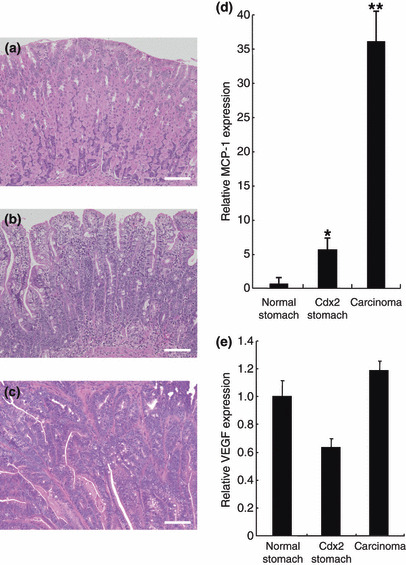
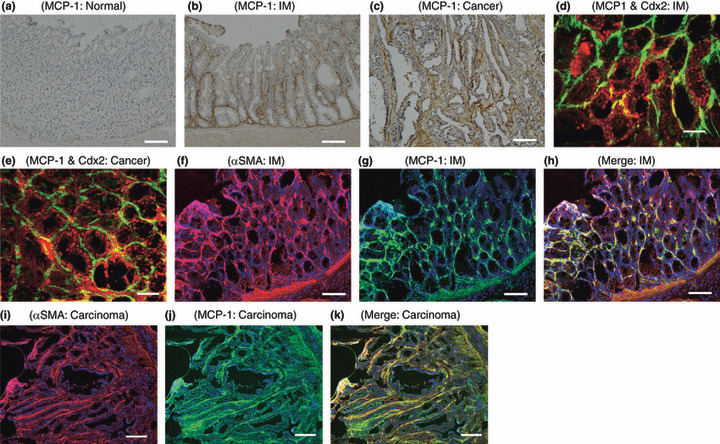
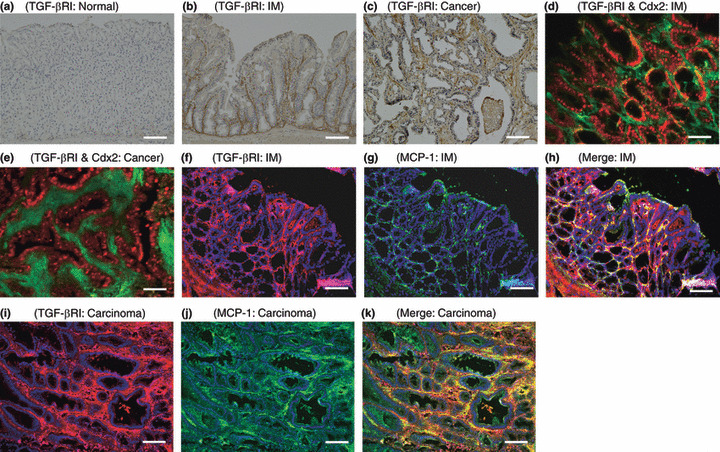
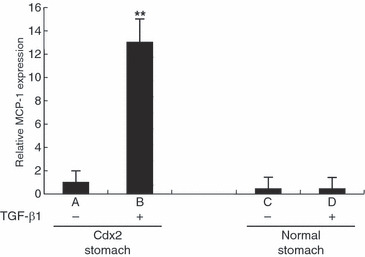
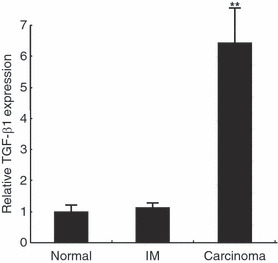
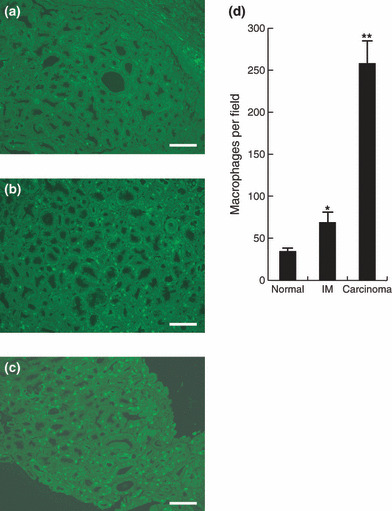
Helicobacter pylori (H. pylori) stimulates secretion of monocyte chemoattractant protein 1 (MCP-1) from gastric mucosa. Monocyte chemoattractant protein-1 (MCP-1) expression and macrophage infiltration are recognized in human gastric carcinoma. We have previously generated Cdx2-transgenic mice as model mice for intestinal metaplasia. Both chronic H. pylori-associated gastritis and Cdx2-transgenic mouse stomach develop intestinal metaplasia and finally gastric carcinoma. In this study we have directed our attention to MCP-1 expression in the intestinal metaplastic mucosa and the gastric carcinoma of Cdx2-transgenic mouse stomach. Quantitative real-time PCR was performed to determine MCP-1 and transforming growth factor-beta1 (TGF-beta1) mRNA expression levels and single- or double-label immunohistochemistry was used to evaluate the localization of MCP-1, TGF-beta type I receptor, and alpha-smooth muscle actin (alphaSMA). We determined that MCP-1 mRNA dramatically increased in the intestinal metaplastic mucosa and the gastric carcinoma of Cdx2-transgenic mouse stomach, compared with normal mouse stomach. Both MCP-1 and TGF-beta type I receptor were co-expressed in the alphaSMA-positive myofibroblasts of intestinal metaplastic mucosa and gastric carcinoma. Exogenous application of TGF-beta1 increased MCP-1 mRNA expression levels in the intestinal metaplastic tissue. Furthermore, TGF-beta1 was overexpressed and macrophage was strongly infiltrated in the gastric carcinoma. In conclusion, MCP-1 expression, which was stimulated by TGF-beta1, was recognized in the TGF-beta type I receptor-expressing myofibroblasts of the intestinal metaplastic mucosa and the gastric carcinoma of Cdx2-transgenic mouse stomach. The present results suggest that intestinal metaplasia and gastric carcinoma themselves induce MCP-1 expression independently of H. pylori infection.
Figures
References
-
- Baggiolini M, Loetscher P, Moser B. Interleukin‐8 and the chemokine family. Int J Immunopharmacol 1995; 17: 103–8. - PubMed
-
- Watanabe N, Shimada T, Ohtsuka Y, Hiraishi H, Terano A. Proinflammatory cytokines and Helicobacter pylori stimulate CC‐chemokine expression in gastric epithelial cells. J Physiol Pharmacol 1997; 48: 405–13. - PubMed
-
- Noach LA, Bosma NB, Jansen J, Hoek FJ, Van Deventer SJ, Tytgat GN. Mucosal tumor necrosis factor‐alpha, interleukin‐1 beta, and interleukin‐8 production in patients with Helicobacter pylori infection. Scand J Gastroenterol 1994; 29: 425–9. - PubMed
-
- Jung HC, Kim JM, Song IS, Kim CY. Helicobacter pylori induces an array of pro‐inflammatory cytokines in human gastric epithelial cells: quantification of mRNA for interleukin‐8, ‐1 alpha/beta, granulocyte‐macrophage colony‐stimulating factor, monocyte chemoattractant protein‐1 and tumour necrosis factor‐alpha. J Gastroenterol Hepatol 1997; 12: 473–80. - PubMed
MeSH terms
Substances
LinkOut - more resources
Full Text Sources
Medical
Research Materials
Miscellaneous
