


Comparative performance of the CKD Epidemiology Collaboration (CKD-EPI) and the Modification of Diet in Renal Disease (MDRD) Study equations for estimating GFR levels above 60 mL/min/1.73 m2
- PMID: 20557989
- PMCID: PMC2926290
- DOI: 10.1053/j.ajkd.2010.03.026
Comparative performance of the CKD Epidemiology Collaboration (CKD-EPI) and the Modification of Diet in Renal Disease (MDRD) Study equations for estimating GFR levels above 60 mL/min/1.73 m2
Abstract
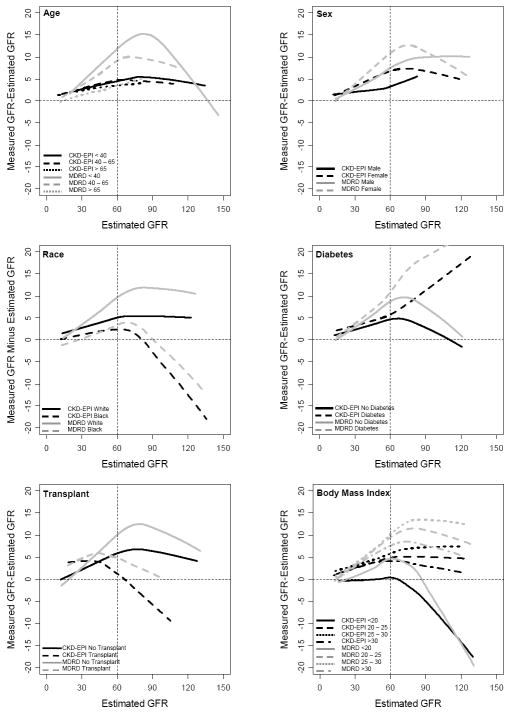
Background: The Modification of Diet in Renal Disease (MDRD) Study equation underestimates measured glomerular filtration rate (GFR) at levels>60 mL/min/1.73 m2, with variable accuracy among subgroups; consequently, estimated GFR (eGFR)>or=60 mL/min/1.73 m2 is not reported by clinical laboratories. Here, performance of a more accurate GFR-estimating equation, the Chronic Kidney Disease Epidemiology Collaboration (CKD-EPI) equation, is reported by level of GFR and clinical characteristics.
Study design: Test of diagnostic accuracy.
Setting & participants: Pooled data set of 3,896 people from 16 studies with measured GFR (not used for the development of either equation). Subgroups were defined by eGFR, age, sex, race, diabetes, prior solid-organ transplant, and body mass index.
Index tests: eGFR from the CKD-EPI and MDRD Study equations and standardized serum creatinine.
Reference test: Measured GFR using urinary or plasma clearance of exogenous filtration markers.
Results: Mean measured GFR was 68+/-36 (SD) mL/min/1.73 m2. For eGFR<30 mL/min/1.73 m2, both equations have similar bias (median difference compared with measured GFR). For eGFR of 30-59 mL/min/1.73 m2, bias was decreased from 4.9 to 2.1 mL/min/1.73 m2 (57% improvement). For eGFR of 60-89 mL/min/1.73 m2, bias was decreased from 11.9 to 4.2 mL/min/1.73 m2 (61% improvement). For eGFR of 90-119 mL/min/1.73 m2, bias was decreased from 10.0 to 1.9 mL/min/1.73 m2 (75% improvement). Similar or improved performance was noted for most subgroups with eGFR<90 mL/min/1.73 m2, other than body mass index<20 kg/m2, with greater variation noted for some subgroups with eGFR>or=90 mL/min/1.73 m2.
Limitations: Limited number of elderly people and racial and ethnic minorities with measured GFR.
Conclusions: The CKD-EPI equation is more accurate than the MDRD Study equation overall and across most subgroups. In contrast to the MDRD Study equation, eGFR>or=60 mL/min/1.73 m2 can be reported using the CKD-EPI equation.
Copyright (c) 2010 National Kidney Foundation, Inc. All rights reserved.
Figures
References
-
- Steindel SJ, Rauch WJ, Simon MK, Handsfield J. National Inventory of Clinical Laboratory Testing Services (NICLTS). Development and test distribution for 1996. Archives of pathology & laboratory medicine. 2000;124(8):1201–1208. - PubMed
-
- Miller WG. Estimating glomerular filtration rate. Clin Chem Lab Med. 2009;47(9):1017–1019. - PubMed
-
- Stevens LA, Coresh J, Feldman HI, et al. Evaluation of the modification of diet in renal disease study equation in a large diverse population. J Am Soc Nephrol. 2007;18(10):2749–2757. - PubMed
Publication types
MeSH terms
Grants and funding
LinkOut - more resources
Full Text Sources
Medical
Research Materials
Miscellaneous
