


A parallel process growth mixture model of conduct problems and substance use with risky sexual behavior
- PMID: 20558013
- PMCID: PMC2950227
- DOI: 10.1016/j.drugalcdep.2010.04.013
A parallel process growth mixture model of conduct problems and substance use with risky sexual behavior
Abstract
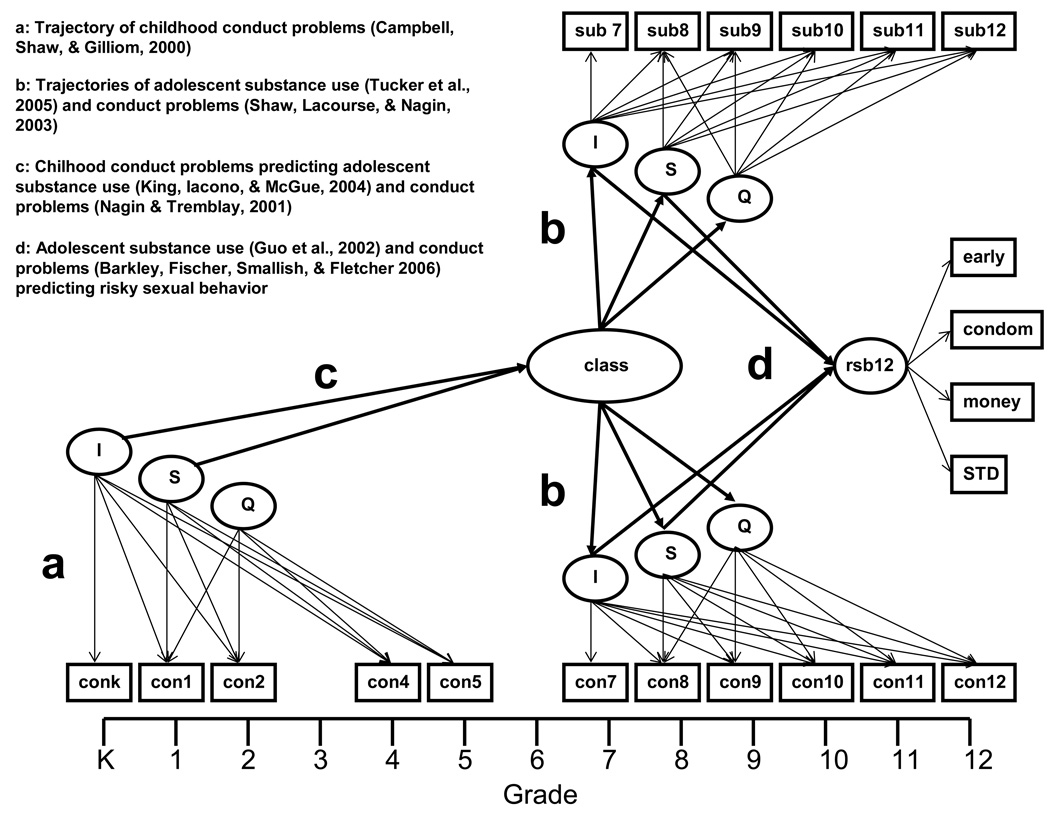
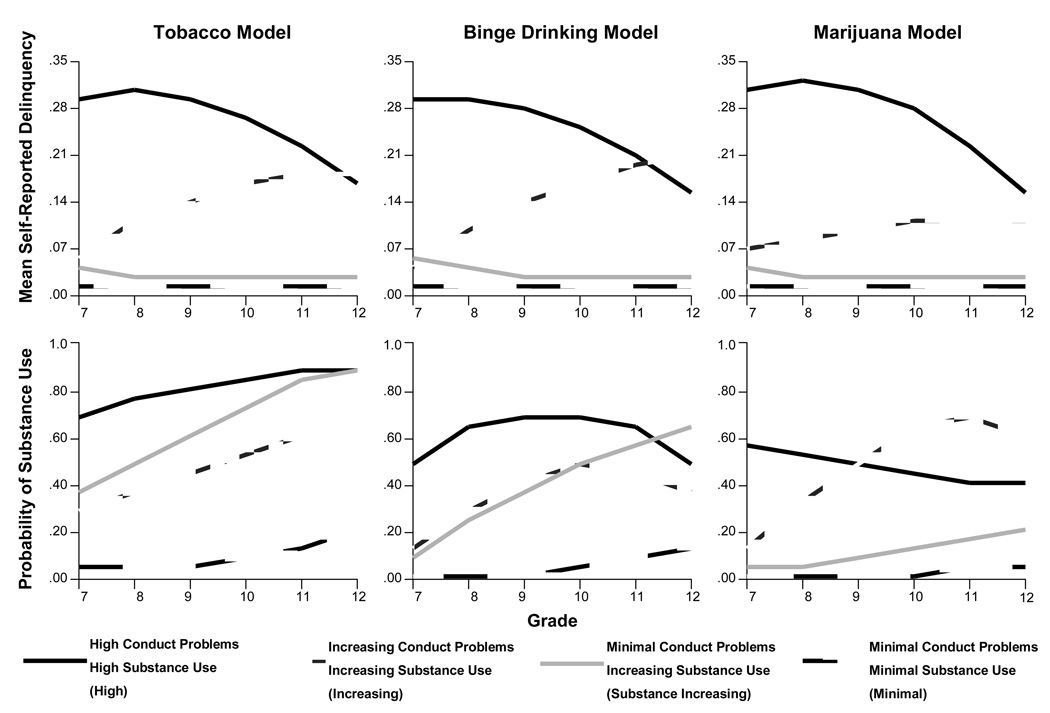
Conduct problems, substance use, and risky sexual behavior have been shown to coexist among adolescents, which may lead to significant health problems. The current study was designed to examine relations among these problem behaviors in a community sample of children at high risk for conduct disorder. A latent growth model of childhood conduct problems showed a decreasing trend from grades K to 5. During adolescence, four concurrent conduct problem and substance use trajectory classes were identified (high conduct problems and high substance use, increasing conduct problems and increasing substance use, minimal conduct problems and increasing substance use, and minimal conduct problems and minimal substance use) using a parallel process growth mixture model. Across all substances (tobacco, binge drinking, and marijuana use), higher levels of childhood conduct problems during kindergarten predicted a greater probability of classification into more problematic adolescent trajectory classes relative to less problematic classes. For tobacco and binge drinking models, increases in childhood conduct problems over time also predicted a greater probability of classification into more problematic classes. For all models, individuals classified into more problematic classes showed higher proportions of early sexual intercourse, infrequent condom use, receiving money for sexual services, and ever contracting an STD. Specifically, tobacco use and binge drinking during early adolescence predicted higher levels of sexual risk taking into late adolescence. Results highlight the importance of studying the conjoint relations among conduct problems, substance use, and risky sexual behavior in a unified model.
Copyright © 2010 Elsevier Ireland Ltd. All rights reserved.
Figures
References
-
- Achenbach TM. Manual for the Child Behavior Checklist/4–18 and 1991 Profile. Burlington, VT: University of Vermont Department of Psychiatry; 1991.
-
- Adams EH, Blanken AJ, Ferguson LD, Kopstein A. Overview of Selected Drug Trends. Rockville, MD: National Institute on Drug Abuse; 1990.
-
- Allison PD. Missing Data. Thousand Oaks, CA: Sage; 2002.
-
- Armstrong TD, Costello EJ. Community studies on adolescent substance use, abuse, or dependence and psychiatric comorbidity. Journal of Consulting and Clinical Psychology. 2002;70:1224–1239. - PubMed
-
- Auerbach KJ, Collins LM. A multidimensional developmental model of alcohol use during emerging adulthood. Journal of Studies on Alcohol and Drugs. 2006;67:917–925. - PubMed
Publication types
MeSH terms
Grants and funding
LinkOut - more resources
Full Text Sources
Medical
Research Materials
