Impact of age and overt proteinuria on outcomes of stage 3 to 5 chronic kidney disease in a referred cohort
- PMID: 20558563
- PMCID: PMC2974394
- DOI: 10.2215/CJN.08061109
Impact of age and overt proteinuria on outcomes of stage 3 to 5 chronic kidney disease in a referred cohort
Abstract
Background and objectives: Population-based studies have reported outcomes and risk factors for patients with chronic kidney disease (CKD), defined primarily by decreased estimated GFR (eGFR). They are characterized by old age, low proteinuria level, and stage 3 CKD. However, many patients referred to nephrologists are younger and have overt proteinuria and advanced CKD. This study evaluated the association between outcomes and those factors among referred CKD patients.
Design, setting, participants, & measurements: We retrospectively reviewed 461 referred patients with stage 3 to 5 CKD from January 2003 to December 2007. Key outcomes were death and ESRD. Patients were followed from the time of first serum creatinine measurement to December 2009.
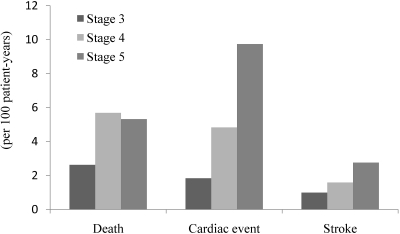
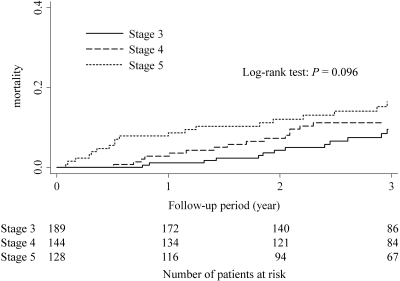
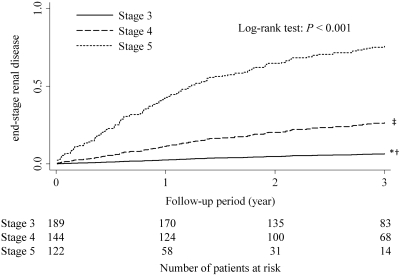
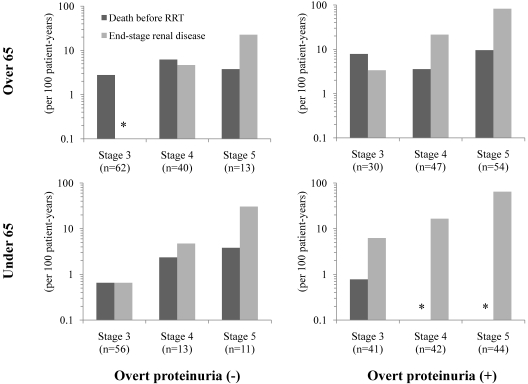
Results: The median age of subjects was 67.0 years, and median follow-up was 3.2 years. Overt proteinuria was present in 57.0% of subjects. For stage 3, 4, and 5 CKD, cumulative mortality and probability of ESRD at 3 years was 9.5 and 6.5%, 11.2 and 27.8%, and 16.5 and 79.1%, respectively. Using proportional-hazards regression models, age was a determinant for death, whereas overt proteinuria was strongly associated with ESRD. Among stage 3 CKD patients older than 65 years without overt proteinuria, the incidence of death before renal replacement therapy (RRT) was 2.8/100 patient-years and none had ESRD. In patients with advanced CKD and overt proteinuria, the incidence of ESRD was substantially higher than that of death before RRT.
Conclusions: Stratification by age, proteinuria level, and CKD stage could predict the competing outcomes of death before RRT and ESRD among CKD patients.
Figures
References
-
- National Kidney Foundation : K/DOQI clinical practice guidelines for chronic kidney disease: Evaluation, classification, and stratification. Am J Kidney Dis 39: S1–S266, 2002 - PubMed
-
- Sarnak MJ, Levey AS, Schoolwerth AC, Coresh J, Culleton B, Hamm LL, McCullough PA, Kasiske BL, Kelepouris E, Klag MJ, Parfrey P, Pfeffer M, Raij L, Spinosa DJ, Wilson PW: Kidney disease as a risk factor for development of cardiovascular disease: A statement from the American Heart Association Councils on Kidney in Cardiovascular Disease, High Blood Pressure Research, Clinical Cardiology, and Epidemiology and Prevention. Hypertension 42: 1050–1065, 2003 - PubMed
-
- Chen J, Muntner P, Hamm LL, Jones DW, Batuman V, Fonseca V, Whelton PK, He J: The metabolic syndrome and chronic kidney disease in U.S. adults. Ann Intern Med 140: 167–174, 2004 - PubMed
-
- Kaysen GA, Eiserich JP: The role of oxidative stress-altered lipoprotein structure and function and microinflammation on cardiovascular risk in patients with minor renal dysfunction. J Am Soc Nephrol 15: 538–548, 2004 - PubMed
MeSH terms
Substances
LinkOut - more resources
Full Text Sources
Medical
Research Materials
Miscellaneous