


MicroRNAs in vascular biology and vascular disease
- PMID: 20560045
- PMCID: PMC3626441
- DOI: 10.1007/s12265-010-9164-z
MicroRNAs in vascular biology and vascular disease
Abstract
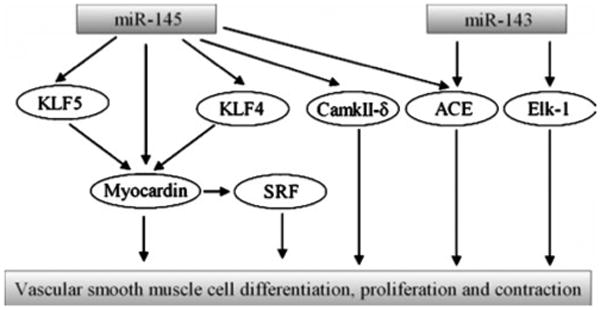
MicroRNAs (miRNAs) have emerged as a novel class of endogenous, small, non-coding RNAs that negatively regulate over 30% of genes in a cell via degradation or translational inhibition of their target mRNAs. Functionally, an individual miRNA is important as a transcription factor because it is able to regulate the expression of its multiple target genes. Recent studies have identified that miRNAs are highly expressed in vasculature and their expression is deregulated in diseased vessels. miRNAs are found to be critical modulators for vascular cell functions such as cell differentiation, migration, proliferation, and apoptosis. Accordingly, miRNAs are involved in the angiogenesis and in the pathogenesis of vascular diseases. miRNAs may serve as novel biomarkers and therapeutic targets for vascular disease. This review article summarizes the research progress regarding the roles of miRNAs in vascular biology and vascular disease.
Figures
References
-
- Ambros V. The functions of animal microRNAs. Nature. 2004;431:350–355. - PubMed
-
- Lee RC, Feinbaum RL, Ambros V. The C. elegans heterochronic gene lin-4 encodes small RNAs with antisense complementarity to lin-14. Cell. 1993;75(5):843–854. - PubMed
-
- Wightman B, Ha I, Ruvkun G. Posttranscriptional regulation of the heterochronic gene lin-14 by lin-4 mediates temporal pattern formation in C. elegans. Cell. 1993;75(5):855–862. - PubMed
-
- Lagos-Quintana M, Rauhut R, Lendeckel W, Tuschl T. Identification of novel genes coding for small expressed RNAs. Science. 2001;294(5543):853–858. - PubMed
Publication types
MeSH terms
Substances
Grants and funding
LinkOut - more resources
Full Text Sources
Other Literature Sources
Medical
