. 2009 Aug 27;52(16):5164-75.
doi: 10.1021/jm900473p.

Improving metabolic stability by glycosylation: bifunctional peptide derivatives that are opioid receptor agonists and neurokinin 1 receptor antagonists

Affiliations

Improving metabolic stability by glycosylation: bifunctional peptide derivatives that are opioid receptor agonists and neurokinin 1 receptor antagonists

Takashi Yamamoto et al. J Med Chem. .

Abstract

In order to obtain a metabolically more stable analgesic peptide derivative, O-beta-glycosylated serine (Ser(Glc)) was introduced into TY027 (Tyr-d-Ala-Gly-Phe-Met-Pro-Leu-Trp-NH-3',5'-Bzl(CF(3))(2)) which was a previously reported bifunctional compound with delta/micro opioid agonist and neurokinin-1 receptor antagonist activities and with a half-life of 4.8 h in rat plasma. Incorporation of Ser(Glc) into various positions of TY027 gave analogues with variable bioactivities. Analogue 6 (Tyr-d-Ala-Gly-Phe-Nle-Pro-Leu-Ser(Glc)-Trp-NH-3',5'-Bzl(CF(3))(2)) was found to have effective bifunctional activities with a well-defined conformation with two beta-turns based on the NMR conformational analysis in the presence of DPC micelles. In addition, 6 showed significant improvement in its metabolic stability (70 + or - 9% of 6 was intact after 24 h incubation in rat plasma). This improved metabolic stability, along with its effective and delta selective bifunctional activities, suggests that 6 could be an interesting research tool and possibly a promising candidate as a novel analgesic drug.


Figures
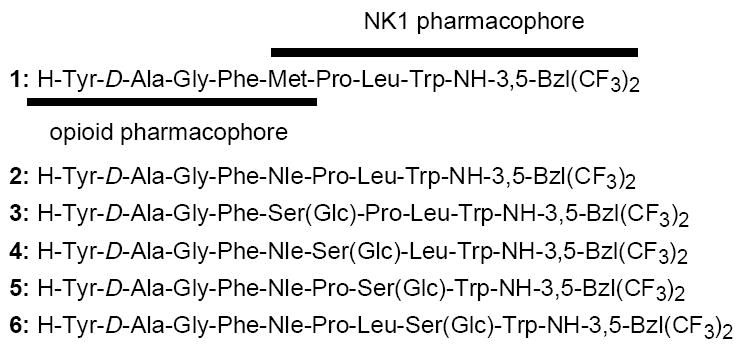
Figure 1
Figure 1
Sequences of opioid and NK1 receptor peptides.
Figure 2
Figure 2
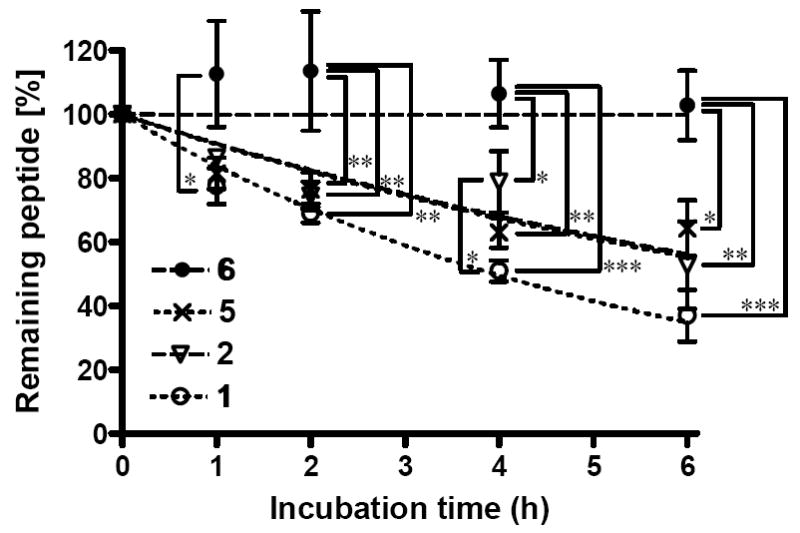
Comparison of the in vitro metabolic stability for 1 (open circle), 2 (open triangle), 5 (crossing) and 6 (filled circle) incubated in rat plasma at 37°C. Calculated half lives of peptide derivatives (T1/2) were 4.8 h for 1 and > 6 h for 2, 5 and 6. 70 ± 9 % of 6 was found intact after 24 h incubation. The samples were tested in three independent experiments (n = 3) and the mean values were used for the analysis with the SD. Statistical significance was determined by Kruskal-Wallis test followed by Tukey’s test. Asterisks denote significant differences (* p < 0.05; ** p < 0.01; *** p < 0.001).
Figure 3
Figure 3
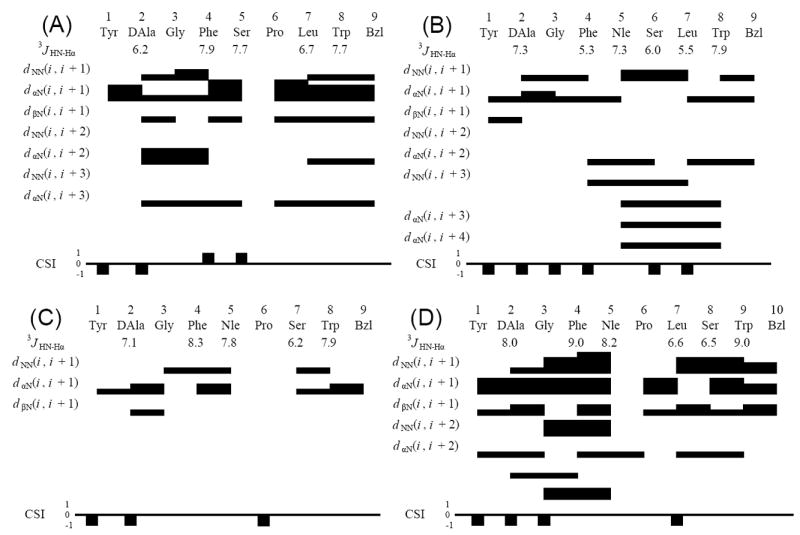
Diagram of HN-Hα coupling constants, NOE connectivities, and Hα chemical shift index (CSI) for the (A) 3, (B) 4 and (C) 5 and (D) 6. The Hα CSI was calculated using the random-coil values reported by Andersen et al.,
Figure 4
Figure 4
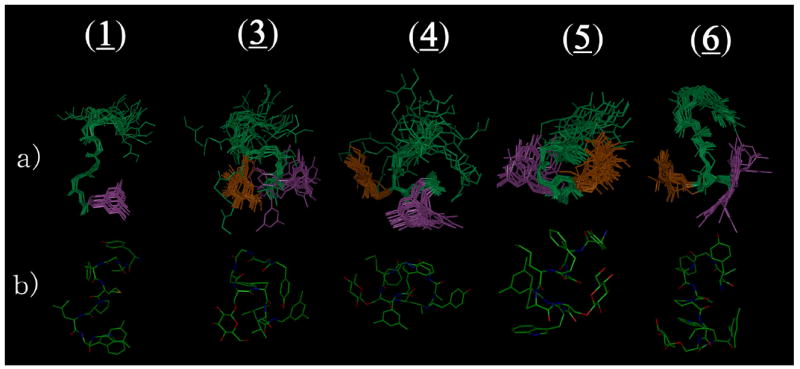
Ensembles of the best 20 calculated structures in 40-fold DPC micelle / pH 4.5 buffer for 1, 3, 4, 5 and 6, respectively, with the lowest restraint energy, (a) aligned on backbone atoms of residues 5-8. The aligned structures are illustrated with the C-terminal benzyl moiety (purple) and glucose (orange). (b) The most stable conformers are shown with all heavy atoms (C, N and O).
Figure 5
Figure 5
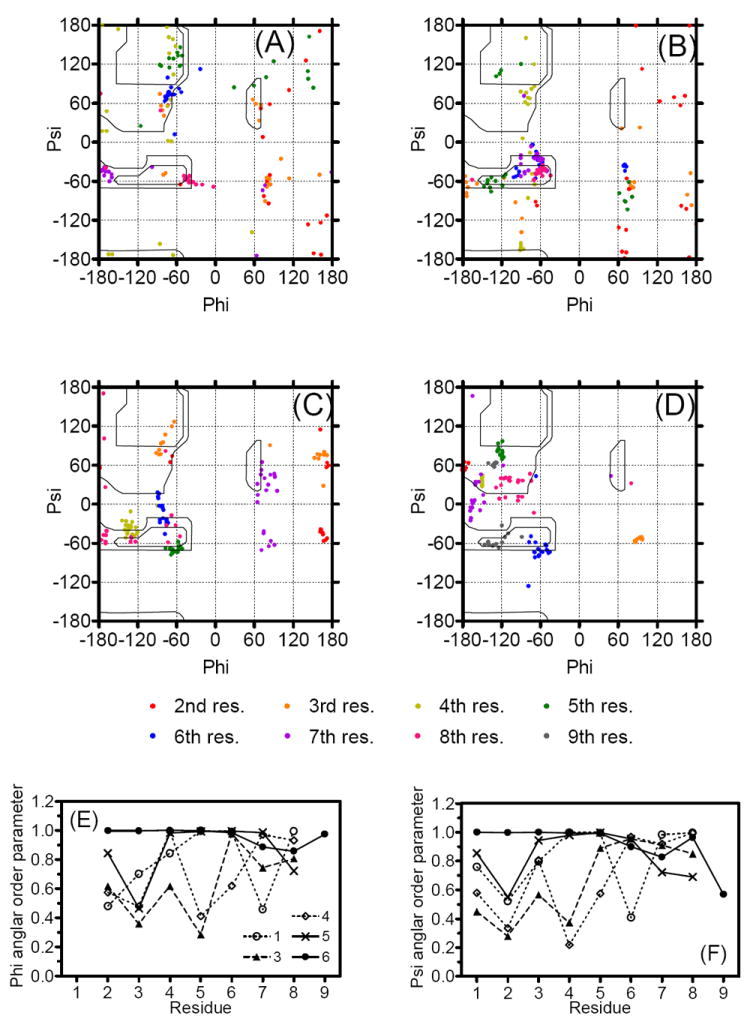
The Glycosylated Ser (crosses) and Gly (open circle) were indicated in the Ramachandran φ,ψ plots for (A) 3, (B) 4 and (C) 5 for residues 2-7 and (D) 6 for residues 2-8 of 20 final structures. Ser(OGlc) (crossing) and Gly3 (open diamond) were specified. The Nle5 with negative φ angle in 4 (circled) were illustrated in (B). Angular order parameters for φ (E) and ψ (F) angles calculated from the 20 final structures for 1 (open circle), 3 (filled triangle), 4 (open diamond), 5 (crossing) and 6 (filled circle), respectively. For calculating the ψ angles of Trp8, the nitrogen atoms of C-terminal benzyl amide were used instead of N (i + 3), respectively.
Figure 6
Figure 6
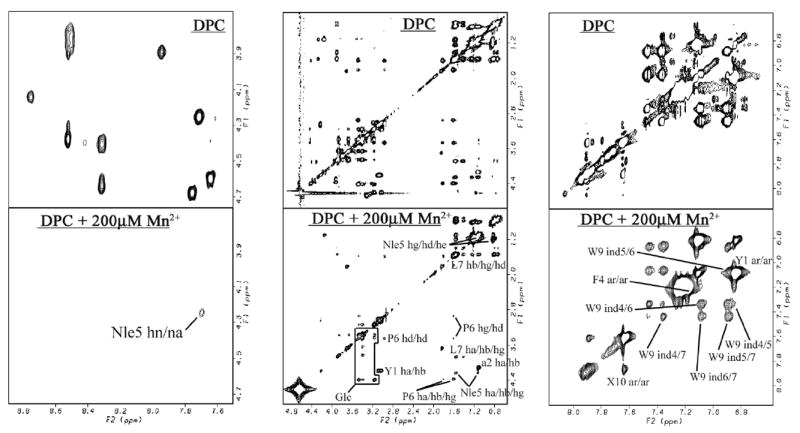
The paramagnetic effects on TOCSY Spectra of 6. 6 with DPC micelles (top row) and with 200 μM Mn2+ (bottom). Preserved resonances (labeled) are in a phase not missed by the phase-specific radical probe (Mn2+). Spectra were compared from the same noise level. X10 represents the cross-peaks derived from the corresponding aromatic protons of benzyl moiety.

References

    1. Witt KA, Davis TP. CNS drug delivery: opioid peptides and the blood-brain barrier. Aaps J. 2006;8:E76–88. - PMC - PubMed
    1. Albert R, Marbach P, Bauer W, Briner U, Fricker G, Bruns C, Pless J. SDZ CO 611: a highly potent glycated analog of somatostatin with improved oral activity. Life Sci. 1993;53:517–525. - PubMed
    1. Bilsky EJ, Egleton RD, Mitchell SA, Palian MM, Davis P, Huber JD, Jones H, Yamamura HI, Janders J, Davis TP, Porreca F, Hruby VJ, Polt R. Enkephalin glycopeptide analogues produce analgesia with reduced dependence liability. J Med Chem. 2000;43:2586–2590. - PubMed
    1. Negri L, Lattanzi R, Tabacco F, Scolaro B, Rocchi R. Glycodermorphins: opioid peptides with potent and prolonged analgesic activity and enhanced blood-brain barrier penetration. Br J Pharmacol. 1998;124:1516–1522. - PMC - PubMed
    1. Polt R, Porreca F, Szabo LZ, Bilsky EJ, Davis P, Abbruscato TJ, Davis TP, Harvath R, Yamamura HI, Hruby VJ. Glycopeptide enkephalin analogues produce analgesia in mice: evidence for penetration of the blood-brain barrier. Proc Natl Acad Sci U S A. 1994;91:7114–7118. - PMC - PubMed

Publication types

MeSH terms

LinkOut - more resources