


Review
doi: 10.3109/15419061.2010.492535.
Directed stem cell differentiation: the role of physical forces
Affiliations
- PMID: 20560867
- PMCID: PMC3285265
- DOI: 10.3109/15419061.2010.492535
Item in Clipboard
Review
Directed stem cell differentiation: the role of physical forces
Cell Commun Adhes.
2010 Apr.
Abstract
A number of factors contribute to the control of stem cell fate. In particular, the evidence for how physical forces control the stem cell differentiation program is now accruing. In this review, the authors discuss the types of physical forces: mechanical forces, cell shape, extracellular matrix geometry/properties, and cell-cell contacts and morphogenic factors, which evidence suggests play a role in influencing stem cell fate.
Figures
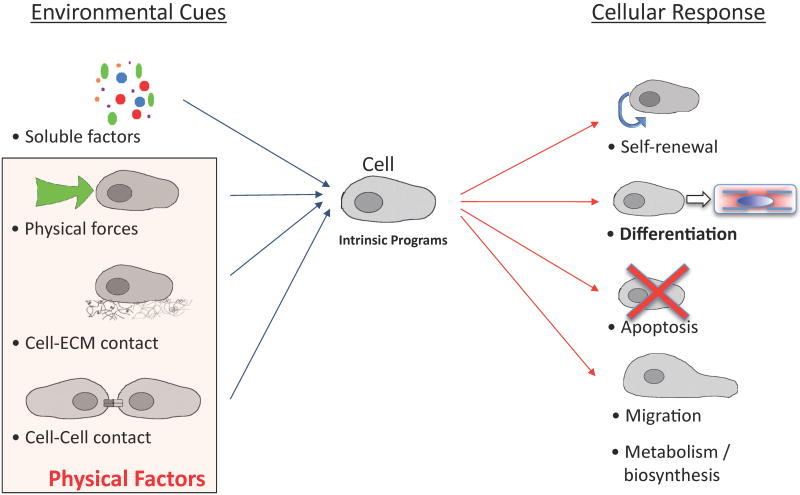
Schematic of the factors that have been shown to play a role in stem cell differentiation and the possible cellular responses to those factor.
References
-
- Abbott A. Cell culture: biology's new dimension. Nature. 2003;424(6951):870–872. - PubMed
-
- Adams D, Keller R, Koehl M. The mechanics of notochord elongation, straightening and stiffening in the embryo of Xenopus laevis. Development. 1990;110:115–130. - PubMed
-
- Altman G, Horan R, Martin I, et al. Cell differentiation by mechanical stress. FASEB J. 2002;16:270–272. - PubMed
-
- Angele P, Yoom JU, Smith C, et al. Cyclic hydrostatic pressure enhances the chondrogenic phenotype of human mesenchymal progenitor cells differentiated in vitro. J Orthop Res. 2003;21:451–457. - PubMed
-
- Arai A, Yamamoto K, Toyama J. Murine cardiac progenitor cells require visceral embryonic endoderm and primitive streak for terminal differentiation. Dev Dyn. 1997;210(3):344–353. - PubMed
Publication types
MeSH terms
Grants and funding
LinkOut - more resources
Full Text Sources
Medical
