. 2010 Aug;9(4):607-15.
doi: 10.1111/j.1474-9726.2010.00583.x. Epub 2010 Jun 17.

Lifestyle impacts on the aging-associated expression of biomarkers of DNA damage and telomere dysfunction in human blood

Affiliations

Lifestyle impacts on the aging-associated expression of biomarkers of DNA damage and telomere dysfunction in human blood

Zhangfa Song et al. Aging Cell. 2010 Aug.

Abstract

Cellular aging is characterized by telomere shortening, which can lead to uncapping of chromosome ends (telomere dysfunction) and activation of DNA damage responses. There is some evidence that DNA damage accumulates during human aging and that lifestyle factors contribute to the accumulation of DNA damage. Recent studies have identified a set of serum markers that are induced by telomere dysfunction and DNA damage, and these markers showed an increased expression in blood during human aging. Here, we investigated the influence of lifestyle factors (such as exercise, smoking, body mass) on the aging-associated expression of serum markers of DNA damage (CRAMP, EF-1alpha, stathmin, n-acetyl-glucosaminidase and chitinase) in comparison with other described markers of cellular aging (p16(INK4a) upregulation and telomere shortening) in human peripheral blood. The study shows that lifestyle factors have an age-independent impact on the expression level of biomarkers of DNA damage. Smoking and increased body mass indices were associated with elevated levels of biomarkers of DNA damage independent of the age of the individuals. In contrast, exercise was associated with an age-independent reduction in the expression of biomarkers of DNA damage in human blood. The expression of biomarkers of DNA damage correlated positively with p16(INK4a) expression and negatively with telomere length in peripheral blood T-lymphocytes. Together, these data provide experimental evidence that both aging and lifestyle impact on the accumulation of DNA damage during human aging.


Figures
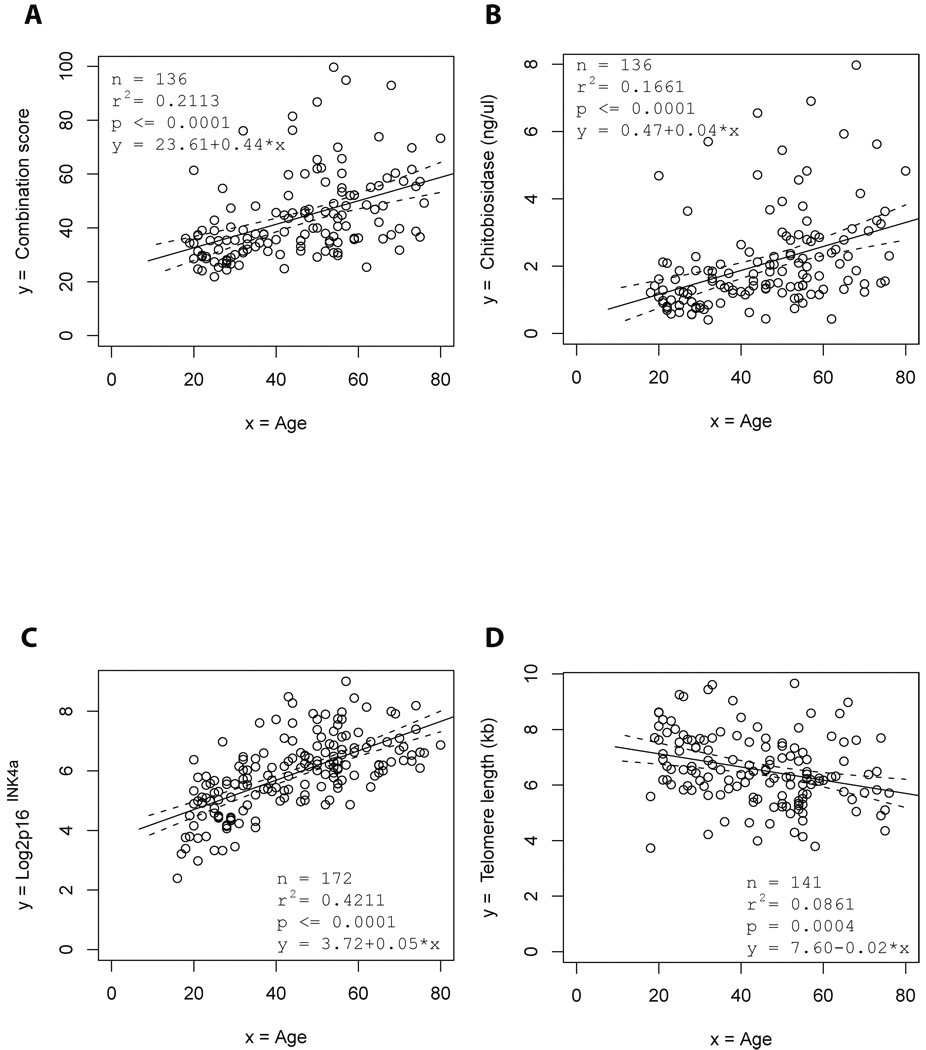
Figure 1
Figure 1. The expression of serum markers of telomere dysfunction and DNA damage is directly associated with chronological age
The graphs show the association of the indicated biomarkers with age of the blood donors. Regression analysis shows the association of age with (A) the best combination of serum levels of biomarkers of telomere dysfunction and DNA damage (combination score equals to 0.1168 × stathmin + 0.0679 × n-acetyl-glucosaminidase + 8.8630 × chitobiosidase), (B) the level of chitobiosidase activity in blood serum, (C) the expression of P16 INK4a mRNA in PBTLs, (D) the telomere length in PBTLs. The black line shows the regression line and the dashed lines the 95% confidence bands for the regression line.
Figure 2
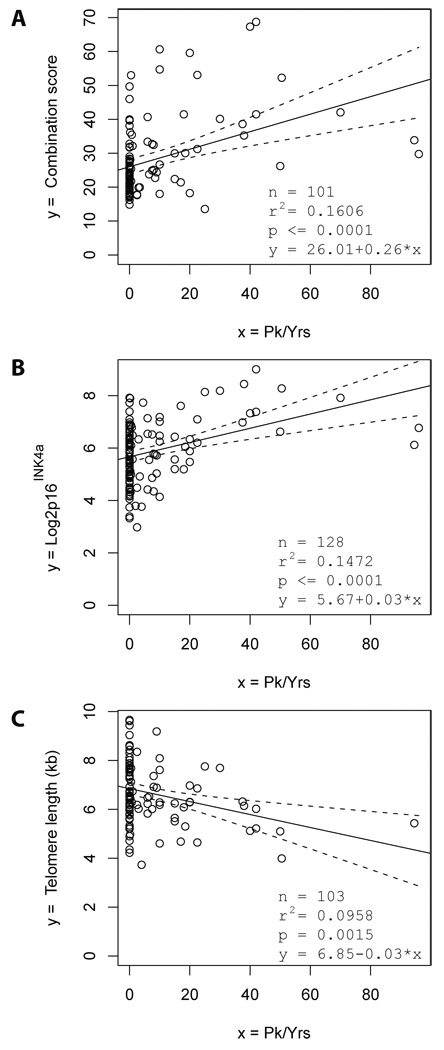
Figure 2. The dosage of smoking is directly associated with the expression of serum markers of telomere dysfunction and DNA damage
(A–C) The Regression analysis shows the correlation of tobacco smoking (measured in pack years: 1 pack per day for 1 year = 1 pack year) with (A) the best combination of serum markers of telomere dysfunction and DNA damage (combination score equals to 0.0942 × stathmin +7.2519 × chitobiosidase), (B) with the expression of P16INK4a mRNA in PBTLs, and (C) with telomere length in PBTLs. The black line shows the regression line and the dashed lines the 95% confidence bands for the regression line.
Figure 3
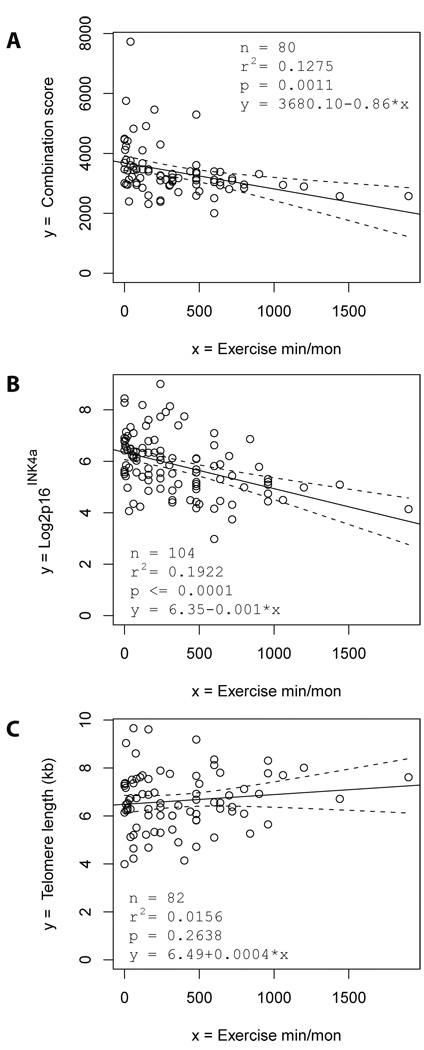
Figure 3. The duration of physical exercise is inversely associated with the expression of serum markers of telomere dysfunction and DNA damage
(A–C) The regression analysis shows the correlation between physical exercise (measured in minutes per month) with (A) the best combination score of serum markers of telomere dysfunction and DNA damage (which equals to 11.6553 × stathmin + 9.7161 × n-acetyl-glucosaminidase + 0.0201 × chitotriosidase + 8.494 × CRAMP), (B) the expression of P16 INK4a mRNA in PBTLs, and (C) the telomere length in PBTLs. The black line shows the regression line and the dashed lines the 95% confidence bands for the regression line.
Figure 4
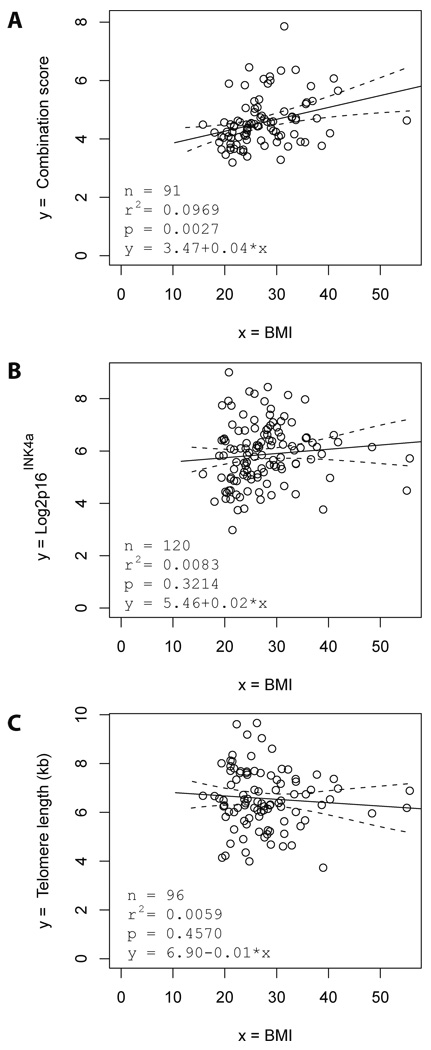
Figure 4. The body mass index (BMI) is directly associated with the expression of serum markers of telomere dysfunction and DNA damage
(A–C) Regression analysis shows the correlation of the body mass index (BMI) of the blood donors with (A) the best combination score of serum markers of telomere dysfunction and DNA damage (which equals to 0.0313 × chitobiosidase + 0.0097 × CRAMP + 4.151 × EF-1α), (B) the expression of P16 INK4a mRNA in PBTLs, and (C) the telomere length in PBTLs. The black line shows the regression line and the dashed lines the 95% confidence bands for the regression line.
Figure 5
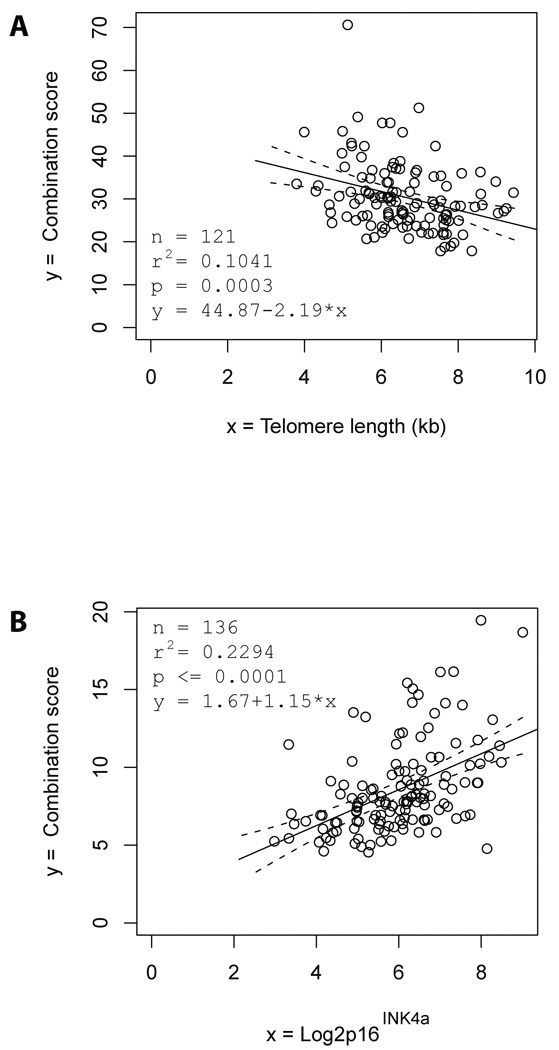
Figure 5. The combination of serum markers of telomere dysfunction and DNA damage is directly associated with expression of P16 INK4a and inversely associated with telomere length
Regression analysis showed that the combination of serum markers of telomere dysfunction and DNA damage is correlated with expression of P16 INK4a and telomere length. (A) the best combination score of serum markers of telomere dysfunction and DNA damage correlating to telomere length (0.1090 × Stathmin + 0.0948 × n-acetyl-glucosaminidase + 1.6531 × chitotriosidase), (B) the best combination score of serum markers of telomere dysfunction and DNA damage correlating to of P16 INK4a mRNA expression in blood lymphocytes (which equals to 1.7874 × chitibiosidase + 5.1279 × EF-1α). The black lines show the regression line and the dashed lines the 95% confidence bands for the regression line.

References

    1. Alcorta DA, Xiong Y, Phelps D, Hannon G, Beach D, Barrett JC. Involvement of the cyclin-dependent kinase inhibitor p16 (INK4a) in replicative senescence of normal human fibroblasts. Proc Natl Acad Sci U S A. 1996;93:13742–13747. - PMC - PubMed
    1. Allgayer H, Owen RW, Nair J, Spiegelhalder B, Streit J, Reichel C, Bartsch H. Short-term moderate exercise programs reduce oxidative DNA damage as determined by high-performance liquid chromatography-electrospray ionization-mass spectrometry in patients with colorectal carcinoma following primary treatment. Scand J Gastroenterol. 2008;43:971–978. - PubMed
    1. Cawthon RM. Telomere measurement by quantitative PCR. Nucleic Acids Res. 2002;30:e47. - PMC - PubMed
    1. Cawthon RM, Smith KR, O'Brien E, Sivatchenko A, Kerber RA. Association between telomere length in blood and mortality in people aged 60 years or older. Lancet. 2003;361:393–395. - PubMed
    1. Cherkas LF, Aviv A, Valdes AM, Hunkin JL, Gardner JP, Surdulescu GL, Kimura M, Spector TD. The effects of social status on biological aging as measured by white-blood-cell telomere length. Aging Cell. 2006;5:361–365. - PubMed

Publication types