


doi: 10.1128/AEM.00851-10.
Epub 2010 Jun 18.
Inhibition of Salmonella host cell invasion by dimethyl sulfide
Affiliations
- PMID: 20562287
- PMCID: PMC2916459
- DOI: 10.1128/AEM.00851-10
Item in Clipboard
Inhibition of Salmonella host cell invasion by dimethyl sulfide
Appl Environ Microbiol.
2010 Aug.
Abstract
We show that dimethyl sulfoxide (DMSO) inhibits Salmonella hilA expression and that this inhibition is stronger under anaerobiosis. Because DMSO can be reduced to dimethyl sulfide (DMS) during anaerobic growth, we hypothesized that DMS was responsible for hilA inhibition. Indeed, DMS strongly inhibited the expression of hilA and multiple Salmonella pathogenicity island 1 (SPI-1)-associated genes as well as the invasion of cultured epithelial cells. Because DMSO and DMS are widespread in nature, we hypothesize that this phenomenon may contribute to environmental sensing by Salmonella.
Figures
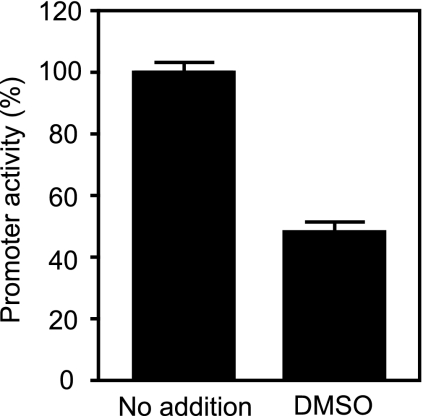
DMSO inhibits hilA expression. The activity of the hilA promoter in cultures grown in the presence of 275 mM DMSO is shown as a percentage of the activity in cultures grown in the absence of DMSO. The results shown represent the averages for five replicates. Error bars indicate the standard errors of the means.
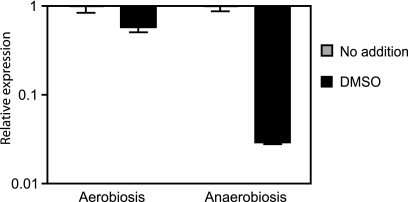
The effect of DMSO on hilA expression is more pronounced during anaerobic growth. Transcript levels of hilA in cultures grown in the absence or presence of 275 mM DMSO were assessed by RT-PCR. Transcript levels from cultures without DMSO were normalized to 1, and the results from cultures grown in the presence of DMSO were normalized accordingly. In the absence of DMSO, hilA was expressed at relatively high levels; the average numbers of cycles required for hilA detection were 18.6 for aerobic and 20.1 for anaerobic cultures. For comparison purposes, gapA detection occurred after 16.2 cycles during aerobic growth and after 19 cycles during anaerobic growth. The results shown represent the averages for five (aerobiosis) or six (anaerobiosis) replicates. Error bars indicate the standard errors of the means.
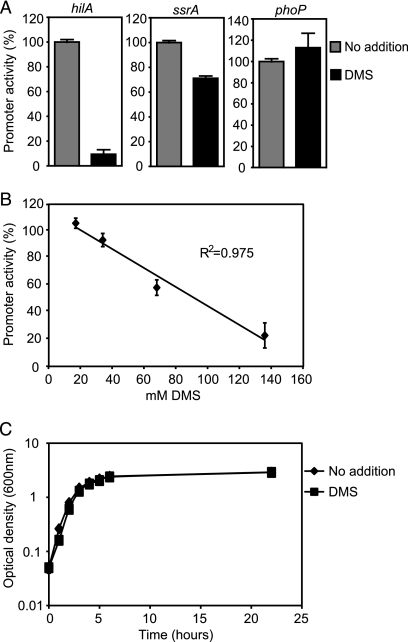
DMS inhibits hilA expression. (A) The expression of hilA in bacterial cultures grown in the absence or presence of 135 mM DMS using the reporter strain was measured. The results are shown as percentages of the activity of cultures grown in the absence of DMS and represent the averages for three (ssrA and phoP) or eight (hilA) replicates. Error bars indicate the standard errors of the means. (B) The effect of DMS on hilA expression is dose dependent. The activity of the reporter strain in the presence of the indicated DMS concentrations was monitored and is shown as percentage of the activity of cultures grown in the absence of DMS. The results shown represent the averages for six replicates. Error bars indicate the standard errors of the means. (C) The effect of DMS on hilA expression is not due to an effect on bacterial fitness. Growth of S. Typhimurium in the absence or presence of 135 mM DMS was monitored over time through optical density (600 nm) measurements. The results shown represent the averages for five replicates. Error bars indicate the standard errors of the means.
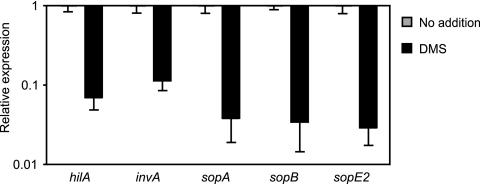
DMS inhibits multiple SPI-1-associated genes. Transcript levels of SPI-1-associated genes in cultures grown in the absence or presence of 135 mM DMS were assessed by RT-PCR. Transcript levels from cultures without DMS were normalized to 1, and the results from cultures grown in the presence of DMS were normalized accordingly. In the absence of DMS, all genes were expressed at relatively high levels; the average numbers of cycles required for detection were 18.7 for hilA, 24.1 for invA, 17.2 for sopA, 14.3 for sopB, and 15.9 for sopE2. For comparison purposes, gapA detection occurred after 16.2 cycles. The results shown represent the averages for five replicates. Error bars indicate the standard errors of the means.
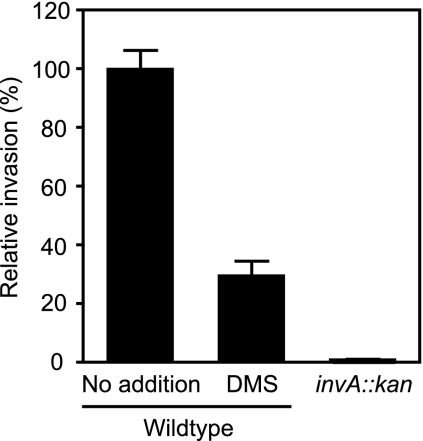
DMS inhibits S. Typhimurium host cell invasion. Invasion was assessed through a standard gentamicin protection assay (see text). The invasions of host cells were compared using S. Typhimurium cultures grown in the absence or presence of 135 mM DMS. The result for an invasion-deficient (invA::kan) mutant is shown for comparison. The results shown represent the averages for eight (wild-type) or three (mutant) replicates. Error bars indicate the standard errors of the means.
References
-
- Bajaj, V., R. L. Lucas, C. Hwang, and C. A. Lee. 1996. Co-ordinate regulation of Salmonella typhimurium invasion genes by environmental and regulatory factors is mediated by control of hilA expression. Mol. Microbiol. 22:703-714. - PubMed
-
- Bentley, R., and T. G. Chasteen. 2004. Environmental VOSCs—formation and degradation of dimethyl sulfide, methanethiol and related materials. Chemosphere 55:291-317. - PubMed
-
- Charlson, R. J., J. E. Lovelock, M. O. Andreae, and S. G. Warren. 1987. Oceanic phytoplankton, atmospheric sulphur, cloud albedo and climate. Nature 326:655-661.
Publication types
MeSH terms
Substances
Grants and funding
LinkOut - more resources
Full Text Sources
Medical
