. 2010 Sep;299(3):H763-71.
doi: 10.1152/ajpheart.00345.2010. Epub 2010 Jun 18.

Angiotensin-(1-12) requires angiotensin converting enzyme and AT1 receptors for cardiovascular actions within the solitary tract nucleus

Affiliations

Angiotensin-(1-12) requires angiotensin converting enzyme and AT1 receptors for cardiovascular actions within the solitary tract nucleus

Amy C Arnold et al. Am J Physiol Heart Circ Physiol. 2010 Sep.

Abstract

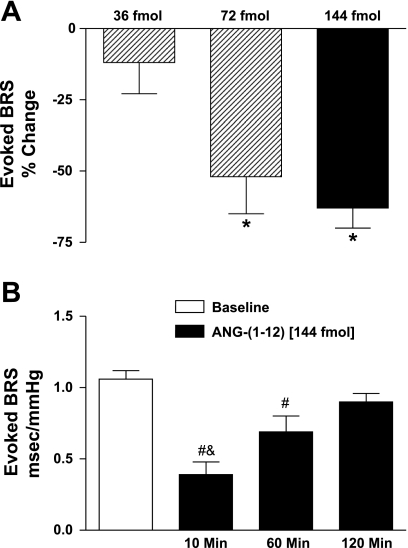
The novel peptide, angiotensin (ANG)-(1-12), elicits a systemic pressor response and vasoconstriction. These effects are blocked by ANG converting enzyme (ACE) inhibitors or AT(1) receptor antagonists, suggesting a role as an ANG II precursor. However, ANG-(1-12) can serve as a substrate for either ANG II or ANG-(1-7) formation, depending on the local tissue enzymes. Although levels of ANG-(1-12) are higher than ANG I or ANG II in brain, the role and processing of this peptide for autonomic control of heart rate (HR) has yet to be considered. Thus we examined the effects of nucleus tractus solitarii (NTS) microinjection of ANG-(1-12) on baroreflex sensitivity for control of HR, resting arterial pressure (AP) and HR, and indexes of sympathovagal balance in urethane/chloralose anesthetized Sprague-Dawley rats. NTS injection of ANG-(1-12) (144 fmol/120 nl) significantly impaired the evoked baroreflex sensitivity to increases in AP [n = 7; 1.06 +/- 0.06 baseline vs. 0.44 +/- 0.07 ms/mmHg after ANG-(1-12)], reduced the vagal component of spontaneous baroreflex sensitivity and HR variability, and elicited a transient depressor response (P < 0.05). NTS pretreatment with an AT(1) receptor antagonist or ACE inhibitor prevented ANG-(1-12)-mediated autonomic and depressor responses. ANG-(1-12) immunostaining was observed in cells within the NTS of Sprague-Dawley rats, providing a potential intracellular source for the peptide. However, acute NTS injection of an ANG-(1-12) antibody did not alter resting baroreflex sensitivity, AP, or HR in these animals. Collectively, these findings suggest that exogenous ANG-(1-12) is processed to ANG II for cardiovascular actions at AT(1) receptors within the NTS. The lack of acute endogenous ANG-(1-12) tone for cardiovascular regulation in Sprague-Dawley rats contrasts with chronic immunoneutralization in hypertensive rats, suggesting that ANG-(1-12) may be activated only under hypertensive conditions.


Figures
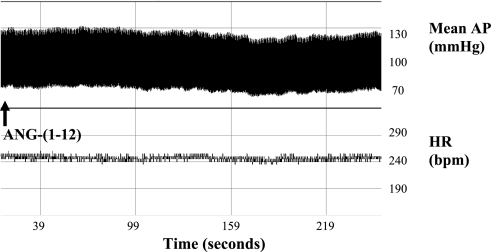
Fig. 1.
Fig. 1.
Representative pressure and heart rate (HR) response to nucleus tractus solitarii (NTS) injection of ANG-(1–12). Representative tracing of mean arterial pressure (AP) and HR in response to NTS injection of the 144 fmol ANG-(1–12) dose is shown. ANG-(1–12) elicited a transient depressor response that peaked at 3 min, with no significant effect on HR. bpm, beats/min.
Fig. 2.
Fig. 2.
ANG-(1–12)-mediated impairments in baroreflex sensitivity (BRS). A: bilateral NTS injection of ANG-(1–12) (36, 72, or 144 fmol; n = 4, 4, or 7) produced dose-dependent impairments in BRS for control of heart rate in response to increases in arterial pressure. B: ANG-(1–12) injection (144 fmol) significantly impaired the BRS at 10 and 60 min with recovery to baseline levels at 120 min (n = 4). *P < 0.05 vs. 36 fmol; #P < 0.05 vs. baseline; &P < 0.05 vs. 60 and 120 min.
Fig. 3.
Fig. 3.
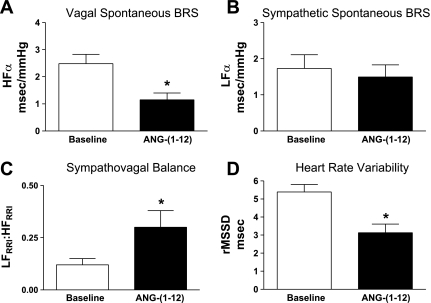
Spontaneous BRS and indexes of sympathovagal balance. NTS injection of ANG-(1–12) (144 fmol; n = 7) impaired the vagal component (A) with no effect on the sympathetic component (B) of the spontaneous BRS, resulting in an overall increase in sympathovagal balance (C). ANG-(1–12) injection also significantly reduced heart rate variability (D). HF, high frequency; LF, low frequency; rMSSD, root mean square of successive differences; RRI, beat-to-beat interval. *P < 0.05 vs. baseline.
Fig. 4.
Fig. 4.
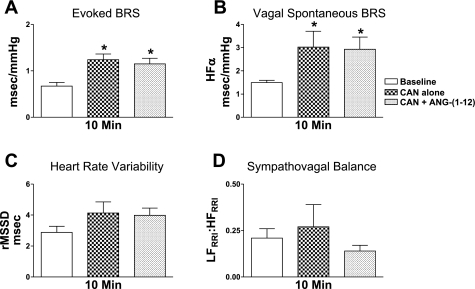
Effect of AT1 receptor antagonist pretreatment on ANG-(1–12) responses. A: candesartan (CAN; n = 4) significantly improved the evoked BRS (A) and vagal component of the spontaneous BRS (B) with no effect on heart rate variability (C) or sympathovagal balance (D) at 10 min after NTS injection. Candesartan pretreatment prevented ANG-(1–12)-mediated impairments in BRS and the shift in sympathovagal balance toward increased sympathetic activity. *P < 0.05 vs. baseline.
Fig. 5.
Fig. 5.
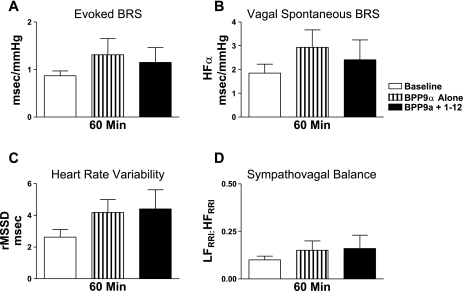
Effect of ANG converting enzyme (ACE) inhibitor pretreatment on ANG-(1–12) responses. A: NTS injection of bradykinin potentiating peptide 9-α (BPP9α; n = 4) had no significant effect on the evoked BRS (A), parasympathetic component of spontaneous BRS (B), heart rate variability (C), or sympathovagal balance (D) at 60 min. BPP9a pretreatment prevented ANG-(1–12)-mediated impairments in BRS and heart rate variability as well as the shift in sympathovagal balance.
Fig. 6.
Fig. 6.
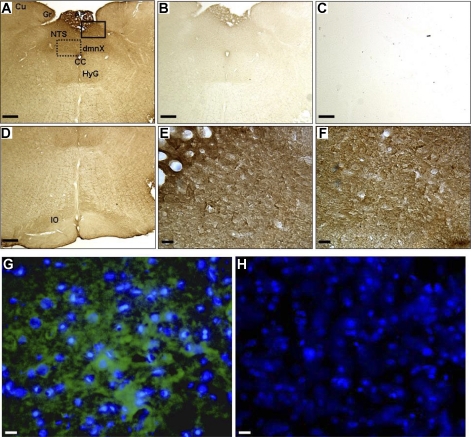
Immunolocalization of ANG-(1–12). Paraformaldehyde-fixed, frozen brain sections (n = 3 and 30 μm) were incubated with the ANG-(1–12) antibody to determine expression of ANG-(1–12) in dorsal medulla of Sprague-Dawley rats. 3,3′-Diaminobenzidine (AF) and immunofluorescence (G and H) staining show ANG-(1–12) expression in various brainstem regions, including the NTS, in representative adjacent sections at ∼−13.8 mm caudal to bregma. ANG-(1–12) immunostaining was widely expressed in the medulla (A and D; 5×). Control sections (5×) were incubated with 40 μM ANG-(1–12) peptide together with the ANG-(1–12) antibody (B) or no ANG-(1–12) antibody (C). A higher magnification (40×) shows ANG-(1–12)-like immunoreactivity in cell bodies and fibers in the area postrema (E), NTS (E), and dorsal motor nucleus of the vagus (F). Adjacent sections were incubated with the ANG-(1–12) antibody (G) or no primary antibody (H) for immunofluorescence localization. ANG-(1–12) fluorescence is shown in green and nuclei in blue (40×). dmnX, Dorsal motor nucleus of the vagus; Cu, cuneate nucleus; Gr, nucleus gracilis; CC, central canal; HyG, hypoglossal nucleus; IO, inferior olivary nucleus. Scale bars: AD, 100 μm, and EH, 10 μm.

References

    1. Akselrod S, Gordon D, Madwed JB, Snidman NC, Shannon DC, Cohen RJ. Hemodynamic regulation: investigation by spectral analysis. Am J Physiol Heart Circ Physiol 249: H867–H875, 1985 - PubMed
    1. Andresen MC, Kunze DL. Nucleus tractus solitarius—gateway to neural circulatory control. Annu Rev Physiol 56: 93–116, 1994 - PubMed
    1. Arnold AC, Sakima A, Ganten D, Ferrario CM, Diz DI. Modulation of reflex function by endogenous angiotensins in older transgenic rats with low glial angiotensinogen. Hypertension 51: 1326–1331, 2008 - PMC - PubMed
    1. Arnold AC, Shaltout HA, Gallagher PE, Diz DI. Leptin impairs cardiovagal baroreflex function at the level of the solitary tract nucleus. Hypertension 54: 1001–1008, 2009 - PMC - PubMed
    1. Campagnole-Santos MJ, Diz DI, Ferrario CM. Baroreceptor reflex modulation by angiotensin II at the nucleus tractus solitarii. Hypertension 11: I167–I171, 1988 - PubMed

Publication types

MeSH terms