. 2010 Aug;17(8):997-1003.
doi: 10.1038/nsmb.1866. Epub 2010 Jun 18.

Unique functionality of 22-nt miRNAs in triggering RDR6-dependent siRNA biogenesis from target transcripts in Arabidopsis

Affiliations

Unique functionality of 22-nt miRNAs in triggering RDR6-dependent siRNA biogenesis from target transcripts in Arabidopsis

Josh T Cuperus et al. Nat Struct Mol Biol. 2010 Aug.

Abstract

RNA interference pathways can involve amplification of secondary siRNAs by RNA-dependent RNA polymerases. In plants, RDR6-dependent secondary siRNAs arise from transcripts targeted by some microRNAs (miRNAs). Here, Arabidopsis thaliana secondary siRNAs from mRNA as well as trans-acting siRNAs are shown to be triggered through initial targeting by a 22-nucleotide (nt) miRNA that associates with AGO1. In contrast to canonical 21-nt miRNAs, 22-nt miRNAs primarily arise from foldback precursors containing asymmetric bulges. Using artificial miRNA constructs, conversion of asymmetric foldbacks to symmetric foldbacks resulted in the production of 21-nt forms of miR173, miR472 and miR828. Both 21- and 22-nt forms associated with AGO1 and guided accurate slicer activity, but only 22-nt forms were competent to trigger RDR6-dependent siRNA production from target RNA. These data suggest that AGO1 functions differentially with 21- and 22-nt miRNAs to engage the RDR6-associated amplification apparatus.


Figures

Figure 1
Figure 1
Small RNA from Arabidopsis annotated transcripts. (a) Proportion of small RNA-generating transcripts that are targeted (at single or multiple sites) by miRNA or tasiRNA, or non-targeted. Outer rings show proportion of small RNA size. (b) Mean 20–24 nt siRNA levels from targeted or non-targeted transcripts. (c) Non-redundant small RNA-target transcript pairs yielding four levels (bins) of 21 nt siRNA in Col-0 and dcl2-1 dcl3-1 dcl4-2 (dcl234) mutant plants. Data are from averages of six (Col-0) and five (dcl234) replicates. (d) Box plots showing the mean numbers of 21 nt siRNA originating from non-redundant transcripts targeted by small RNA that are 22 nt or less than 22 nt in length.
Figure 2
Figure 2
MIRNA foldback asymmetry leads to formation of 22 nt miRNAs. (a) Mean proportions of distinct miRNA size classes in read datasets (top), and of predominant size class for MIRNA families (bottom), from Arabidopsis and rice. The rice miRNA were from a filtered subset that passed basic criteria for bona fide miRNA (see Supplemental Table 4). (b) Rank order showing proportion of 22 nt size class, from averages of sequencing datasets, corresponding to non-redundant MIRNA loci in Arabidopsis and rice. Multigene MIRNA families with loci encoding the identical miRNA, but that have both symmetric and asymmetric foldbacks, are color coded grey. (c) Proportion of 22 nt miRNA from non-redundant MIRNA loci with base-pair asymmetry or symmetry within the miRNA/miRNA* segment of the foldback. (d) Examples of 22 nt miRNA-generating MIRNA foldbacks, average miRNA size distribution, and proportion of target transcripts that yield 21 nt siRNA (at least four reads from 4/6 replicate libraries). Green arrows indicate the predicted asymmetric position within the foldbacks.
Figure 3
Figure 3
Production and activities of 21 and 22 nt miR173 forms. (a) Foldbacks of from wild-type MIR173, amiR173 and amiR173-21. Artificial miRNAs were engineered within the MIR390a foldback. miRNA guide and miRNA* strands are represented with green and red, respectively. The arrows indicate the predicted asymmetric position in MIR173 and amiR173 foldbacks. (b) Accumulation of miR173 and TAS1c tasiRNA (siR255) in N. benthamiana transient assays. Constructs were coexpressed as indicated above the blot panels. Mean (n=3) relative miR173 (red) and siR255 (blue) levels +/− SD (lane 2 and lane 3 = 1.0 for miR173 and tasiRNA255 respectively) were plotted (top). One of three biological replicates of the blot data, and EtBr-stained rRNA as loading controls, are shown (bottom). (c) Analysis of miR173 (from 35S:MIR173, 35S:amiR173 and 35S:amiR173-21) and TAS1c-derived siRNA sequences by high-throughput sequencing after transient assays in N. benthamiana. Pie charts display the percentage of 18–24 nt reads. Radar plots display percentages of 21 nt reads corresponding to each of the 21 registers from TAS1c transcripts, with position 1 designated as immediately after the miR173-guided cleavage site. (d) Analysis of co-immunoprecipitation of 21 nt and 22 nt miR173 variants with HA-AGO1. Protein and RNA blot assays using input (in) and IP (HA) fractions from N. benthamiana following coexpression of 35S:HA-AGO1 and 35S:TAS1c with 35S:MIR173, 35S:amiR173 and 35S:amiR173-21. The TAS1c 3'D2(−) panel shows an HA-AGO1-nonassociated tasiRNA generated from the TAS1c transcript as an IP control. U6 RNA and EtBr-stained rRNA were included as input loading and HA-AGO1-nonassociated controls. (e) EtBr-stained 5' RACE products corresponding to the 3' cleavage product from miR173-guided cleavage. N. benthamiana actin RT-PCR products are shown as a control. (f) Proportion of cloned 5' RACE products corresponding to cleavage within TAS1c transcripts at the canonical miR173-guided site in assays with amiR173 and amiR173-21.
Figure 4
Figure 4
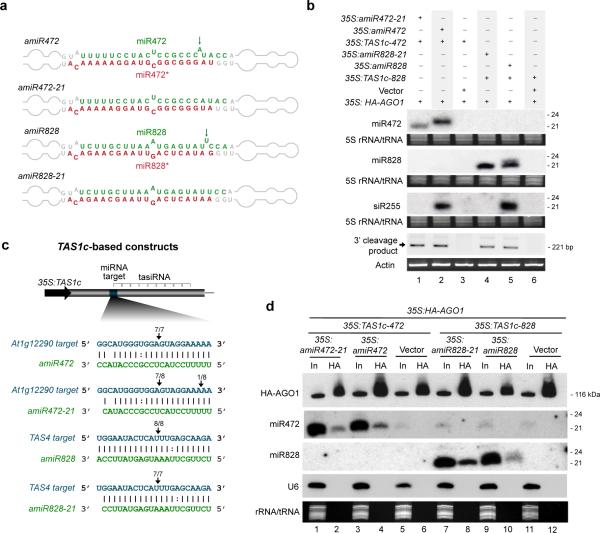
Production and activities of 21 and 22 nt miR472 and miR828 forms. (a) Foldbacks of amiR828, amiR828-21, amiR472, and amiR472-21. (b) Accumulation of miR472, miR828 and modified TAS1c tasiRNA (siR255), and 5'RACE to detect miRNA-guided cleavage products of the modified TAS1c transcripts, in N. benthamiana transient assays. (c) Proportion of cloned 5' RACE products corresponding to cleavage within modified TAS1c transcripts at the canonical miR472- or miR828-guided sites in assays with the designated artificial miRNAs. The target site sequences are actual sites from At1g12290 and TAS4 transcripts, which are recognized by miR472 and miR828, respectively. (d) Analysis of co-immunoprecipitation of 21 nt and 22 nt amiR472 and amiR828 variants with HA-AGO1. Protein and RNA assays for input (in) and IP (HA) fractions from N. benthamiana expressing the amiR472 and amiR828 variants were done using blots containing samples from both sets of experiments. U6 RNA and EtBr-stained rRNA were included as input loading and HA-AGO1-non-associated controls.

References

    1. Kim VN, Han J, Siomi MC. Biogenesis of small RNAs in animals. Nat Rev Mol Cell Biol. 2009;10:126–139. - PubMed
    1. Ghildiyal M, Zamore PD. Small silencing RNAs: an expanding universe. Nat Rev Genet. 2009;10:94–108. - PMC - PubMed
    1. Guang S, et al. An Argonaute transports siRNAs from the cytoplasm to the nucleus. Science. 2008;321:537–541. - PMC - PubMed
    1. Gu W, et al. Distinct argonaute-mediated 22G-RNA pathways direct genome surveillance in the C. elegans germline. Mol Cell. 2009;36:231–244. - PMC - PubMed
    1. Claycomb JM, et al. The Argonaute CSR-1 and its 22G-RNA cofactors are required for holocentric chromosome segregation. Cell. 2009;139:123–134. - PMC - PubMed

Publication types

MeSH terms

Associated data