


doi: 10.1038/nmeth.1473.
Epub 2010 Jun 20.
Rationally improving LOV domain-based photoswitches
Affiliations
- PMID: 20562867
- PMCID: PMC2914111
- DOI: 10.1038/nmeth.1473
Item in Clipboard
Rationally improving LOV domain-based photoswitches
Nat Methods.
2010 Aug.
Abstract
Genetically encoded protein photosensors are promising tools for engineering optical control of cellular behavior; we are only beginning to understand how to couple these light detectors to effectors of choice. Here we report a method that increases the dynamic range of an artificial photoswitch based on the LOV2 domain of Avena sativa phototropin 1 (AsLOV2). This approach can potentially be used to improve many AsLOV2-based photoswitches.
Figures

Conformational and binding equilibria in AsLOV2 and LovTAP. (a) Photoexcitation (hν) of AsLOV2 (blue) is accompanied by displacement and unfolding of the Jα helix (dark blue). (b) In AsLOV2 (left), photoactivation shifts the equilibrium from mostly docked to mostly undocked. Black lines, dark-state free energy surfaces; dashed lines, lit-state free energy surfaces. Upon fusion with an effector (center), the equilibrium is shifted due to interactions with the effector and the helix is mostly undocked in the dark and lit states. As a consequence, the effector is mostly active in both states. Helix stabilizing mutations specifically stabilize the docked state (ΔG = – RT ln xeff), bringing the equilibrium back into a regime where the effector is mostly inactive in the dark, and photoactivation shifts the equilibrium from mostly inactive to mostly active. (c) Khelix, equlibrium constant of helix undocking for the isolated LOV2 domain. The fusion protein LovTAP is in equilibrium between an inactive conformation (left), in which the shared helix is docked on the LOV domain, and an active conformation (center), in which it is docked on the TrpR domain. Due to competition by TrpR (orange) for the helix, the equilibrium constant of the helix undocking reaction, Khelix, is increased by a factor 1 / xeff. In the active conformation, LovTAP binds DNA with an intrinsic association constant KDNA.
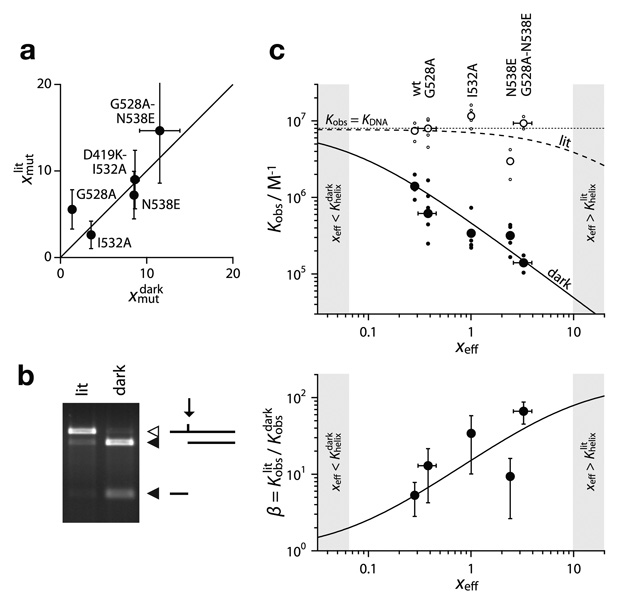
Mutational stabilization LOV–Jα association and its effect on DNA binding activity in LovTAP. (a) Comparison of CD-derived xlit
mut with NMR-derived xdark
mut for AsLOV2 with the indicated mutations. The identity line is shown as a reference. (b) Gel image of RsaI protection assay for LovTAP(G528A, N538E). Open and closed triangles denote reactant and product bands, respectively. (c) Effects of the helix-stabilizing mutations on LovTAP. In the upper panel, observed affinity constants (Kobs) are plotted against xeff. Large data points are average Kobs values, and small points show individual measurements. The data are compared to Eqs. 4 and 5 (solid and dashed lines). For wild-type LovTAP, xeff = xfus is calculated using Eq. 3. For mutants, xmut is determined by NMR, and xeff = xmut
xfus. In the lower panel, β= Klit
obs / Kdark
obs is plotted as a function of xeff and compared to Eq. 6. The shaded regions indicate regimes where β is relatively insensitive to changes in xeff.
Comment in
-
Hold me tightly LOV.Nat Methods. 2010 Aug;7(8):595, 597. doi: 10.1038/nmeth0810-595. Nat Methods. 2010. PMID: 20676078 No abstract available.
References
Publication types
MeSH terms
Substances
Grants and funding
LinkOut - more resources
Full Text Sources
Other Literature Sources
Research Materials
