. 2010 Jul;5(7):520-4.
doi: 10.1038/nnano.2010.107. Epub 2010 Jun 20.

Self-assembly of three-dimensional prestressed tensegrity structures from DNA

Affiliations

Self-assembly of three-dimensional prestressed tensegrity structures from DNA

Tim Liedl et al. Nat Nanotechnol. 2010 Jul.

Abstract

Tensegrity, or tensional integrity, is a property of a structure indicating a reliance on a balance between components that are either in pure compression or pure tension for stability. Tensegrity structures exhibit extremely high strength-to-weight ratios and great resilience, and are therefore widely used in engineering, robotics and architecture. Here, we report nanoscale, prestressed, three-dimensional tensegrity structures in which rigid bundles of DNA double helices resist compressive forces exerted by segments of single-stranded DNA that act as tension-bearing cables. Our DNA tensegrity structures can self-assemble against forces up to 14 pN, which is twice the stall force of powerful molecular motors such as kinesin or myosin. The forces generated by this molecular prestressing mechanism can be used to bend the DNA bundles or to actuate the entire structure through enzymatic cleavage at specific sites. In addition to being building blocks for nanostructures, tensile structural elements made of single-stranded DNA could be used to study molecular forces, cellular mechanotransduction and other fundamental biological processes.


Figures
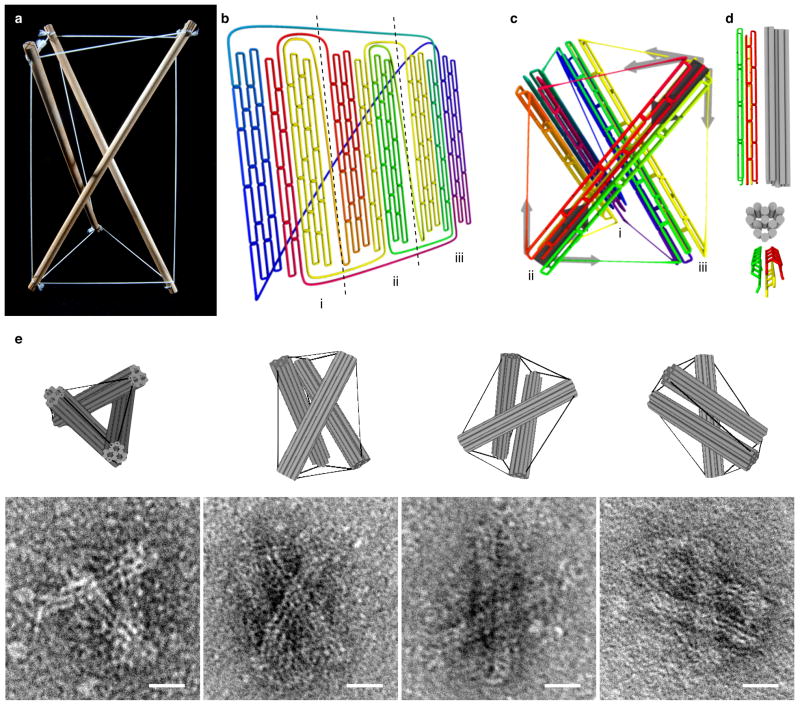
Figure 1
Figure 1. 3D prestressed DNA tensegrity
a, Tensegrity prism constructed from wood and cord. b, Quasi-2D representation of the scaffold pathway through the prestressed tensegrity prism. The color code indicates the nucleotide (nt) index along the circular path. Red represents the first nt on the 8634-nt-long scaffold, violet the last nt. The three struts are labeled as i, ii, iii. c, 3D representation of the scaffold pathway for the assembled prism. Staple strands are omitted for clarity. Light grey arrows denote the contractile forces exerted by the ssDNA springs, while dark grey arrows indicate the sum of compressive forces along the axis of the 13-helix bundle. d, Cylinder and scaffold models of an individual 13-helix bundle. Every cylinder represents one double helix. e, Electron micrographs and cylinder models of DNA tensegrity prisms. Scale bars: 20 nm.
Figure 2
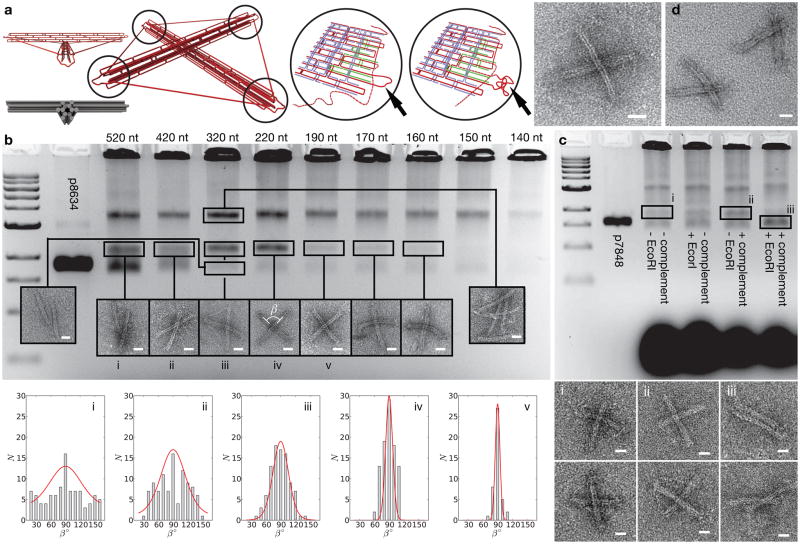
Figure 2. DNA tensegrity-structure kite
a, 3D scaffold path representation for the prestressed tensegrity kite and transmission electron micrograph of assembled object with 220 nt-long springs. Changes of the spring lengths of a DNA tensegrity structure can be achieved by spooling of the scaffold DNA. Staple strands that have to be exchanged to achieve a shortening of a spring are depicted in green. b, Gel and TEM analysis of kites equipped with varying spring lengths between the ends of the struts. Left to right: 2-Log DNA ladder, p8634 scaffold, 520 nt, 420 nt, 320 nt, 220 nt, 190 nt, 170 nt, 160 nt, 150 nt, 140 nt. The bands containing the various objects were extracted and investigated with TEM. Below: Histograms of observed angles β between the struts. c, A 12-helix–bundle kite with four springs of equal length (300 nt) was designed such that the restriction site for EcoRI is located in one of the 300-nt–spring regions. Gel and TEM analysis shows that the enzymes only cut the springs when the complementary sequence to the restriction site is present during folding. Species cut out of gel and analyzed by TEM are indicated as i, ii, iii. d, TEM image of kites with one short spring (140 nt) and three longer springs (320 nt). All scale bars: 20 nm.
Figure 3
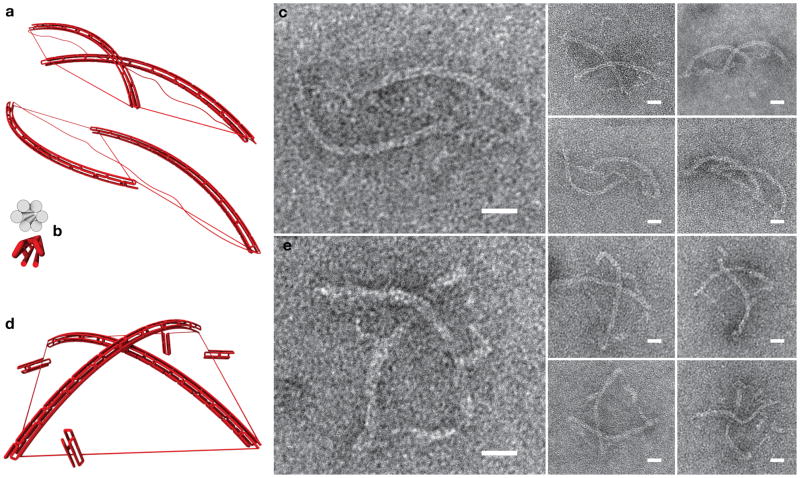
Figure 3. Force generation with DNA tensegrity objects
Six-helix bundles under compression buckle if the compressive force exceeds the critical Euler force Fc. a, Models of distorted tensegrity kites with 128 nm long six-helix-bundle struts, three short ssDNA springs that are 273-nt long, and a long fourth spring that is 2207-nt long. b, Profile views of the design of the struts, cylinder model and scaffold path representation. c, TEM micrographs of gel purified objects of the type shown in (a). d, Model of a buckling kite with four springs of equal length (486 nt each, length adjusted with four six-helix-bundle clamps). e, TEM micrographs of gel purified buckling kites. By measuring the end-to-end distance, c, of multiple six-helix bundles like in (c) and (e), the resultant force acting on the six-helix bundle ends, Fs, could be estimated to be 4 pN. Equating the obtained value with Fc leads to an estimated persistence length P of the six-helix bundle of 1.4 μm. This is in good agreement with a P-value obtained for gel-purified, ethidium-bromide-soaked six-helix bundles by independent measurements (cf. Fig. S7). All scale bars: 20 nm.

Comment in

  • Help from above.
    [No authors listed] [No authors listed] Nat Nanotechnol. 2010 Jul;5(7):473. doi: 10.1038/nnano.2010.147. Nat Nanotechnol. 2010. PMID: 20606634

References

    1. Snelson K. Snelson on the tensegrity invention. Int J Space Struct. 1996;11:43–48.
    1. Fuller B. Synergetics-Explorations in the Geometry of Thinking. I & II. New York: Macmillan Publishing Co; 1975, 1979.
    1. Skelton RE, Adhikari R, Pinaud JP, Chan W. An Introduction to the Mechanics of Tensegrity Structures. IEEE Decis Contr P. 2001;5:4254–4259.
    1. Sultan C, Corless M, Skelton RE. The Prestressabilty Problem of Tensegrity Structures: Some Analytical Solutions. Int J Solids Struct. 2001;38:5223–5252.
    1. Visscher K, Schnitzer MJ, Block SM. Single kinesin molecules studied with a molecular force clamp. Nature. 1999;400:184–189. - PubMed

Publication types