Review
. 2010;94(5):659-64.
doi: 10.1002/bip.21416.

Ribosomal biosynthesis of the cyclic peptide toxins of Amanita mushrooms

Affiliations
Review

Ribosomal biosynthesis of the cyclic peptide toxins of Amanita mushrooms

Jonathan D Walton et al. Biopolymers. 2010.

Abstract

Some species of mushrooms in the genus Amanita are extremely poisonous and frequently fatal to mammals including humans and dogs. Their extreme toxicity is due to amatoxins such as alpha- and beta-amanitin. Amanita mushrooms also biosynthesize a chemically related group of toxins, the phallotoxins, such as phalloidin. The amatoxins and phallotoxins (collectively known as the Amanita toxins) are bicyclic octa- and heptapeptides, respectively. Both contain an unusual Trp-Cys crossbridge known as tryptathionine. We have shown that, in Amanita bisporigera, the amatoxins and phallotoxins are synthesized as proproteins on ribosomes and not by nonribosomal peptide synthetases. The proproteins are 34-35 amino acids in length and have no predicted signal peptides. The genes for alpha-amanitin (AMA1) and phallacidin (PHA1) are members of a large family of related genes, characterized by highly conserved amino acid sequences flanking a hypervariable "toxin" region. The toxin regions are flanked by invariant proline (Pro) residues. An enzyme that could cleave the proprotein of phalloidin was purified from the phalloidin-producing lawn mushroom Conocybe apala. The enzyme is a serine protease in the prolyl oligopeptidase (POP) subfamily. The same enzyme cuts at both Pro residues to release the linear hepta- or octapeptide.


Figures
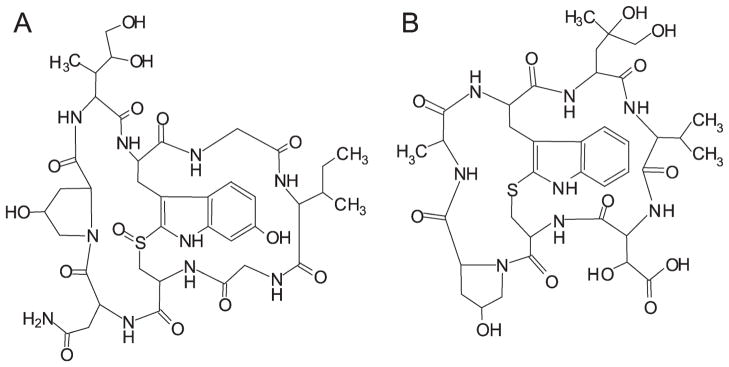
FIGURE 1
FIGURE 1
A: Structure of α-amanitin (an amatoxin). B: Structure of phallacidin (a phallotoxin). All amino acids have the L configuration except D-hydroxyAsp in phallacidin (D-Thr in phalloidin).
FIGURE 2
FIGURE 2
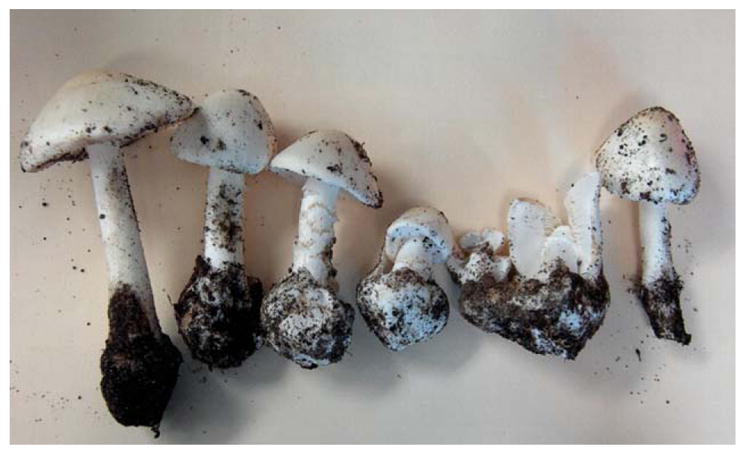
Amanita bisporigera collected in Michigan in 2009. This deadly white mushroom, known as the “destroying angel,” is a native of North America and biosynthesizes amatoxins and phallotoxins.
FIGURE 3
FIGURE 3
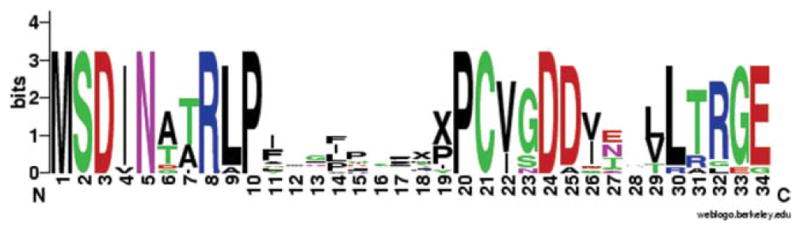
WebLogo alignment of 15 members of the “MSDIN” family (named for the first five highly conserved amino acids). The height of the amino acid at each position represents its degree of conservation. The MSDIN family encodes the amatoxins and phallotoxins and is also predicted to encode a variety of unknown peptides within the hypervariable central region (amino acids 11–20), which is 6–10 amino acids in length (Xs have been inserted in the hypervariable regions of less than 10 amino acids to emphasize the conservation of the carboxy terminus of the MSDIN peptides). As defined here, the “hypervariable” region includes the carboxy-terminal Pro, which is completely conserved in the MSDIN family as well as being a constituent of the mature toxins. Based on cDNA sequences, the M (Met) of MSDIN is the translational start codon. Amino acids 35–39 are not shown, because there is an intron (experimentally established for AMA1 and PHA1; deduced for the others) that interrupts the third to the last codon (Originally published in Luo et al. J Biol Chem 2009, 284, 18070–18077. © the American Society for Biochemistry and Molecular Biology.).
FIGURE 4
FIGURE 4
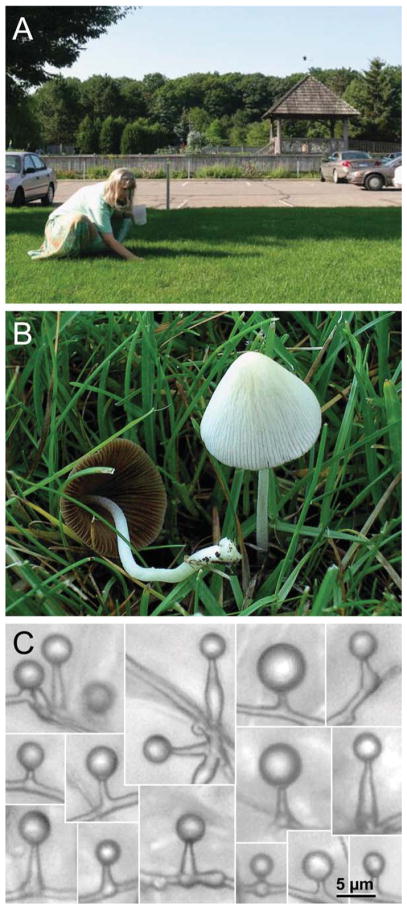
A: Collecting Conocybe apala (formerly C. lactea or C. albipes) from watered lawns on the campus of Michigan State University. B: C. apala. The mushrooms are ~8 cm tall. C: High magnification of secretory cells with attached liquid droplets from a culture of C. apala established in our laboratory. The droplets are not membrane-bound and are easily washed off. For more pictures of C. apala secretory cells, see http://www.uoguelph.ca/~gbarron/2008/conocybe.htm and Ref. .
FIGURE 5
FIGURE 5
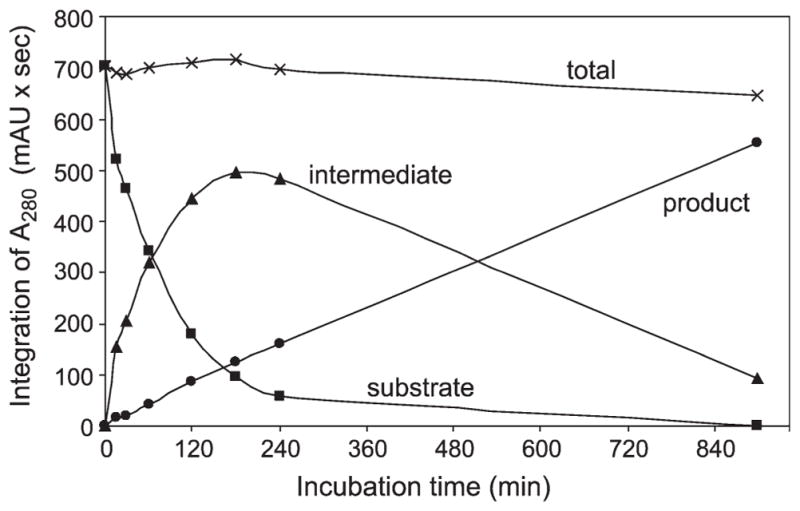
Time course of cleavage of a synthetic phalloidin precursor (substrate: MSDINATRLPAWLATCPCAGDD). Purified POP from C. apala was incubated with the substrate for the indicated times. Products were separated by HPLC and quantitated by their absorbance at 280 nm. The intermediate was identified as MSDI-NATRLPAWLATCP and the product as AWLATCP by mass spectrometry. No evidence for a carboxy-terminal intermediate (AWLATCPCAGDD) was found. Dithiothreitol was included in the enzyme buffer to prevent oxidation of the two Cys residues (Originally published in Luo et al. J Biol Chem 2009, 284:18070–18077. © the American Society for Biochemistry and Molecular Biology).
FIGURE 6
FIGURE 6
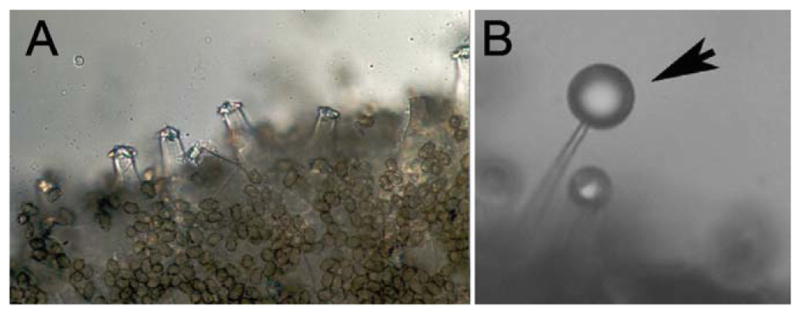
Examples of anatomically and biochemically specialized cells in mushrooms. A: “Inocybe sp. involved in a fatal poisoning case of a young dog. The encrusted cystidia stand up on the gill edges.” The abundant brown circles are basidiospores (http://www.flickr.com/photos/cornellfungi/2829688392/). B: Cystidia of Russula. These contain unknown insecticidal compound(s). The droplets (arrow) are not membrane bound and the contents adhere to glass. The droplet is is ~10 μm in diameter (from Ref. ; reprinted with permission).

References

    1. Wieland T. Peptides of Poisonous Amanita Mushrooms. Springer; New York: 1986.
    1. Bushnell DA, Cramer P, Kornberg RD. Proc Natl Acad Sci USA. 2002;99:1218–1222. - PMC - PubMed
    1. Hallen HE, Watling R, Adams GC. Mycol Res. 2003;107:969–979. - PubMed
    1. Hallen HE, Luo H, Scott-Craig JS, Walton JD. Proc Natl Acad Sci USA. 2007;104:19097–19101. - PMC - PubMed
    1. Wight W, Kim KH, Lawrence CB, Walton JD. Mol Plant-Microbe Interact. 2009;22:1258–1267. - PubMed

Publication types

LinkOut - more resources