


Outcome of patients with myelodysplastic syndrome after failure of decitabine therapy
- PMID: 20564137
- PMCID: PMC4295788
- DOI: 10.1002/cncr.25247
Outcome of patients with myelodysplastic syndrome after failure of decitabine therapy
Abstract
Background: The prognosis of patients with myelodysplastic syndrome (MDS) after decitabine failure is not known.
Methods: Data from 87 patients with MDS (n=67) and chronic myelomonocytic leukemia (n=.20) after failure of decitabine regimens were reviewed.
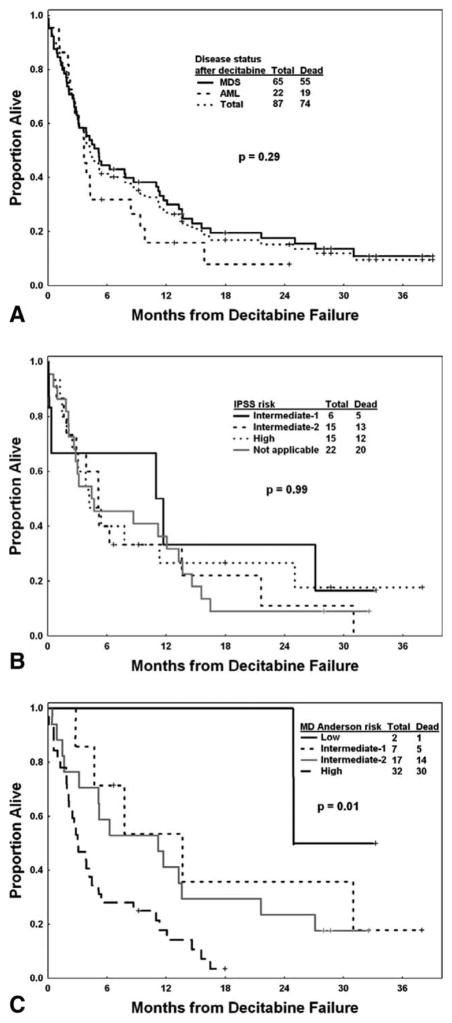
Results: After a median follow-up of 21 months from decitabine failure, 13 (15%) patients remained alive; the median survival was 4.3 months, and the estimated 12-month survival rate was 28%. The estimated 12-month survival rates were 27%, 33%, and 33%, respectively, for patients with high-risk, intermediate-2-risk, and intermediate-1-risk disease (P=.99) by the International Prognostic Scoring System. The estimated 12-month survival rates were 100%, 54%, 41%, and 18%, respectively, for patients with low-risk, intermediate-1-risk, intermediate-2-risk, and high-risk disease according to The University of Texas M. D. Anderson Cancer Center risk model (P=.01).
Conclusions: The outcome of patients after decitabine failure is poor and appears to be predictable after decitabine failure.
Copyright (c) 2010 American Cancer Society.
Conflict of interest statement
CONFLICT OF INTEREST DISCLOSURES
The authors have received financial support from the Betty Foster Leukemia Research Fund. These funds were used to help defray the cost for research nurses.
Figures
References
-
- Silverman LR, Demakos EP, Peterson BL, et al. Randomized controlled trial of azacitidine in patients with the myelodys-plastic syndrome: a study of the Cancer and Leukemia Group B. J Clin Oncol. 2002;20:2429–2440. - PubMed
-
- Fenaux P, Mufti G, Santini V, et al. Azacitidine (AZA) treatment prolongs overall survival (OS) in higher-risk MDS patients compared with conventional cure regimens (CCR): results of the AZA-001 phase III study [abstract] Blood. 2007;110:250a. Abstract 817.
-
- Kantarjian H, Issa JP, Rosenfeld CS, et al. Decitabine improves patient outcomes in myelodysplastic syndromes: results of a phase III randomized study. Cancer. 2006;106:1794–1803. - PubMed
-
- Kantarjian H, Oki Y, Garcia-Manero G, et al. Results of a randomized study of 3 schedules of low-dose decitabine in higher-risk myelodysplastic syndrome and chronic myelomonocytic leukemia. Blood. 2007;109:52–57. - PubMed
MeSH terms
Substances
Grants and funding
LinkOut - more resources
Full Text Sources
Medical
Research Materials
Miscellaneous
