


Exposure to cigarette smoke condensate reduces calcium activated chloride channel transport in primary sinonasal epithelial cultures
- PMID: 20564721
- PMCID: PMC3763501
- DOI: 10.1002/lary.20930
Exposure to cigarette smoke condensate reduces calcium activated chloride channel transport in primary sinonasal epithelial cultures
Abstract
Objectives/hypothesis: The cystic fibrosis transmembrane conductance regulator (CFTR) serves as a predominant Cl(-) transport conduit in airway epithelium and is inhibited by cigarette smoke in vitro and in vivo. Activation of secondary Cl(-) transport pathways through calcium-activated Cl(-) channels (CaCC) has been postulated as a mechanism to bypass defects in CFTR-mediated transport. Because it is not known whether CaCCs are also inhibited by tobacco exposure, the current study was designed to investigate the effect of cigarette smoke condensate (CSC) on CaCC transport.
Study design: In vitro study.
Methods: Well-characterized primary murine nasal septal epithelial (MNSE) and human sinonasal epithelial (HSNE) cultures were exposed to CSC in Ussing chambers. We monitored CaCC short-circuit current through stimulation of P2Y purinergic receptors with uridine triphosphate or adenosine triphosphate and selective inhibition of the CFTR-dependent secretory pathway. Characterization of CaCC current was also accomplished in primary airway cells derived from transgenic CFTR(-/-) (knockout) murine models.
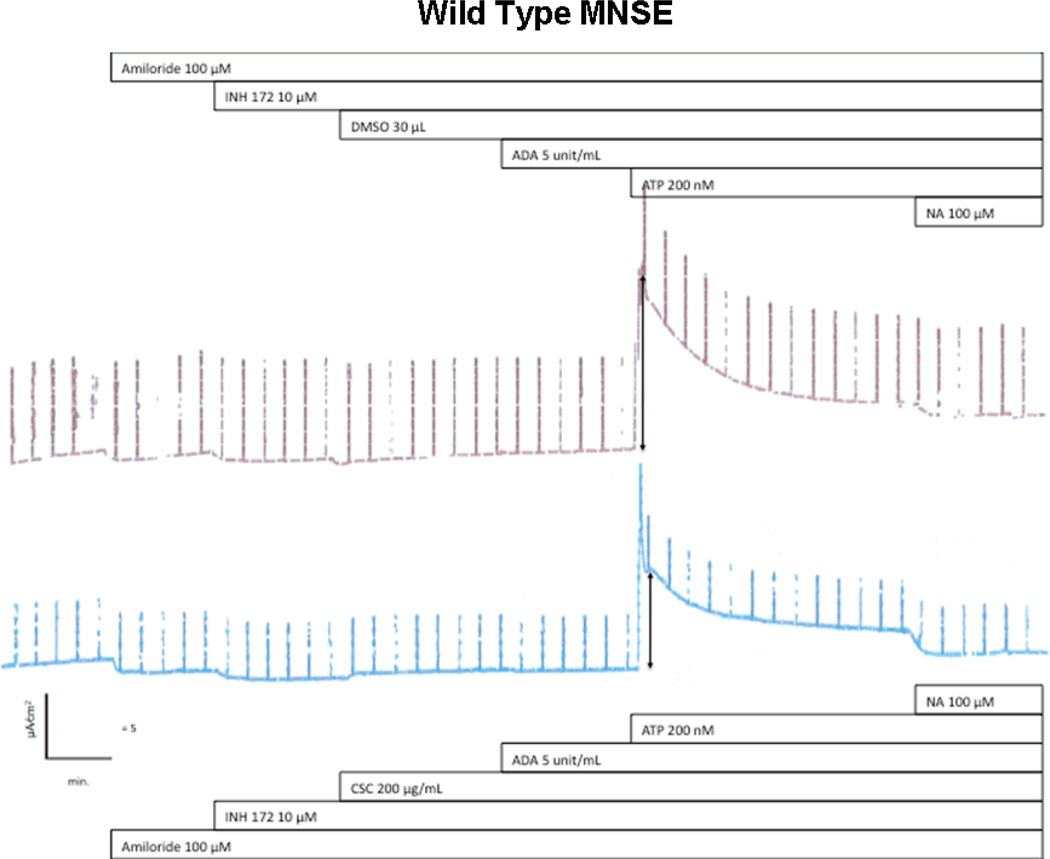
Results: Change in CaCC-mediated current (DeltaI(SC) representing transepithelial Ca-mediated Cl(-) secretion in muA/cm(2)) was significantly decreased in CSC-exposed wild type MNSE when compared to controls (32.8 +/- 4.6 vs. 47.5 +/- 2.3; respectively; P < .02). A similar effect was demonstrated in CFTR(-/-) MNSE cultures (33.4 +/- 2.8 vs. 38.6 +/- 2.0; P < .05>. HSNE cultures also had a significant reduction in I(SC) (16.1 +/- 0.6 vs. 22.7 +/- 0; P = .008).
Conclusions: CSC affects multiple pathways fundamental to airway ion transport, including both cyclic adenosine monophosphate and calcium activated Cl(-) transport. Inhibition of Cl(-) transport may contribute to common diseases of the airways, such as chronic rhinosinusitis and chronic obstructive pulmonary disease.
Conflict of interest statement
Conflict of Interest: Dr. Sorscher serves as a consultant for a Birmingham start up company (PNP Therapeutics, Inc) but is not employed by the company and draws no salary from the company. His consulting includes a role as Director/Officer. He acts as a consultant with the approval of UAB and the UAB CIRB. He is compensated for consulting with stock. This company has no relationship to the current manuscript. Dr. Sorscher and Dr. Woodworth are inventors on a patent submitted regarding the possible activity of chloride secretagogues for therapy of sinus disease (Provisional Patent Application Under 35 U.S.C. §111(b) and 37 C.F.R. § 1.53(c) in the United States Patent and Trademark Office). Dr. Woodworth is a consultant for Gyrus ENT, ArthroCare ENT, and is on the GlaxcoSmithKline speaker’s bureau.
Figures


References
-
- Trout L, King M, Feng W, Inglis SK, Ballard ST. Inhibition of airway liquid secretion and its effect on the physical properties of airway mucus. Am J Physiol. 1998;274:L258–L263. - PubMed
-
- Anderson MP, Gregory RJ, Thompson S, et al. Demonstration that CFTR is a chloride channel by alteration of its anion selectivity. Science. 1991;253:202–205. - PubMed
-
- Agius AM, Smallman LA, Pahor AL. Age, smoking and nasal ciliary beat frequency. Clin Otolaryngol. 1998;23:227–230. - PubMed
-
- Dalhamn T, Rylander R. Ciliotoxicity of cigar and cigarette smoke. Arch Environ Health. 1970;20:252–253. - PubMed
Publication types
MeSH terms
Substances
Grants and funding
LinkOut - more resources
Full Text Sources
